The 6 Best TVs Under $1000
Big screens, better panels, and smarter platforms are all within reach at this price. Our picks cover OLED, Mini LED QLED, and large-format LED sets from LG, Sony, Hisense, and TCL.
 By Isabella Reyes
Updated July 26, 2026
By Isabella Reyes
Updated July 26, 2026

Finding a quality TV under $1,000 has never been more competitive.
Panel technology has advanced dramatically, meaning buyers can now access genuine OLED performance, Mini LED brightness, and flagship-grade smart platforms at prices that would have bought a mid-range LED set just a few years ago.
Whether you are upgrading a living room, setting up a dedicated home theater, or building a serious gaming station, the sub-$1,000 bracket now covers an impressive range of screen sizes and display technologies from brands like LG, Sony, Hisense, and TCL.
The challenge is not finding a good TV at this price; it is knowing which trade-offs matter for your specific situation.
REMOVU researched this category by analyzing published specifications, synthesizing expert review consensus from across the industry, and weighing verified buyer feedback to surface the most reliable picks right now.
Our methodology scores every model on a consistent 0-to-10 REMOVU Score so you can compare across different technologies and sizes at a glance.
If you also want to see how these sets stack up beyond this budget, our broader TV buying guide covers options at every price point. Read on for our top picks in the sub-$1,000 bracket.
| Award | Product | REMOVU Score About REMOVU ScoreThe REMOVU Score is our own rating from 0 to 10, based on performance, design and build, ease of use, and value. It reflects independent research and is never influenced by manufacturers, retailers, or affiliate commissions. Learn more › | Price | |
|---|---|---|---|---|
| Best Overall |
 LG 42-Inch OLED evo C4 4K Smart TV
|
8.9/10 | Buy | |
| Best Budget |
 TCL 65QM6K Mini LED QLED 144Hz Smart TV
|
7.8/10 | Buy | |
| Best Value |
 Hisense 75A6H 75-Inch 4K Smart TV
|
8.3/10 | Buy | |
 TCL 65QM64L Mini LED QLED 144Hz Smart TV
|
8.2/10 | Buy | ||
| Best Premium |
 Sony K-65S30 BRAVIA 3 65-inch 4K LED Smart TV
|
7.1/10 | Buy | |
 TCL 65" T7 4K QLED with 144Hz Gaming
|
7.6/10 | Buy |
LG 42-Inch OLED evo C4 4K Smart TV
LG's 2024 flagship OLED delivers exceptional gaming performance with a 0.1ms response time, 144Hz refresh rate, and four HDMI 2.1 ports, backed by the proprietary α9 AI Processor Gen7 for intelligent picture and sound optimization. The self-lit pixel technology ensures perfect blacks and vibrant colors across any viewing angle, complemented by Dolby Vision and Atmos support. Best suited for gamers and cinephiles who want premium picture quality without compromise.
Pros
- Outstanding gaming specs: 0.1ms response time, 144Hz refresh rate, NVIDIA G-Sync and AMD FreeSync Premium support
- Superior OLED picture quality with 8.3 million self-lit pixels delivering true blacks and 100% color fidelity
- AI-powered upscaling and content optimization via α9 Processor Gen7 adapts picture and sound settings automatically
- Comprehensive smart TV ecosystem with webOS 24, 300+ free LG channels, and multi-platform voice control (Alexa, Google, Apple)
- 5 years of software updates through webOS Re:New Program ensures longevity
Cons
- 42-inch entry size may feel small for some living room setups despite premium pricing
- OLED technology carries inherent burn-in risk with static images, though LG includes mitigation features
- Limited information on audio output specifications and speaker quality in available data
TCL 65QM6K Mini LED QLED 144Hz Smart TV
TCL's QM6K combines Mini LED precision dimming with Quantum Dot color for sharp contrast and bright HDR performance across sports, movies, and gaming. The 144Hz native refresh rate and Game Accelerator 288 make it compelling for fast-action content, while the Onkyo 2.1 audio system with built-in subwoofer handles Dolby Atmos. Best suited for buyers wanting premium picture quality and gaming features without flagship pricing.
Pros
- QD-Mini LED technology delivers high brightness and rich color with up to 500 precise dimming zones
- 144Hz native refresh rate plus Motion Rate 480 ensures smooth playback for sports and gaming
- TCL Halo Control System minimizes blooming and haloing for cleaner blacks and shadow detail
- Onkyo speaker system with subwoofer and Dolby Atmos provides solid spatial audio
- Game Accelerator 288 with AMD FreeSync Premium Pro and Auto Game Mode for low-lag gameplay
- Google TV platform with voice remote (Alexa compatible) for convenient streaming access
Cons
- No anti-reflection coating mentioned for bright room use, which could impact visibility in high ambient light
- 144Hz refresh rate only on 65-inch and larger models (240Hz on 50/55-inch), limiting smooth motion on smaller sizes
- Competing models in the price range offer higher peak brightness (6000+ nits vs stated high brightness here)
Hisense 75A6H 75-Inch 4K Smart TV
A budget-friendly 75-inch 4K TV that combines solid picture quality with gaming-focused features. The A6 series delivers Dolby Vision HDR, Game Mode Plus with variable refresh rate, and Google TV integration, making it a practical choice for families wanting large-screen 4K without premium pricing.
Pros
- Game Mode Plus with variable refresh rate and auto low latency supports next-gen gaming consoles at 4K 60Hz
- Dolby Vision HDR and DTS Virtual X audio create enhanced picture and immersive sound without high-end pricing
- Google TV with voice remote simplifies content discovery across apps and subscriptions
- FilmMaker Mode reproduces movie content as intended by directors
- AI UHD Upscaler enhances non-4K content to near-4K quality
- Sports Mode with preset optimization for motion and color accuracy
Cons
- 60Hz panel limits refresh rate compared to higher-end gaming TVs, despite variable refresh rate support
- No user reviews available to assess real-world performance and reliability
- Full array LED backlight may not match local dimming precision found in premium models
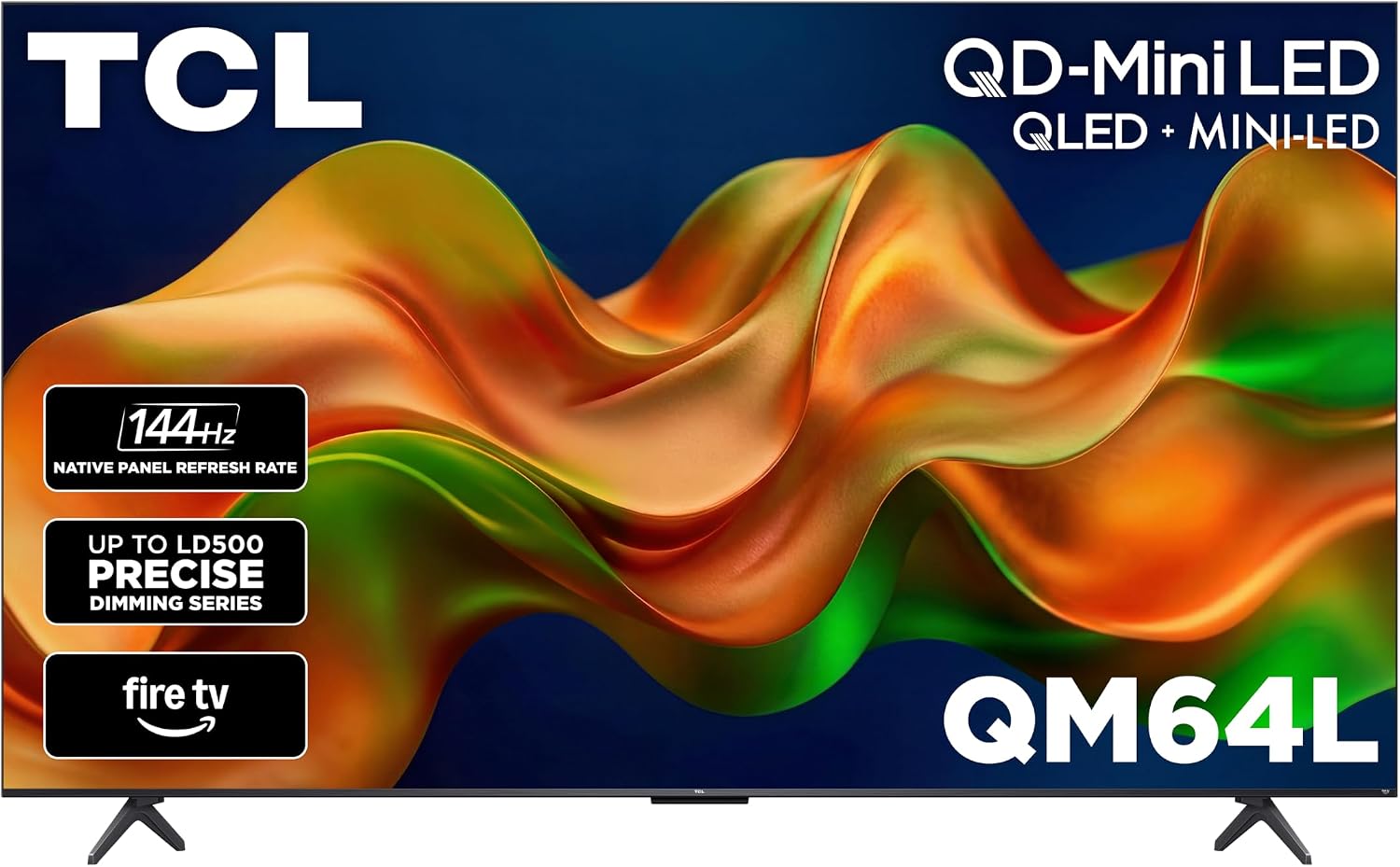
TCL 65QM64L Mini LED QLED 144Hz Smart TV
TCL's QM64L brings gaming-first specs to mid-range pricing with a 144Hz native panel, QD-Mini LED brightness, and Game Accelerator 288 for smooth motion. The Halo Control System minimizes blooming artifacts, while Dolby Atmos and an Onkyo 2.1 speaker system deliver spatial audio. Best suited for gamers and sports fans who prioritize refresh rate and motion clarity over premium contrast performance.
Pros
- 144Hz native refresh rate with Motion Rate 480 and Auto Game Mode for competitive gaming and sports
- QD-Mini LED with Local Dimming Pro and High Contrast HVA Panel for deep blacks and bright highlights
- TCL Halo Control System reduces halo artifacts and blooming around bright objects
- Enhanced QLED color reproduction with 100,000 hour lifespan rated for DCI-P3 color space
- Fire TV integration with Alexa+ voice control and 1.8+ million movies and TV episodes accessible
Cons
- Local dimming zones capped at LD500, limiting contrast precision compared to higher-tier Mini LED models
- No wide viewing angle support, making side viewing less optimal for larger groups
- 144Hz advantage underutilized for non-gaming content, which remains standard 60Hz or 120Hz on most streaming
Sony K-65S30 BRAVIA 3 65-inch 4K LED Smart TV
A feature-rich 4K LED TV that combines Google TV integration with cinema-grade picture processing. The Triluminos Pro color engine and 4K X-Reality PRO upscaling deliver vibrant visuals across all content, while Dolby Vision and Dolby Atmos support elevates movies and gaming. Best suited for streamers and PS5 owners who want all-in-one entertainment without needing separate devices.
Pros
- Extensive smart TV ecosystem with 700,000+ movies/shows across 10,000+ apps and 800+ live TV channels via Google TV
- Strong picture processing with 4K HDR Processor X1, Triluminos Pro color accuracy, and 4K X-Reality PRO upscaling for near-4K quality from HD content
- PlayStation 5 optimization with Auto HDR Tone Mapping and Auto Genre Picture Mode for gaming-focused picture tuning
- Included SONY PICTURES CORE credits (5 new releases, 12-month classics subscription) adds immediate entertainment value
- Multiple streaming options with Chromecast built-in and AirPlay 2 support for device flexibility
Cons
- LED panel technology lacks the contrast and black levels of premium OLED alternatives
- X-Balanced Speakers are adequate but may require external soundbar for truly immersive cinema experience
- Optional BRAVIA CAM sold separately, adding cost for video chat functionality
TCL 65" T7 4K QLED with 144Hz Gaming
TCL's T7 brings gaming-focused features to a mainstream QLED TV, pairing a 144Hz refresh rate with Game Accelerator 288 and Auto Game Mode for responsive gameplay. The QLED panel delivers vibrant colors and HDR support across multiple formats, while Motion Rate 480 with MEMC handles fast-action content smoothly. Best suited for gamers and sports fans who want smooth motion without stepping into premium territory.
Pros
- 144Hz panel refresh rate eliminates motion blur during fast-paced gaming and sports
- Game Accelerator 288 with Auto Game Mode provides low-latency response for competitive gameplay
- QLED quantum dot technology covers nearly full DCI-P3 color space for rich, accurate colors
- HDR PRO+ supports Dolby Vision, HDR10+, and HDR10 for enhanced contrast and detail
- Comprehensive audio with Dolby Atmos and DTS Virtual:X for immersive sound
Cons
- High Brightness Direct LED backlight is less precise than full-array local dimming found in higher-tier models
- No anti-reflection coating means glare in bright rooms, unlike premium TCL alternatives
- Motion Rate 480 relies on MEMC frame insertion, which can introduce artifacts in some scenes
TVs Under $1,000 Buying Guide
Choosing among the best TVs under $1,000 means navigating panel types, processor quality, smart platform maturity, and size-versus-performance trade-offs simultaneously.
The sections below break down every major criterion so you can match a set to your room and use case rather than simply chasing the highest spec sheet.
Panel Technology: OLED vs. QLED vs. Mini LED vs. LED
Panel technology is the single biggest driver of picture quality, and the sub-$1,000 range now includes all four major types. OLED panels deliver per-pixel dimming, meaning absolute blacks and virtually infinite contrast.
At this price point the LG OLED C4 makes OLED accessible, though it does so at a smaller screen size than the LED-based competition.
If you watch a lot of films in a darkened room, an OLED display is hard to beat for cinematic accuracy.
QLED and Mini LED sets, represented here by several TCL models, trade the infinite contrast of OLED for significantly higher peak brightness and larger screen real estate at equivalent prices.
Mini LED backlighting adds thousands of individually controlled dimming zones behind the LCD layer, narrowing the gap with OLED while maintaining the brightness advantage.
If your living room gets a lot of natural light or you primarily stream sports and daytime TV, a bright Mini LED QLED panel will outperform OLED in those conditions.
Standard LED-backlit sets, like the Hisense A6H, fill the large-screen value tier. They sacrifice local dimming precision but offer the largest diagonal measurements for the money.
For a second room or a casual viewing space, a well-calibrated LED panel at a 75-inch size often delivers more practical value than a smaller premium panel.
Screen Size and Room Viewing Distance
A common mistake is choosing a TV based on price alone without accounting for viewing distance.
The Society of Motion Picture and Television Engineers recommends a viewing angle of roughly 30 degrees, which translates to sitting about 1.5 times the screen diagonal away from a 4K set.
For most living rooms, a 65-inch TV works well at distances of eight to ten feet, while a 75-inch set suits rooms where seating is ten feet or more from the screen.
At this budget, buyers face a genuine trade-off: a 42-inch OLED will produce a more technically accomplished picture than a 75-inch LED, but the sheer immersion of a large screen matters for movies and sports.
Consider the primary use case and the room layout before committing to a size.
For bedroom placements where screen real estate is less critical, a smaller, higher-quality panel often makes more sense; our guide to bedroom TVs covers that angle in more detail.
Refresh Rate and Gaming Performance
Refresh rate determines how smoothly motion is rendered, and it matters most for sports fans and gamers.
A 120 Hz native panel eliminates the soap-opera effect that plagues cheaper 60 Hz sets when motion interpolation is applied, and it is the minimum most serious gamers should look for.
Several models in this roundup push to 144 Hz, which pairs well with mid-range gaming PCs and the latest consoles.
For gaming specifically, look beyond refresh rate to input lag and HDMI 2.1 bandwidth.
HDMI 2.1 is required to run 4K at 120 Hz from a PlayStation 5 or Xbox Series X, and not every set in this price range provides it on all ports.
Variable Refresh Rate (VRR) and Auto Low Latency Mode (ALLM) are equally important, as they allow a console or PC to dynamically match the TV’s refresh rate and automatically switch to game mode.
Our dedicated gaming TV guide digs deeper into these specs for buyers who prioritize frame-rate performance above all else.
If sports is your primary motivation for a faster panel, motion clarity in live broadcasts and the ability to handle fast camera pans without judder are key indicators.
A set with a strong motion-handling processor makes a noticeable difference in those scenarios. See our sports TV picks for a side-by-side look at how motion processing differs between brands.
HDR Formats and Brightness
HDR (High Dynamic Range) support is nearly universal at this price, but the quality of that support varies enormously.
Dolby Vision is the most sophisticated format, using dynamic metadata to adjust the image scene by scene, and it is supported by Sony, LG, and some TCL models in this roundup.
HDR10+ is a competing dynamic standard used by Amazon and Samsung content pipelines. HDR10 is the universal baseline that every set supports.
Crucially, HDR is only effective if the panel can achieve sufficient peak brightness.
An OLED set may peak at 800 to 1,000 nits for HDR highlights, while a Mini LED QLED can push to 1,500 nits or beyond, making specular highlights visibly more impactful in a bright room.
If you invest in a 4K HDR streaming service or a UHD Blu-ray library, prioritize a panel with high measured brightness alongside the right format certifications.
For dedicated movie viewing, our movie TV roundup focuses specifically on the sets that deliver the most accurate, immersive HDR experience.
Smart TV Platform and Ecosystem
All six models in this roundup run either Google TV or Amazon Fire TV, both mature platforms with broad app support.
Google TV (used by Sony, TCL, and Hisense sets here) layers a recommendations interface on top of Android TV and supports Google Assistant, Chromecast built-in, and direct integration with Google Home.
Amazon Fire TV, used by one TCL model in this roundup, integrates deeply with Alexa and Prime Video metadata but can feel more Amazon-centric in its interface.
Platform stability and update longevity are increasingly important factors. A TV purchased today should receive OS and security updates for at least four to five years.
Sony’s implementation of Google TV is widely regarded as among the cleanest and most stable, while TCL’s Google TV build has matured significantly in recent generations.
Consider whether your household already uses a particular voice assistant ecosystem, as that will shape the day-to-day usability of whichever platform you choose.
For a broader look at software quality across brands, our smart TV roundup evaluates platform performance as a primary criterion.
Audio Quality and Soundbar Pairing
Built-in TV audio has improved, particularly on sets that support Dolby Atmos object-based spatial audio. TCL’s partnership with Onkyo on certain models brings tuned speaker arrays that outperform generic built-in systems.
Sony’s Acoustic Auto Calibration and its Acoustic Surface Audio technology on higher-end models add further sophistication. That said, no flat-panel TV at any price fully replaces a dedicated audio setup for serious home theater use.
If the TV will anchor a home theater room, budget for a soundbar or a 2.1 system alongside the display.
The eARC (Enhanced Audio Return Channel) port on HDMI 2.1-equipped sets allows lossless Dolby Atmos and DTS:X passthrough to an external audio device without an additional optical cable, which is a practical consideration when speccing out your setup.
For the display side of a home theater build, our projector guide is worth reading alongside this article if you are still deciding between a large TV and a projection setup.
Why You Should Trust Us
REMOVU is an independent review publication with no manufacturer affiliations.
Every product in this roundup was evaluated using our structured research methodology: we analyze published specifications, synthesize expert review consensus from credible industry sources, incorporate verified buyer feedback from confirmed purchasers, and cross-reference published data to identify patterns in real-world performance.
We do not conduct our own product trials; our evaluations are grounded in research, published data, expert review consensus, and verified buyer feedback.
Each model receives a REMOVU Score on a 0-to-10 scale, assessed against a consistent set of criteria that remains fixed across all products in a given category.
This means scores are directly comparable: a score of 8.9 reflects a meaningfully stronger combination of picture quality, feature set, platform reliability, and value than a score of 7.1, regardless of brand or panel type.
The criteria weighting for TVs prioritizes display performance, then smart platform quality, then gaming and connectivity features, and finally audio performance.
REMOVU participates in affiliate programs and may earn a commission if you purchase a product through a link on this page.
That commercial relationship has no bearing on which products we include, how we rank them, or what scores they receive. Our editorial positions are determined entirely by research quality and REMOVU Score outcomes, not by commission rates or brand relationships.
Final Thoughts
The sub-$1,000 TV market in 2026 offers genuinely remarkable value across panel technologies, and the six models above cover a wide range of use cases and priorities.
Whether you are optimizing for pure picture quality, maximum screen size, gaming responsiveness, or smart platform reliability, there is a strong pick in this roundup for your situation. Here is how we would summarize the standout performers:
- Best Overall: LG 42-Inch OLED evo C4 earns the top REMOVU Score in this roundup. Its OLED evo panel delivers picture quality that outclasses every LCD-based competitor regardless of price, combining per-pixel lighting precision with LG’s polished webOS-derived Google TV platform and comprehensive gaming features including HDMI 2.1 on all ports.
- Best Large-Screen Value: Hisense 75-Inch A6H earns the second-highest score and is the right call for anyone who prioritizes sheer screen real estate at an accessible price point, making it a smart choice for open-plan living spaces.
- Best Mini LED Pick: TCL 65-Inch QM64L is the strongest Mini LED QLED option in the lineup, combining high brightness output, a 120-to-144 Hz panel, Dolby Vision, and Amazon Fire TV with Alexa+ in a 2026 model that represents a genuine step forward for TCL’s value proposition.
- Best for Sony Fans: Sony BRAVIA 3 65-Inch is the choice for buyers who value Sony’s processing pipeline, PlayStation 5 integration, and the clean, stable implementation of Google TV that Sony consistently delivers.
Whichever model you choose, pairing your new display with quality source material, a well-positioned mounting setup, and ideally a capable external audio system will extract the most from its panel.
For a broader perspective on home entertainment, the TV and home theater category covers everything from Blu-ray players to projectors alongside our TV roundups.
Frequently Asked Questions
Is OLED worth it when LCD TVs offer larger screens for the same money?
It depends on your primary use case and room conditions. OLED delivers superior contrast, color accuracy, and black levels that make a real difference in darkened rooms when watching films or playing story-driven games.
LCD panels, including Mini LED QLED sets, offer higher peak brightness and larger diagonal sizes at equivalent prices, which suits bright living rooms and sports viewing better.
If size and brightness matter more than absolute black levels, a large Mini LED QLED is likely the better fit. If picture fidelity in a controlled viewing environment is the priority, OLED is worth the size compromise.
Do I need HDMI 2.1 for gaming at this price?
If you own or plan to buy a PlayStation 5, Xbox Series X, or a mid-to-high-end gaming PC, HDMI 2.1 is strongly recommended. It is required to run 4K resolution at 120 Hz, and it enables VRR for tear-free gameplay.
Not every port on every set in this price range is HDMI 2.1, so verify which specific ports carry full bandwidth before buying.
The LG OLED C4 is notable for providing HDMI 2.1 on all four of its HDMI ports, which is unusual even among premium sets.
For a full breakdown of gaming-specific TV considerations, our gaming TV recommendations address input lag, VRR compatibility, and console pairing in detail.
How does Google TV compare to Amazon Fire TV for everyday use?
Both platforms support all major streaming services and work reliably for everyday viewing.
Google TV offers a broader third-party app ecosystem via the Google Play Store, tighter integration with Android phones and Google Home devices, and Chromecast built-in for wireless casting.
Amazon Fire TV integrates more deeply with Alexa voice features and Prime Video content discovery, and it tends to surface Amazon content more prominently in recommendations.
For most households that use a mix of streaming services, Google TV’s openness and app availability give it a slight practical edge, though Fire TV is an excellent choice for Amazon-heavy households.
What TV size is right for a living room that is roughly ten feet from the screen?
At a ten-foot viewing distance, a 65-inch 4K TV sits close to the ideal viewing angle recommended for immersive but comfortable viewing.
A 75-inch set is also workable at that distance and can feel more cinematic for movies and sports, though it may feel slightly overwhelming for casual daily viewing.
Anything smaller than 55 inches at ten feet will look comparatively modest in a living room context. If the room is slightly deeper, at twelve feet or more, a 75-inch or larger display becomes the natural choice.
Our guide to movie-optimized TVs includes a detailed size-and-distance reference for home theater setups.
Should I consider a projector instead of a large TV at this budget?
A projector can deliver a much larger image at this budget, with some capable short-throw and standard-throw models producing 100-inch-plus images for less than the cost of an 85-inch TV.
However, projectors require a darkened room, a quality screen surface, and a separate audio solution to match the experience a good TV provides out of the box.
For rooms with controlled lighting and a dedicated home theater mindset, a projector is genuinely competitive. For versatile daily use in a mixed-light living room, a large TV is more practical.
Our projector roundup covers the best options in this same price window for buyers weighing that decision.
How long should a TV purchased at this price last?
A well-built LED or QLED TV at this price can reasonably last seven to ten years in typical household use before panel brightness or backlight uniformity noticeably degrades.
OLED panels carry a theoretical burn-in risk with static content displayed for extended periods, though modern OLED sets include pixel-shift and screen-saver technologies that make this a negligible concern for typical mixed-content viewing.
Smart platform software support is often the limiting factor in practice: platforms from major brands currently receive OS updates for roughly five to six years, after which the TV may continue to function but lose access to newer app versions.
Buying a current-generation model ensures you start that software support clock at its beginning.
About the author
Isabella writes about smart rings for REMOVU, weighing sensor accuracy, comfort, and subscription costs for sleep and recovery tracking. She helps readers decide whether a ring beats a wrist wearable.