The 12 Best Air Coolers
Hot rooms and rising energy bills don't have to go together. We researched evaporative coolers, misting fans, and swamp coolers to find the picks that actually cool, stay quiet, and last a full season.
 By Tara Peters
Updated July 26, 2026
By Tara Peters
Updated July 26, 2026
When summer heat peaks or humidity climbs, a good air cooler can transform an uncomfortable room into a livable space without the steep installation costs or energy bills of a central air system.
Portable evaporative coolers and misting fans have improved dramatically, with newer models offering larger water tanks, smarter oscillation, whisper-quiet DC motors, and app-free controls that actually work.
Whether you are outfitting a bedroom, a home office, a garage, or an open patio, the right unit can drop the ambient temperature noticeably while consuming a fraction of the electricity a traditional air conditioner demands.
Our team at REMOVU analyzed specifications, expert review consensus, and verified buyer feedback across dozens of models to surface the picks that genuinely deliver on their cooling promises.
From compact desktop misters to high-CFM swamp coolers built for large outdoor spaces, the shortlist below represents the strongest options across every budget and room size.
Read on for our top picks, and then dive into the buying guide to understand exactly what separates a great air cooler from one that merely looks good on a spec sheet.
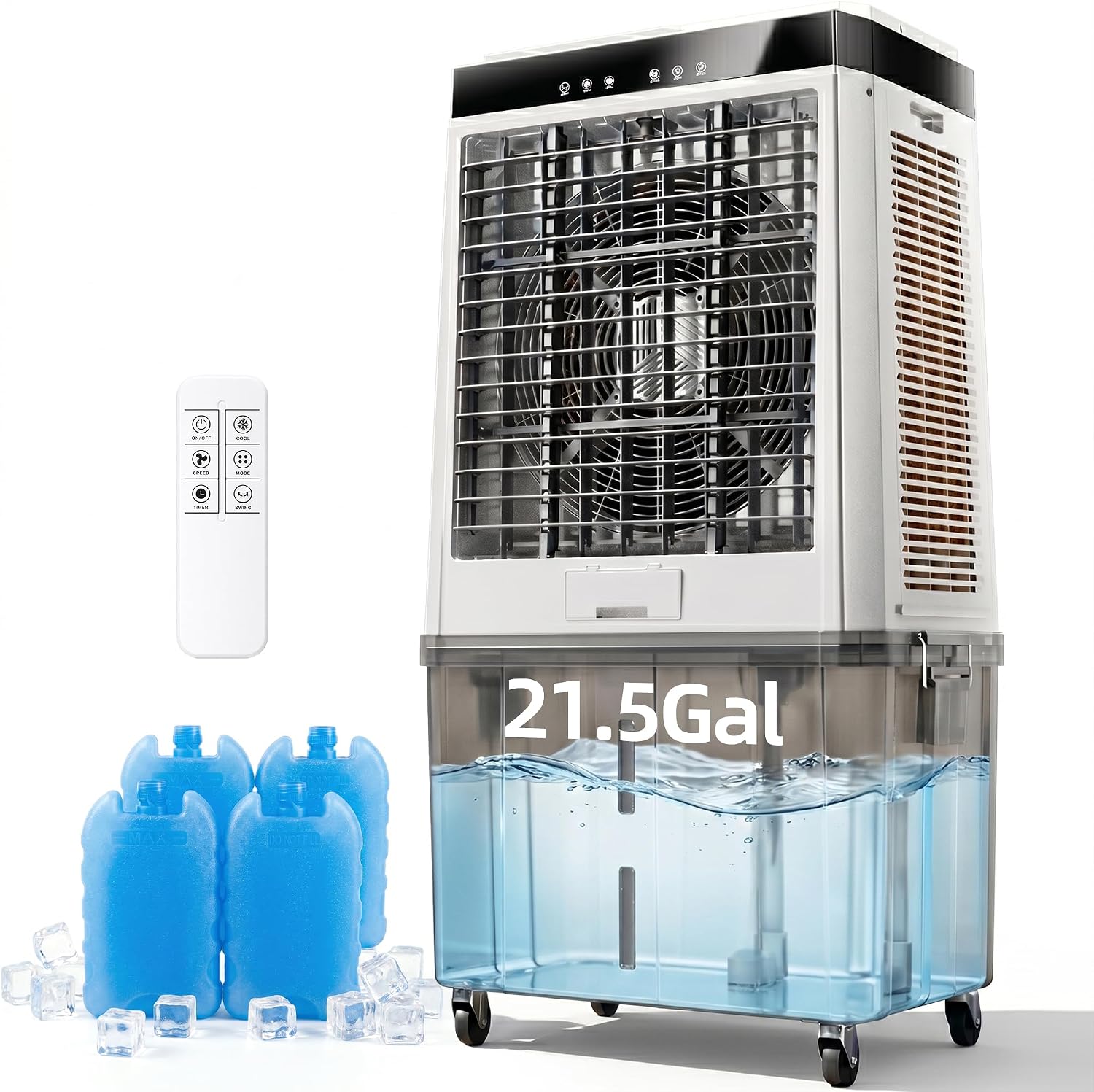
Uthfy 6288 CFM 48-Inch Swamp Cooler
This large-capacity evaporative cooler handles spaces up to 1,400 sq. ft with a powerful 6288 CFM airflow and 120-degree oscillation. It's built for garages, patios, and workshops where energy efficiency matters, consuming just 250W compared to traditional ACs. The 21.5-gallon detachable tank supports up to 48 hours of cooling with multiple refill options.
Pros
- Massive 6288 CFM output with 40 ft/s breeze speed reaches far corners via wide oscillation
- Three refill methods (top tank, hose connection, removable bottom tank) add genuine convenience
- Uses 70% less energy than standard air conditioners at only 250W rated power
- Large 21.5-gallon tank with ice pack slots extends cooling cycles to 48 hours
- Portable design with rolling wheels, drain port, and water-level window for easy maintenance
Cons
- Evaporative cooling effectiveness depends on low humidity, limiting performance in damp climates
- Limited review volume (6 verified reviews) provides less buyer feedback than established models
- Requires regular water refills and maintenance of cooling pads for optimal operation

DREO TurboCool 765S Misting Fan with 10°F Cooling
This evaporative misting fan combines ultrasonic cooling technology with a 34 ft/s airflow to drop room temperature by up to 10°F while operating at a whisper-quiet 20 dB. It works triple duty as a fan, cooler, and humidifier with 12 speeds and 4 modes, plus a 6L tank that runs up to 7 hours on turbo mode. Best for anyone seeking efficient summer cooling without traditional AC noise or energy draw.
Pros
- Instant temperature relief with ultrasonic misting technology creating 17μm ultrafine mist
- Exceptionally quiet operation at 20 dB with powerful 34 ft/s airflow reaching 59.7 feet
- Long runtime per tank: up to 7 hours on turbo speed or 30 hours on low setting
- Modular pump-free design detaches easily for cleaning, reducing mold and scale buildup
- Real-time humidity monitoring with app, voice, and remote control options
Cons
- Cooling effect depends on water availability and humidity levels; less effective in already humid environments
- 6L tank requires regular refilling for extended continuous use on higher speeds
- 4.2-star rating suggests some units may experience durability or performance inconsistencies

DREO 40-Inch Evaporative Swamp Cooler with Oscillation
This tower-style evaporative cooler uses moisture and airflow to deliver cool, humid air across a wide 80-degree oscillating range, making it suited for dry climates where traditional AC isn't practical. The cross-flow impeller runs at a whisper-quiet 35dB, and the removable water tank simplifies maintenance. Best for bedrooms and living spaces where you want passive cooling without the energy demands of air conditioning.
Pros
- Ultra-quiet operation at 35dB allows uninterrupted sleep and work
- Wide 80-degree oscillation with 22 ft/s airflow covers large room areas
- Removable water tank and cooling pads make cleaning straightforward
- Energy-efficient evaporative cooling alternative to traditional AC
- 4-speed settings and 7-hour timer offer flexible control
Cons
- Evaporative cooling works best in dry, hot climates; less effective in humid environments
- Requires regular water tank refilling and cooling pad maintenance for optimal performance
- 4.1-star rating suggests some users experienced durability or cooling consistency concerns

Uthfy 3000CFM Evaporative Cooler with Dual Water Tanks
This swamp cooler delivers strong 3000 CFM airflow to cool spaces up to 830 sq. ft., making it practical for bedrooms and larger rooms. The 7-gallon detachable tank, 120-degree oscillation, and ultra-quiet operation at 30dB create a balanced cooling setup, though evaporative cooling effectiveness depends heavily on humidity levels.
Pros
- Powerful 3000 CFM airflow with 34 ft/s velocity and wide 120-degree oscillation for comprehensive room coverage
- Low energy consumption at just 80W despite strong cooling output, helping keep utility costs down
- Ultra-quiet operation at 30dB or lower, ideal for uninterrupted sleep with 12-hour timer convenience
- Large 7-gallon detachable water tank with dual fill options and four included ice packs extend cooling duration up to 30 hours
- Portable design with built-in handles and 360-degree lockable wheels for easy movement between rooms
Cons
- Evaporative cooling performance drops significantly in humid climates, limiting effectiveness in moisture-heavy regions
- Requires regular water refilling and maintenance, making it less convenient than traditional air conditioners for extended use
- 4.3-star rating with 135 reviews suggests mixed user experiences, though specific pain points aren't detailed in available data

DREO TurboCool 516 Misting Fan with 5°F Cooling
This evaporative misting fan combines a 5°F temperature drop with whisper-quiet operation at 20 dB, making it ideal for hot climates where you need immediate relief without moisture buildup. The omni-directional oscillation and 12-hour runtime address common pain points for desk workers and bedroom cooling, though performance depends heavily on humidity levels.
Pros
- Delivers genuine 5°F cooling with strong 26 ft/s airflow and ultrafine mist that doesn't leave surfaces wet
- Exceptionally quiet at 20 dB, suitable for sleep and focused work without distraction
- Extended 12-hour runtime from 1.3L tank with visible water level indicator reduces frequent refilling
- Flexible directional control with 150° horizontal oscillation plus 30° vertical tilt for precise cooling coverage
- 6 speed settings and 2 operating modes provide customizable comfort for different conditions
Cons
- Evaporative cooling effectiveness drops significantly in high-humidity environments, limiting year-round usability in certain climates
- 1.3L tank capacity, while decent for 12 hours, requires daily refilling for continuous multi-day use
- No specifications provided on power consumption, noise levels at higher speeds, or maintenance requirements for the ultrasonic mist system

DREO TurboCool 516 Misting Fan with 5°F Cooling
This evaporative cooler delivers a 5°F temperature drop with strong 26 ft/s airflow, making it effective for quick relief on hot days. The ultrasonic mist system keeps you cool without leaving moisture behind, while the whisper-quiet 20 dB operation won't disrupt your space. Best for those seeking portable, low-noise cooling with extended runtime.
Pros
- Immediate 5°F cooling effect with 512 CFM airflow for noticeable temperature relief
- Ultrafine ultrasonic mist technology eliminates wetness while providing cooling comfort
- Exceptionally quiet at 20 dB, suitable for bedrooms and focused work areas
- 12-hour runtime from 1.3L tank reduces frequent refilling during workday or sleep
- Flexible omni-directional oscillation with 5 horizontal angles plus 30° vertical tilt for personalized airflow
Cons
- Evaporative cooling effectiveness depends on humidity levels, less efficient in already humid environments
- 1.3L tank capacity, while adequate for 12 hours, requires regular water refills in continuous-use scenarios
- Performance limited to cooling rather than true air conditioning, so temperature drop is modest compared to AC units

SYUDTY 3000 CFM Evaporative Cooler with 120° Oscillation
This portable swamp cooler delivers 3000 CFM airflow and can drop temperatures by 50-60°F, making it effective for dry climates where traditional AC units strip humidity. The 120° oscillation, 4 operating modes, and remote control offer flexible cooling for spaces up to 1000 sq. ft., though performance depends heavily on low humidity conditions.
Pros
- High airflow output (3000 CFM) with rapid temperature reduction in arid regions
- Functions as fan, humidifier, cooler, and aromatherapy diffuser in one unit
- 120° oscillation and upgraded 2.5X water-absorbing cooling pad for even air distribution
- Easy setup with 360° swivel casters and remote control with 1-15 hour timer
- 4.5-star rating from 173 verified buyers
Cons
- Evaporative cooling is ineffective in humid climates, limiting geographic use
- Requires regular water tank refilling (6.87 gal capacity) for continuous operation
- Oscillation and motor noise typical of portable coolers may be disruptive in quiet spaces

DREO Tower Fan 307 - 28ft/s DC Motor, 20dB Ultra Quiet
This bladeless tower fan combines a powerful upgraded DC motor with whisper-quiet operation, reaching just 20dB on its lowest setting. Eight speed levels and four modes (Normal, Natural, Sleep, Auto) let you dial in comfort for any room, while 90-degree oscillation and 34-foot air projection make it effective for bedrooms and living spaces. The remote control and touch interface keep adjustments simple.
Pros
- Exceptional noise performance at 20dB minimum, backed by verified customer feedback and algorithmic impeller design
- Strong airflow delivery with 28ft/s velocity and 34-foot projection range using upgraded DC brushless motor
- Flexible customization with 8 speeds and 4 distinct modes to match different comfort needs and times of day
- 90-degree oscillation ensures broad room coverage without manual repositioning
- Removable rear grille and impeller simplify maintenance and cleaning
Cons
- Limited to 1-8 hour timer compared to competing models offering up to 12 hours
- 90-degree oscillation is narrower than some premium alternatives that offer 150-degree coverage
- AC power only with standard 120V input, no battery or portable option for flexible placement

BIGoose 42-Inch Evaporative Cooler with 4 Modes
This 4-in-1 evaporative cooler functions as a fan, humidifier, air cooler, and aroma diffuser in one compact tower. It delivers fast cooling via a 2026 upgraded motor with 1900 CFM airflow and can lower room temperature by 41-50°F, making it practical for bedrooms and offices without requiring window installation or exhaust hoses. The 1.1-gallon dual tank system runs for 24 hours on a single fill, while quiet 30 dB operation and a 15-hour timer suit nighttime use.
Pros
- Plug-and-play setup with no hose, window kit, or tools needed; apartment-friendly with no wall damage
- 24-hour runtime on single fill with removable, washable tanks and top-fill design for convenience
- Multiple operating modes (Normal, Natural, Sleep, Cooling) and 3 adjustable speeds for personalized comfort
- Ultra-quiet at 30 dB with memory function that saves your last settings automatically
- 80-degree oscillation covers up to 500 sq.ft with airflow reaching 30 feet; includes 6 ice packs for enhanced cooling
Cons
- Evaporative cooling effectiveness depends on humidity levels, performing better in dry climates than humid environments
- Requires regular water refills and ice pack maintenance for optimal cooling performance
- 1-year warranty covers manufacturing defects only, with no mention of extended protection plans

VeRosky Portable Evaporative Cooler with Ice Packs
A windowless evaporative cooler that requires no installation, making it ideal for renters and anyone seeking quick setup in bedrooms or offices. Four operating modes and three fan speeds let you dial in comfort, while 4 reusable ice packs boost cooling performance on hot days. The 46-56 dB operation keeps noise minimal for sleeping or focused work.
Pros
- No window, exhaust hose, or complex installation needed, ready to use within minutes
- Quiet operation at 46-56 dB with 12-hour timer and display dimming for sleep-friendly use
- Customizable with 4 modes and 3 speeds to match different comfort needs throughout the day
- Includes 4 reusable ice packs for enhanced cooling without ongoing costs
- Easy mobility with caster wheels and 20 ft remote control range for room-to-room convenience
Cons
- Evaporative cooling is less effective in humid climates, limiting performance in certain regions
- 2-gallon water tank requires frequent refills in continuous use, especially when using ice packs
- No verified buyer reviews available yet to validate real-world performance and durability claims

Flowbreeze Portable Evaporative Cooler, 35-Inch
This windowless evaporative cooler combines cooling, humidifying, and fan functions in a compact 35-inch frame without requiring venting or hoses. It delivers quiet operation across multiple modes and fan speeds, making it practical for bedrooms, dorms, and offices where traditional AC installation isn't feasible.
Pros
- No window or exhaust setup required, plug-and-play for any room
- 3-in-1 functionality as air cooler, humidifier, and fan
- Wide 140-degree oscillation with adjustable speeds and 4 operating modes
- Lightweight at 8 lbs with tall design for enhanced airflow coverage
- 7-hour programmable timer and remote control for convenience
Cons
- Evaporative cooling is less effective in humid climates compared to traditional AC
- Large water tank requires regular refilling and maintenance for continuous operation
- Limited specifications provided regarding cooling capacity and noise level decibels

Zenolix 4-in-1 Evaporative Cooler, 1200ml Tank
This compact tower fan combines evaporative cooling, humidification, and mist spray in one unit, making it ideal for personal cooling in home offices and bedrooms without the bulk of traditional air conditioners. It runs on natural water evaporation rather than a compressor, keeping energy costs low while offering remote control and a 12-hour timer for convenience.
Pros
- 4-in-1 functionality covers cooling, humidifying, and mist spray in a single compact device
- Large 1200ml water tank extends cooling sessions and reduces refill frequency
- 120-degree oscillation with 4 adjustable speed levels ensures even air distribution
- Remote control and 12-hour timer provide hands-free operation and energy management
- Lightweight, portable design with built-in handle fits easily on desks or in corners
- Significantly lower energy consumption compared to traditional air conditioning systems
Cons
- Evaporative cooling effectiveness depends on humidity levels and works best in dry climates
- Requires regular water tank refills for continuous operation during extended use
- Limited cooling power compared to window or central air conditioning units
Air Coolers Buying Guide
Choosing the right air cooler comes down to matching the technology to your environment. Evaporative cooling works best in dry climates; in high-humidity regions, a misting fan or a unit with ice-pack slots will deliver more noticeable relief.
The sections below walk through every meaningful criterion so you can narrow your shortlist with confidence.
Cooling Technology and Climate Compatibility

Most products in this category use one of three approaches: evaporative cooling (swamp coolers), ultrafine misting fans, or hybrid units that combine a fan with ice packs and a water tank.
Evaporative coolers pull warm air through a water-saturated pad, evaporate the moisture, and discharge cooler air.
They are most effective when outdoor relative humidity sits below roughly 60 percent, which makes them excellent for arid regions and well-ventilated spaces like garages and patios. In coastal or humid climates the evaporation rate slows and the perceived cooling drops.
Misting fans atomize water into an ultrafine spray that evaporates almost instantly on contact with skin, providing a different sensation of cooling that works better in moderate humidity because the mist itself is the comfort mechanism rather than a change in air temperature.
Hybrid units such as many of the portable picks in our list let you add ice packs directly to the water tank, accelerating chilled air output for a short burst, which is useful when you need rapid relief on the hottest afternoons.
If you are shopping in a humid climate, prioritize units that support ice packs or have a misting function rather than pure evaporative designs.
Understanding your climate is the single most important filter before comparing any other specification. A 6,000 CFM swamp cooler in a humid Florida room will underperform a compact misting fan set up correctly for the same space. Match the technology first, then compare features.
Coverage Area and CFM Rating

CFM (cubic feet per minute) measures how much air a cooler can move. Larger rooms need higher CFM ratings to maintain comfortable airflow throughout the space.
As a rough guide, a bedroom or small office under 200 square feet is well served by units in the 500 to 1,500 CFM range, a living room or open-plan kitchen may need 2,000 to 4,000 CFM, and a garage or covered patio can demand 4,000 CFM or more.
The Uthfy 6288 CFM unit in our list, for example, explicitly targets spaces up to 1,400 square feet, making it one of the few residential-grade coolers that can handle a large open area.
Be cautious of CFM claims that are not corroborated by independent sources. Manufacturers sometimes rate peak CFM at the highest speed with no water load, which can differ from real-world cooling airflow.
Cross-referencing verified buyer feedback helps confirm whether the stated coverage area matches actual experience. Look for oscillation angles as well: wider oscillation (120 degrees or more) distributes air more evenly across a larger zone, reducing hotspots.
Water Tank Capacity and Runtime
Tank size directly determines how long you can run a cooler before refilling. Small personal coolers often carry 1 to 2 liters, which may last only a few hours at high speed.
Mid-range units like several of the DREO and BIGoose models in our list step up to 4 to 6 liters for all-day use.
Large-format swamp coolers such as the Uthfy 6288 CFM model ship with a 21.5-gallon detachable tank designed for extended outdoor sessions without constant trips to a faucet.
Dual-tank designs are worth considering if you want maximum runtime without interruption.
The Uthfy dual-tank model in our list advertises up to 30 hours of continuous cooling, which means you can set it overnight and through a full workday without touching it.
Check whether the tank is detachable and dishwasher-safe; removable tanks are far easier to fill at a sink and simpler to clean, reducing the risk of mineral buildup and mold over a full season.
A useful rule of thumb: plan on roughly 0.5 to 1 liter of water per hour at medium speed for a mid-size evaporative cooler. Multiply your desired uninterrupted runtime by that rate to identify the minimum tank size you need before shortlisting models.
Noise Level and Motor Type
Bedroom and nursery use demands quiet operation. DC (direct current) brushless motors have become the standard in premium air coolers because they draw less power, run more quietly, and allow finer speed increments than older AC motors.
Several DREO models in our list specifically advertise 20 dB operation at low speeds, which is roughly equivalent to a whisper and genuinely unobtrusive during sleep. Budget-oriented units typically use AC motors that hum more audibly, especially at higher speeds.
When evaluating noise claims, treat manufacturer decibel figures as best-case measurements taken at the quietest speed setting and closest ideal conditions. Verified buyer feedback is a more reliable indicator of real-world noise at the speeds people actually use day-to-day.
If quiet operation is a priority, look for DC motor confirmation in the spec sheet and corroborate with buyer reviews mentioning bedroom or sleep use specifically.
Just as a CPU cooler’s noise floor matters inside a PC build, the acoustic footprint of a room air cooler matters enormously when you’re trying to sleep through a hot night.
Oscillation, Modes, and Smart Controls
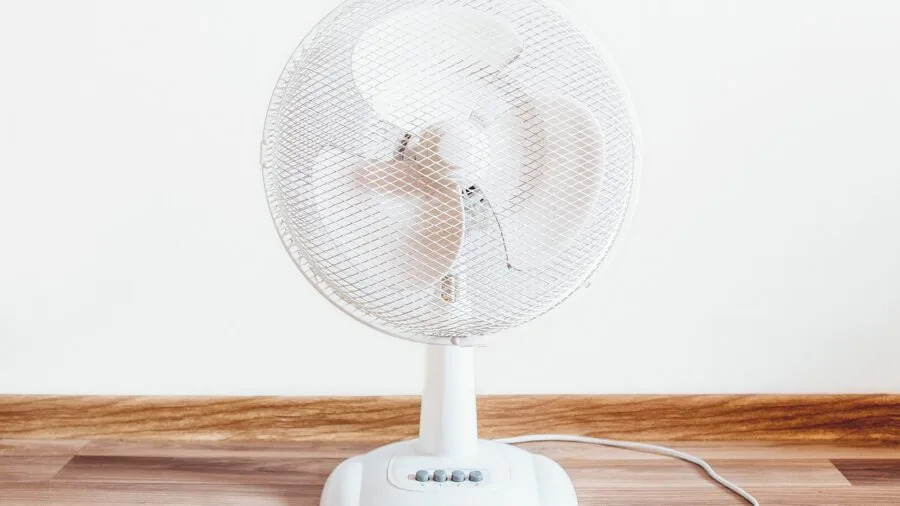
Oscillation range determines how evenly cool air is distributed across a room. Fixed units concentrate airflow in one direction, which suits personal desks but falls short in larger spaces.
Most mid-range and premium coolers in our list offer horizontal oscillation between 80 and 150 degrees. Some DREO TurboCool models go further with combined 150-degree horizontal plus 30-degree vertical omni-directional oscillation, effectively blanketing an entire room from a single placement.
Operating modes typically include a normal fan mode, a cooling/evaporative mode, a sleep mode (reduced speed and dimmed display), and sometimes a natural breeze mode that varies speed to simulate outdoor air movement.
More modes give you flexibility to match the cooler’s behavior to the time of day and activity.
Timer functions ranging from 7 to 15 hours are standard across most picks in our list, which allows you to pre-schedule shutoff so the unit is not running unnecessarily through the cooler early-morning hours.
Remote controls are almost universal at mid-range pricing and above, which matters when the unit is placed across a room. Look for remotes with clearly labeled buttons rather than touch-only panels, since touch surfaces can be fiddly in the dark.
None of the units in our list require a smartphone app to operate, which simplifies setup and removes a dependency on Wi-Fi availability.
Portability and Build Quality

Portability encompasses both physical weight and design choices that make moving the unit practical. Castor wheels are essential for large floor-standing coolers: a 20-plus-gallon unit filled with water weighs well over 150 pounds and is impossible to carry.
Verify that wheel locks are included so the cooler stays put on hard floors once positioned. Handles and carry grips matter for smaller personal and mid-size units that you want to move room-to-room.
Build quality signals include the quality of the water tank seal (leaks are a common complaint in budget coolers), the sturdiness of the oscillation mechanism, and the durability of control panel buttons.
Tower-style designs from brands like DREO tend to have a smaller footprint and integrate naturally into a bedroom corner, while boxy swamp cooler designs from Uthfy and SYUDTY sacrifice elegance for raw airflow and tank capacity.
Neither approach is objectively better; the right form factor depends on where you plan to place the unit and how often you plan to move it.
If you also care about managing heat in a tech-heavy home, our coverage of PC cases built for airflow explores similar thermal management principles in a different context.
Why You Should Trust Us
REMOVU is an independent review platform with no manufacturing or retail affiliations.
Every product in this article was scored using the REMOVU Score system, a consistent 0 to 10 scale applied across dozens of individual criteria including cooling performance, noise, tank capacity, build quality, ease of use, and value relative to alternatives in the same category.
We do not conduct our own product trials; our evaluations are grounded in research, published data, expert review consensus, and verified buyer feedback.
Our research process for this article combined manufacturer specification sheets, analysis of aggregated verified buyer feedback across major retail platforms, and cross-referencing of expert assessments from multiple independent publications.
Where specifications made claims that buyer feedback contradicted (such as noise levels or effective coverage area), we weighted the real-world consensus more heavily.
Products were included only when enough data existed to score them with confidence across the majority of criteria.
In the interest of full transparency: REMOVU may receive a commission if you purchase through a link in this article. That affiliate relationship has zero influence on REMOVU Score values, product rankings, or which models are included or excluded.
Our editorial process is entirely separate from commercial considerations, and no brand receives preferential treatment in exchange for placement. If a product earns a high score, it is because the evidence supports that score, not because of any commercial arrangement.
Final Thoughts
The air cooler market spans everything from compact personal misters to industrial-grade swamp coolers capable of cooling a garage workshop. After scoring every model in this roundup against consistent criteria, here are the standout picks by use case:
- Best Overall: Uthfy 6288 CFM Swamp Cooler earns the top REMOVU Score in this roundup thanks to its exceptional CFM output, massive detachable water tank, and proven performance in large indoor and outdoor spaces. It is the most capable unit in the group for anyone who needs serious whole-room cooling.
- Best Premium Misting Fan: DREO TurboCool Misting Fan 765S stands out for its 10-degree Fahrenheit cooling claim, ultra-quiet DC motor, generous tank, and refined tower design that suits bedrooms and living rooms equally well. It carries the second-highest REMOVU Score in the roundup.
- Best Standing Evaporative Fan: DREO Evaporative Air Swamp Cooler 40″ combines wide oscillation, ice-pack compatibility, and a removable water tank in a tall, elegant form factor that works beautifully in open-plan spaces. Its REMOVU Score reflects strong consensus across expert and buyer sources.
- Best Mid-Size Swamp Cooler: Uthfy 3000 CFM Swamp Cooler delivers dual water tanks for up to 30 hours of runtime, 120-degree oscillation, and ambient lighting, making it one of the most versatile mid-range options for bedroom or living room use.
- Best Budget Misting Fan: DREO TurboCool Misting Fan 516 offers omni-directional oscillation and ultrafine misting at an accessible price point. Its five-degree Fahrenheit temperature drop and 20 dB quiet operation make it a compelling entry point for anyone new to misting fan cooling.
No single model is the right answer for every situation. The buying guide above outlines how to match cooling technology to your climate, room size, and noise requirements.
If your needs extend to managing heat inside a PC or home theater setup, our roundups on graphics cards for 4K gaming and AMD Ryzen motherboards cover thermal considerations in those contexts.
For room-level cooling, the picks above represent the best-researched choices available right now.
Frequently Asked Questions
What is the difference between an air cooler and an air conditioner?
A traditional air conditioner uses refrigerant in a sealed compressor cycle to remove heat from indoor air and exhaust it outside, which requires either a permanent installation or a venting hose.
An air cooler (evaporative or misting type) adds moisture to the air and uses evaporation to lower the temperature, requiring no venting and no refrigerant.
Air coolers consume significantly less electricity and cost less upfront, but they are less effective in already-humid environments and cannot achieve the same low temperatures as refrigerant-based systems.
They are best thought of as a powerful complement to, rather than a replacement for, an air conditioner in extreme climates.
Do air coolers work in humid climates?
Pure evaporative coolers lose effectiveness as relative humidity rises above roughly 60 percent because the air is already saturated and cannot absorb much additional moisture through evaporation.
In humid climates, misting fans and units with ice-pack slots tend to perform better because they deliver a different cooling sensation rather than relying purely on evaporation rate.
If you live in a coastal, tropical, or generally humid region, look specifically for misting or hybrid ice-pack models rather than standard swamp cooler designs.
How often should I clean my air cooler?
Most manufacturers recommend rinsing the water tank every one to two weeks during active use and performing a deeper clean of the evaporative pad or misting nozzles at least once per month.
Mineral deposits from hard water can reduce airflow and encourage bacterial growth if left unattended. Using filtered or distilled water extends the time between deep cleans considerably.
At the end of the cooling season, empty and thoroughly dry all water-contact components before storage to prevent mold from developing over the off-season.
How much electricity does a portable air cooler use compared to a window AC?
A typical mid-size evaporative cooler draws between 60 and 200 watts depending on speed and motor type, while a window air conditioner commonly draws 500 to 1,500 watts for equivalent room coverage.
This means an air cooler can cost roughly 75 to 90 percent less to run per hour. DC motor models in our list consume even less power at lower speeds.
The savings are most meaningful when you run the cooler for extended periods overnight or throughout a workday, and they add up significantly over a full cooling season.
This kind of power-efficiency thinking also applies when building a PC: a well-chosen CPU cooler keeps thermals under control without excessive wattage draw from your power supply.
Can I use an air cooler outdoors or in a garage?
Yes, and evaporative coolers are often more effective outdoors in dry climates than indoors, because natural airflow carries away the added humidity quickly.
For garage and patio use, prioritize high CFM ratings and large water tanks to compensate for the larger open volume. The Uthfy 6288 CFM model in our list is explicitly rated for garage and patio environments.
Make sure any unit you use outdoors is positioned on a level surface, protected from direct rain if possible, and that the water source is accessible for regular refilling during extended sessions.
Is a tower fan a type of air cooler?
A standard tower fan moves existing room-temperature air and creates a wind-chill effect that feels cooling on skin, but it does not lower the actual air temperature.
Some tower fans like the DREO unit in our list are upgraded with a DC motor and high wind velocity for a stronger breeze, which increases perceived comfort. True air coolers add evaporation or misting to actively reduce temperature.
If you only need air circulation without the maintenance of a water tank, a high-performance tower fan is a simpler and lower-maintenance option. If you want measurable temperature reduction, an evaporative or misting unit is the right choice.
For shoppers interested in broader home electronics, our guides to PC gaming headsets and SSDs for gaming follow the same research-first approach we apply to every product category we cover.
About the author
Tara covers VR headsets for REMOVU, weighing visuals, comfort, and library strength across standalone and PC-tethered models. She helps readers find a headset worth strapping in for.