The 12 Best Gaming Monitors for Competitive Gaming
Refresh rate, panel type, and response time are what separate a competitive monitor from a casual one. Here are the displays worth buying right now.
 By Marlene Barnes
Updated July 26, 2026
By Marlene Barnes
Updated July 26, 2026

Competitive gaming lives and dies by milliseconds. Whether you’re grinding ranked matches, competing in tournaments, or simply refusing to lose to input lag, your monitor is the single most impactful piece of hardware between your reflexes and the screen.
A panel that can’t keep up with a fast GPU or that introduces motion blur at critical moments will cost you kills, rounds, and wins no matter how good your aim is.
Pairing a capable monitor with graphics cards that push high frame rates is the foundation of any serious competitive setup.
We researched dozens of monitors across every price tier, synthesizing manufacturer specifications, expert review consensus from across the display industry, and verified buyer feedback to identify the panels that genuinely make a difference in competitive play.
Whether you need a budget-friendly 1080p workhorse, a sharp 1440p IPS for versatile play, or a cutting-edge QD-OLED panel with near-instantaneous response, our picks cover every serious use case.
Read on for our top recommendations, then use the buying guide below to match the right monitor to your setup.

ASUS ROG Strix XG27ACDNG 1440p 360Hz QD-OLED
A premium 27-inch gaming monitor built around QD-OLED technology, delivering exceptional contrast, vivid colors, and blazing-fast 0.03ms response times at 360Hz. The custom heatsink and ASUS OLED Care+ software address burn-in concerns, making it suitable for both competitive gamers and creative professionals who demand color accuracy. Best suited for high-end setups where refresh rate and visual fidelity matter equally.
Pros
- Exceptional 0.03ms gray-to-gray response time and 360Hz refresh rate for competitive gaming
- QD-OLED panel with 99% DCI-P3 gamut and true 10-bit color for professional-grade image quality
- Custom heatsink with graphene film and ASUS OLED Care+ software reduce burn-in risk
- ROG-exclusive OLED Anti-flicker technology minimizes flicker during frame rate fluctuations
- Comprehensive connectivity including DisplayPort 1.4, dual HDMI 2.1, and USB-C with 90W Power Delivery
Cons
- OLED panel longevity remains a consideration despite protective features; requires active management via OLED Care+ software
- Premium positioning likely places it at a significant price point compared to standard gaming monitors
- Limited information on real-world user feedback and long-term reliability from verified buyers

LG 27GX704A-B 27-inch QHD OLED Gaming Monitor 240Hz
A glossy OLED gaming monitor built for competitive play, delivering 240Hz refresh rates, 0.03ms response time, and exceptional contrast through VESA DisplayHDR True Black 400. The 27-inch QHD panel peaks at 1300 nits brightness with 98.5% DCI-P3 color accuracy, while dual HDMI 2.1 and DisplayPort 1.4 connectivity support next-gen consoles and PCs. Best suited for gamers prioritizing speed and visual clarity over maximum resolution.
Pros
- Exceptional gaming responsiveness with 0.03ms response time and 240Hz refresh rate for tear-free gameplay
- Stunning OLED contrast with 1.5M:1 ratio and 1300-nit peak brightness for vivid colors and deep blacks
- Future-ready connectivity with dual HDMI 2.1, DisplayPort 1.4, and USB 3.2 ports
- Comprehensive eye comfort features including three UL certifications for anti-glare, flicker-free, and low blue light
- Fully adjustable stand with swivel, tilt, height, and pivot for ergonomic gaming sessions
Cons
- OLED displays require active care to mitigate image retention and burn-in risk, adding maintenance overhead
- Glossy finish may cause reflections in bright environments despite anti-glare certification
- QHD resolution (2560x1440) is lower than 4K alternatives, which some competitive gamers may find limiting for detail at 27 inches

Alienware AW2523HF 360Hz Gaming Monitor
A competitive gaming monitor built for esports players who demand extreme refresh rates and minimal input lag. The 360Hz variable refresh rate paired with 0.5ms response time delivers the speed advantage serious competitors need, while the redesigned hexagonal base and retractable headset hanger optimize desk real estate. Best suited for fast-paced shooters and fighting games where frame clarity matters most.
Pros
- Industry-leading 360Hz refresh rate with 0.5ms gray-to-gray response time for ultra-responsive gameplay
- Fast IPS panel with 99% sRGB coverage and HDR support for vibrant, wide-angle visuals
- Thoughtfully designed hexagonal base and integrated headset hanger free up desk space for competitive setups
- AMD FreeSync Premium and VESA AdaptiveSync eliminate screen tearing across compatible systems
- AlienVision overlays (Night Vision, Clear Vision, Chroma Vision, Crosshair) provide real-time in-game visual enhancements
- Fully adjustable stand with height markers, swivel, pivot, and tilt for personalized ergonomics
- Comprehensive connectivity with USB 3.2 hub, multiple HDMI, DisplayPort, and headphone jack
Cons
- 360Hz refresh rate requires high-end GPU to fully utilize, limiting value for casual or budget-conscious gamers
- 24.5-inch screen size relatively small for productivity or content creation workflows
- Premium esports-focused pricing reflects niche competitive gaming market rather than general use

Alienware AW2725DM 27-inch QHD 180Hz Gaming Monitor
A solid mid-range gaming monitor built for fast-paced gameplay, this 27-inch panel combines QHD resolution with a 180Hz refresh rate and 1ms response time. The Fast IPS panel delivers vibrant colors through 95% DCI-P3 coverage, while thoughtful features like low blue light and console mode cater to extended gaming sessions. Best suited for competitive gamers who prioritize smoothness over ultra-high refresh rates.
Pros
- 180Hz refresh rate with 1ms gray-to-gray response time ensures fluid, responsive gameplay
- 95% DCI-P3 color coverage and DisplayHDR 400 certification deliver vibrant, detailed visuals
- Fast IPS panel provides wide viewing angles without sacrificing gaming performance
- Hardware-based low blue light and console mode reduce eye strain during long sessions
- Compact base design and 360-degree ventilation optimize desk space and airflow
Cons
- QHD resolution at 27 inches sits between standard and high-end, which may not satisfy users seeking maximum pixel density
- 180Hz is competitive but falls short of 240Hz+ options available in the gaming monitor market
- Limited information on availability of verified buyer feedback to assess real-world reliability

ASUS TUF Gaming VG259QM5A 24.5-inch 240Hz Monitor
A competitive gaming monitor built around speed and clarity, pairing a 240Hz refresh rate with a 0.3ms response time to minimize motion blur during fast-paced action. The Fast IPS panel delivers 99% sRGB color coverage and supports both G-SYNC and FreeSync Premium, making it adaptable across GPU ecosystems. Best suited for esports players and competitive gamers who prioritize frame rate responsiveness over screen size or resolution.
Pros
- 240Hz refresh rate with 0.3ms response time delivers sharp, responsive gameplay for competitive titles
- Dual sync support (G-SYNC and FreeSync Premium) eliminates tearing across NVIDIA and AMD systems
- 99% sRGB color accuracy and Fast IPS panel balance gaming performance with color-accurate visuals
- DisplayWidget Center simplifies settings management and allows importing pro streamer configurations
- Gaming AI features like dynamic crosshair and AI Visual auto-adjust gameplay settings in real time
Cons
- 1080p resolution on a 24.5-inch screen may feel limiting for players accustomed to higher pixel density or larger displays
- 24.5-inch size is relatively compact, potentially requiring closer viewing distance for full immersion
- Specifications lack detailed information on brightness, contrast ratio, and full port connectivity options

ASUS TUF Gaming VG27AQ3A 27-inch 1440p 180Hz
A 1440p gaming monitor built for competitive play, pairing a 180Hz Fast IPS panel with ELMB Sync and variable overdrive to minimize ghosting and blur. The 1ms response time and adaptive refresh rate support (FreeSync Premium, G-Sync compatible) deliver responsive gameplay across most modern GPUs. Best suited for esports and fast-paced titles where motion clarity matters.
Pros
- High refresh rate (180Hz) with 1ms GTG response time for smooth, lag-free competitive gaming
- ELMB Sync technology eliminates ghosting and tearing simultaneously, sharper visuals at high frame rates
- HDR support with 130% sRGB color gamut provides vibrant colors beyond standard monitors
- Fast IPS panel offers 77% more desktop space than 1080p with wide viewing angles
- Multiple adaptive sync technologies (FreeSync Premium, G-Sync compatible) work across AMD and NVIDIA systems
- Eye comfort features including flicker-free tech and four blue light filter settings for extended sessions
Cons
- 1440p at 27 inches results in moderate pixel density, some users may prefer sharper text at typical desktop distances
- Requires capable GPU to maintain 180Hz at high settings in demanding titles, not ideal for budget builds
- No USB hub or extensive connectivity beyond standard gaming inputs (HDMI, DisplayPort)

Samsung 27" Odyssey G5 QHD 200Hz Gaming Monitor
Samsung's 27-inch gaming monitor pairs QHD resolution with a 200Hz refresh rate and 1ms response time, making it well-suited for competitive gamers seeking sharp visuals and fast motion handling. The IPS panel delivers wide viewing angles and HDR10 support for deeper color depth, while AMD FreeSync Premium and Black Equalizer help reduce tearing and enhance shadow detail during intense sessions.
Pros
- QHD resolution (2560x1440) delivers 1.7x pixel density over Full HD for crisp detail
- 200Hz refresh rate and 1ms MPRT response time enable smooth, responsive gameplay
- IPS panel with 178-degree viewing angles maintains color accuracy from multiple positions
- AMD FreeSync Premium reduces screen tearing and input lag during gaming
- HDR10 support with Black Equalizer improves shadow visibility and visual depth
Cons
- 27-inch QHD may feel less immersive than larger ultrawide formats for some gamers
- No HDR1000 or higher peak brightness mentioned, limiting HDR impact versus premium monitors
- IPS panel typically has slower pixel response than VA alternatives, despite the 1ms MPRT rating

Acer Nitro KG271U 27-Inch QHD Gaming Monitor
A 27-inch QHD gaming monitor built for competitive play, the Acer Nitro KG271U pairs a 180Hz refresh rate with AMD FreeSync and a snappy 0.5ms response time to minimize lag and tearing. Beyond gaming, its DCI-P3 95% color accuracy makes it capable for creative work like photo editing and design. The zero-frame design helps maximize screen real estate on a desk.
Pros
- 180Hz refresh rate with 0.5ms response time delivers smooth, responsive gameplay
- AMD FreeSync eliminates screen tearing for fluid motion in fast-paced games
- QHD resolution (2560 x 1440) provides sharp detail at 27 inches
- DCI-P3 95% color accuracy suitable for photographers and designers
- IPS panel with flicker-free, low blue light features for comfortable extended viewing
- 4.5-star rating across over 1,000 verified reviews
Cons
- Limited connectivity: one DisplayPort 1.2 and two HDMI 2.0 ports may restrict multi-source setups
- No NVIDIA G-Sync support, only AMD FreeSync, limiting compatibility with GeForce users
- No mention of height adjustment or extensive ergonomic controls in available specs
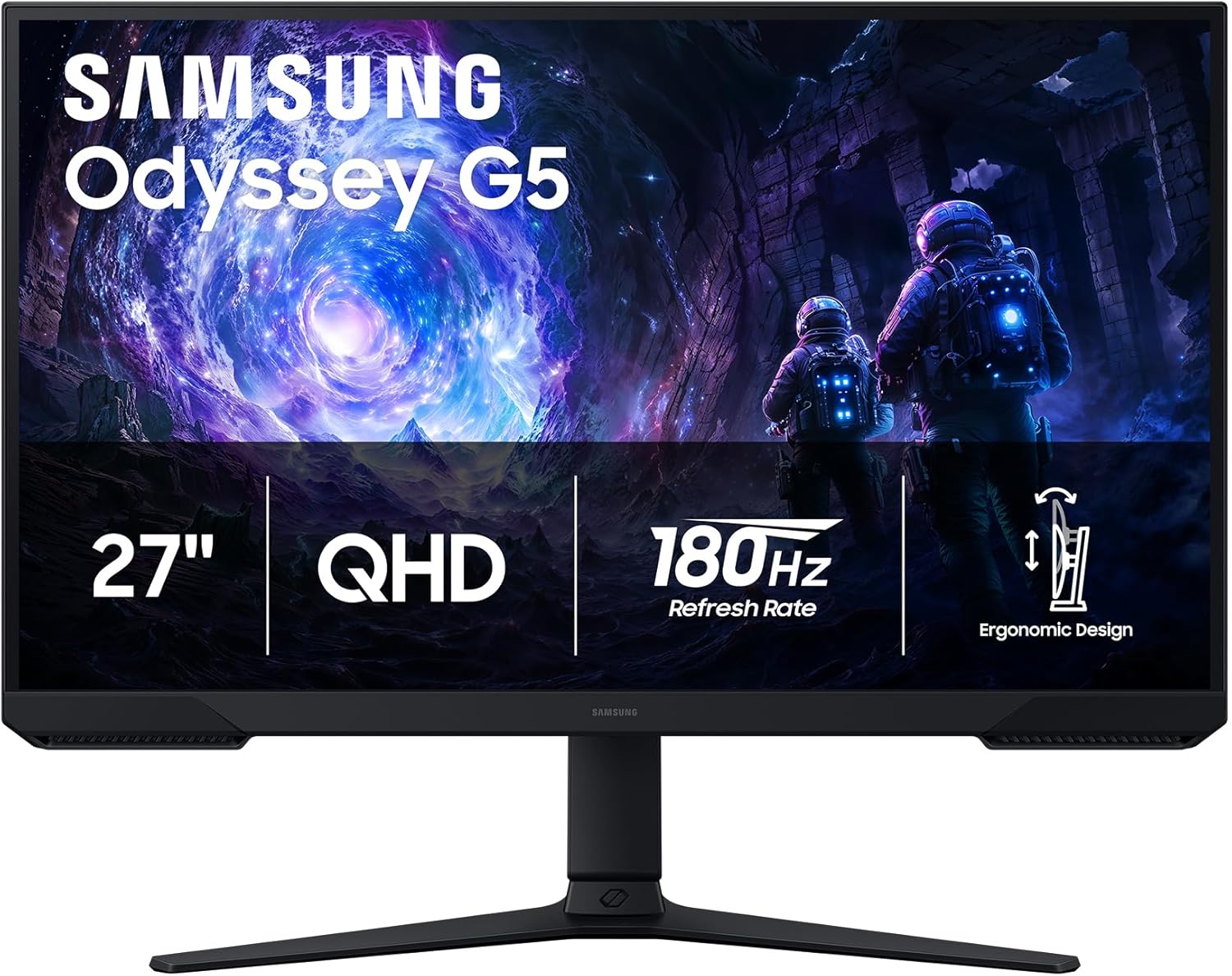
Samsung Odyssey G5 27" QHD 180Hz Gaming Monitor
A solid mid-range gaming monitor that pairs QHD resolution with a 180Hz refresh rate and 1ms response time for competitive play. The VA panel delivers strong contrast and HDR10 support, while AMD FreeSync keeps frame rates smooth. Best suited for gamers who want sharp visuals without jumping to 4K or the highest refresh tiers.
Pros
- QHD resolution (2560x1440) offers 1.7x pixel density over 1080p for crisp, detailed imagery
- 180Hz refresh rate combined with 1ms response time minimizes lag and input delay
- AMD FreeSync eliminates screen tearing and stuttering during gameplay
- Black Equalizer feature helps spot enemies in shadowed areas
- Ergonomic stand with height, tilt, and pivot adjustments for extended gaming sessions
- HDR10 support adds depth with better contrast and color accuracy
Cons
- VA panel lacks Flicker Free certification, which may cause eye strain for sensitive users during long sessions
- No G-Sync support limits compatibility with NVIDIA GPU owners
- 180Hz is solid but trails newer gaming monitors pushing 240Hz and beyond at the same price point

Samsung Odyssey G55C 32" QHD Curved Gaming Monitor
Samsung's 32-inch curved gaming monitor delivers sharp QHD visuals with a 165Hz refresh rate and 1ms response time, designed to minimize motion blur during fast-paced gameplay. The aggressive 1000R curve and AMD FreeSync support create an immersive experience, while HDR10 and Eye Saver Mode add visual depth and reduce strain during extended sessions. Best suited for competitive gamers prioritizing smooth performance over ultra-high resolution.
Pros
- 1.7x pixel density over 1080p delivers noticeably sharper detail at QHD resolution
- 165Hz refresh rate with 1ms MPRT response time provides smooth, responsive gameplay
- 1000R curved VA panel fills peripheral vision and enhances immersion
- AMD FreeSync eliminates tearing for fluid motion in compatible games
- Eye Saver Mode with blue light filter reduces fatigue during long gaming sessions
- HDR10 support brings deeper blacks and brighter highlights to supported content
Cons
- VA panel technology has narrower viewing angles compared to IPS alternatives
- No built-in speakers or USB connectivity, unlike pricier models in Samsung's lineup
- 1ms response time requires 'Extreme mode' setting to achieve, results vary by content and monitor calibration
- 165Hz refresh rate trails behind higher-end 180Hz or 240Hz gaming monitors

Dell SE2426HG 24-inch 240Hz Gaming Monitor
This 24-inch IPS gaming monitor pairs a 240Hz refresh rate with a 0.5ms response time to deliver smooth, responsive gameplay across PC and console platforms. AMD FreeSync Premium and HDMI VRR handle variable refresh rates, while TÜV Rheinland 3-star certification addresses eye comfort with reduced blue light. It's a solid choice for competitive gamers prioritizing speed without sacrificing color accuracy.
Pros
- 240Hz refresh rate with 0.5ms response time minimizes motion blur and input lag
- IPS panel maintains 99% sRGB color coverage and wide viewing angles despite fast response
- FreeSync Premium and HDMI VRR eliminate tearing on both PC and console games
- TÜV Rheinland 3-star certified for blue light reduction and eye comfort
- Multiple connectivity options including 2x HDMI 2.1 and DisplayPort 1.4
Cons
- 1920x1080 FHD resolution may feel limiting on a 24-inch screen for non-gaming work
- IPS panel, while color-accurate, typically has slower native response times than TN alternatives at this refresh tier
- No built-in speakers or USB hub mentioned in specifications

Acer Nitro KG241Y 23.8" 165Hz Gaming Monitor
A competitive gaming monitor built around speed and smoothness. The 165Hz refresh rate and 1ms response time deliver fluid motion for fast-paced titles, while AMD FreeSync Premium eliminates screen tearing. Full HD resolution keeps performance snappy, though the 23.8-inch size suits desk-focused gamers more than those seeking expansive immersion.
Pros
- 165Hz refresh rate with 1ms response time minimizes input lag and ghosting for responsive gameplay
- AMD FreeSync Premium syncs monitor refresh with GPU output, eliminating screen tearing
- VA panel with HDR10 support and multiple gaming modes for customizable color profiles
- Zero-frame design and compact footprint allow side-by-side multi-monitor setups
- Flicker-free, low-dimming ComfyView technology reduces eye strain during long sessions
Cons
- Full HD resolution at 23.8 inches leaves less screen real estate than 1440p alternatives at similar sizes
- VA panel may have narrower viewing angles compared to IPS panels, affecting off-axis visibility
- Limited to 72% NTSC color saturation, making it less ideal for content creation or color-critical work
Gaming Monitors for Competitive Gaming Buying Guide
Choosing a competitive gaming monitor is more nuanced than picking the highest refresh rate you can afford. Panel technology, resolution, response time, and adaptive sync support all interact to define your real-world experience.
Use the criteria below to narrow down the right fit for your rig, your game library, and your budget.
Panel Technology: IPS, VA, or OLED
The panel type sets the baseline for color accuracy, contrast, and motion handling. IPS panels deliver wide viewing angles and accurate colors, making them the dominant choice for competitive players who want clarity in dark scenes without sacrificing versatility.
Fast IPS variants have dramatically improved response times compared to older generations, bringing them close to TN performance while retaining far better image quality.
VA panels offer noticeably higher native contrast ratios, which helps in darker games, but legacy VA designs can suffer from smearing on fast motion.
Newer VA panels from Samsung, such as the Odyssey G5 and G55C series, have improved significantly in this regard. OLED and QD-OLED panels represent the cutting edge: near-zero pixel response, infinite contrast, and stunning color volume.
They carry a premium price and require some care around static elements to minimize burn-in risk, but for competitive players who also enjoy single-player titles, they offer an unmatched dual-purpose experience.
For pure competitive focus at a budget, a Fast IPS display hits the sweet spot. For the best all-around experience, a QD-OLED panel like those found in top-tier picks delivers advantages that no other technology currently matches.
If you’re also considering a larger screen for cinematic content, our guide to TVs built for gaming covers the tradeoffs between monitors and televisions for different room setups.
Refresh Rate: How High Is High Enough?

Refresh rate is the heartbeat of a competitive monitor, measured in hertz (Hz). The jump from 60Hz to 144Hz is transformative: motion is dramatically smoother, target tracking feels more fluid, and input feels more immediate.
Moving from 144Hz to 240Hz brings a meaningful but smaller improvement, and from 240Hz to 360Hz the gains become highly context-dependent and most noticeable only at the very top levels of play in fast-paced shooters.
For most competitive players, a monitor in the 165Hz to 240Hz range delivers an excellent experience without requiring an exceptionally powerful GPU to hit the frame rate ceiling consistently.
Monitors running at 360Hz, such as the Alienware AW2523HF and the ASUS ROG Strix XG27ACDNG, are purpose-built for players who compete at the highest levels in titles like CS2, Valorant, or Overwatch 2 where every rendered frame counts.
If your gaming PC can’t consistently supply frames near the panel’s maximum, a slightly lower refresh rate at 1440p resolution is often a smarter investment.
It’s also worth noting that a higher refresh rate is only useful if your GPU can supply the frames to match. Evaluate your hardware realistically before prioritizing an extreme refresh rate over resolution or panel quality.
Resolution: 1080p vs. 1440p for Competitive Play
The debate between 1080p and 1440p for competitive gaming is genuinely nuanced. Full HD (1920 x 1080) remains the standard on the professional esports circuit because it’s less demanding on GPUs, making it easier to sustain very high frame rates.
On a 24 to 25-inch panel, 1080p is acceptably sharp for most players.
1440p (2560 x 1440, also called QHD or WQHD) offers meaningfully better image sharpness, especially on 27-inch panels, and the performance overhead has become much more manageable as modern GPUs become more capable.
A 27-inch 1440p monitor hits a sweet spot that a large portion of competitive players have migrated to, offering improved clarity for visibility in-game without requiring an extreme GPU to hit 165Hz or higher.
Most picks in our lineup sit at 1440p for exactly this reason.
4K monitors are rarely a good fit for competitive gaming due to the GPU demand required to push high frame rates at that resolution, though they suit more casual or single-player-oriented setups well.
Browse our full monitors category for a broader look at display options across different use cases and resolutions.
Response Time and Motion Clarity

Response time describes how quickly a pixel can transition from one color to another, typically measured in milliseconds. Lower is better for fast-motion clarity.
Marketing figures like “1ms” are often measured using Moving Picture Response Time (MPRT), which can be misleading; gray-to-gray (GtG) or the newer GtG (typical) measurements are more honest benchmarks.
OLED panels genuinely achieve sub-0.1ms GtG response times, which is why they are considered the pinnacle for motion clarity.
In practice, a panel with a 1ms (GtG) or 0.5ms (GtG) spec from a reputable brand will handle virtually any competitive scenario without visible ghosting under normal conditions.
Where response time matters most is in how it interacts with refresh rate: a slow pixel transition at 360Hz will create visible trails.
Most modern Fast IPS panels at 165Hz and above perform well enough that other factors like refresh rate and adaptive sync become more decisive for the average competitive player.
Features like Extreme Low Motion Blur (ELMB), backlight strobing, and similar technologies can enhance perceived sharpness further, though they often require disabling adaptive sync simultaneously. Understanding the tradeoffs is important before enabling these modes.
Adaptive Sync: AMD FreeSync vs. NVIDIA G-Sync

Adaptive sync technology dynamically matches your monitor’s refresh rate to your GPU’s output frame rate, eliminating screen tearing and reducing stutter. AMD FreeSync Premium and NVIDIA G-Sync Compatible are both widely supported across the monitors in our lineup.
G-Sync Compatible certification means the monitor has been validated by NVIDIA to work with G-Sync, even if it uses a FreeSync module rather than a dedicated G-Sync hardware chip.
For most competitive setups, FreeSync Premium or G-Sync Compatible coverage is more than sufficient. Dedicated G-Sync modules (found in premium panels) offer a wider operating range and additional features but come at a noticeable cost premium.
If you own a mid-range NVIDIA GPU, G-Sync Compatible monitors give you the core benefit without the price penalty. AMD GPU owners will find FreeSync Premium support across virtually every monitor in this roundup.
Connectivity and Ergonomics

A competitive monitor should fit naturally into your battle station. Look for HDMI 2.0 or HDMI 2.1 ports alongside DisplayPort 1.2 or 1.4 to ensure you can take full advantage of high refresh rates without bottlenecking the signal.
HDMI 2.1 is particularly useful if you plan to connect a next-generation console alongside your PC. Multiple input options matter if you switch between machines or peripherals.
Ergonomic adjustability, including height adjustment, tilt, swivel, and pivot, is often overlooked but has a real impact on posture and comfort during extended sessions.
A monitor that can be positioned perfectly for your eye level reduces neck strain significantly. Monitors and peripherals work best as a coordinated system: pairing a well-positioned display with a quality mechanical keyboard and a responsive wireless mouse rounds out a genuinely competitive workstation.
Why You Should Trust Us
REMOVU is an independent review platform. Every product we recommend is evaluated against a consistent, category-specific set of criteria and scored on our 0 to 10 REMOVU Score scale.
For gaming monitors, that means we weigh panel technology, refresh rate performance, response time accuracy, adaptive sync implementation, build quality, ergonomic flexibility, and overall value relative to competing options at the same price tier.
We do not conduct our own product trials; our evaluations are grounded in research, published data, expert review consensus, and verified buyer feedback.
Our analysis draws on publicly available display specifications, manufacturer data sheets, aggregated expert review consensus from the display community, and verified buyer feedback from confirmed purchasers.
When expert consensus and buyer experience align on a specific strength or weakness, that agreement is weighted heavily in our scoring.
REMOVU may earn a commission if you purchase through links on this page. That affiliate relationship has no influence on our rankings, scores, or which products we choose to include. Every monitor here earned its place based on merit.
We recommend what we believe is genuinely worth buying, and we note limitations honestly.
Final Thoughts
The best gaming monitors for competitive gaming in 2026 span a wide range of technologies and price tiers, from sharp and affordable 1080p panels to premium QD-OLED displays with near-zero response times.
Based on our research and scoring, here are the standout picks from this lineup:
- Best Overall: ASUS ROG Strix 26.5″ QD-OLED Gaming Monitor (XG27ACDNG) earns the top spot with a combination of 360Hz refresh rate, 0.03ms response, QD-OLED panel quality, and 99% DCI-P3 color coverage that no other display in this roundup can match across all dimensions.
- Best OLED Runner-Up: LG 27GX704A-B 27-inch Ultragear QHD OLED Monitor delivers the same stunning OLED motion clarity and VESA DisplayHDR TrueBlack 400 at a more accessible price, with HDMI 2.1 support for console players as a bonus.
- Best IPS for Competitive Esports: Alienware 25 Gaming Monitor AW2523HF is built specifically for players who need maximum frame rates on a 1080p IPS panel, with 360Hz, AMD FreeSync, and a premium ergonomic stand that suits long sessions.
- Best Budget Pick: Dell 24 240Hz Gaming Monitor SE2426HG punches well above its price tier, delivering a 240Hz IPS panel with AMD FreeSync Premium at a budget-friendly price that makes high-refresh-rate play genuinely accessible.
- Best Curved Option: Samsung 32″ Odyssey G55C QHD 1000R Curved Gaming Monitor combines a 1000R curve, 165Hz refresh, HDR10 support, and a large screen size into a package that balances competitive and immersive gaming exceptionally well.
Whichever direction you go, prioritize the spec that aligns with your primary game genre: refresh rate for fast-paced shooters, resolution and panel quality for strategy or RPG titles that benefit from image fidelity, and adaptive sync compatibility with your GPU.
A great monitor is one of the few upgrades that improves every session, every game, every day.
Frequently Asked Questions
What refresh rate do I actually need for competitive gaming?
For most competitive players, 144Hz to 165Hz represents the point of diminishing returns for general use.
If you play fast-paced shooters like CS2, Valorant, or Apex Legends and your GPU can consistently supply 240 frames per second or higher, stepping up to a 240Hz or 360Hz panel will give you a measurable advantage.
Below that output level, the frames simply won’t be there to utilize the panel’s full capability.
If your system struggles to hit even 144 frames per second, upgrading your GPU or optimizing in-game settings will likely deliver more noticeable improvement than buying a higher-refresh panel.
Pair monitor upgrades with appropriate hardware; our look at graphics cards under a typical mid-range budget can help you identify where to invest first.
Is 1080p or 1440p better for competitive gaming?
It depends on your GPU capability and the games you play. Professional esports players often stick to 1080p because it requires less GPU power to maintain very high frame rates, giving them more headroom for extreme refresh rates.
For players with a capable mid-range or high-end GPU, 1440p at 165Hz or 180Hz on a 27-inch panel offers sharper image quality without a significant competitive penalty, and many players find the improved clarity makes targets easier to spot.
Is an OLED monitor worth the price premium for competitive gaming?
For players who split their time between competitive titles and visually rich single-player games, an OLED or QD-OLED panel is arguably the best all-around monitor investment available right now.
The near-zero pixel response and infinite contrast ratio deliver advantages in both use cases.
The main considerations are price, the need to be mindful of static HUD elements over very long sessions to reduce burn-in risk, and ensuring your GPU can supply enough frames to take advantage of the panel’s peak refresh rate.
If your budget is more constrained and you play primarily competitive titles, a high-refresh Fast IPS panel will serve you extremely well and cost significantly less. OLED makes the most sense when you want a single display that excels at everything.
Do I need both G-Sync and FreeSync, or just one?
You only need adaptive sync support compatible with your GPU. If you own an NVIDIA GPU, look for G-Sync Compatible or G-Sync certification. If you own an AMD GPU, FreeSync Premium is the standard to look for.
In practice, most monitors in this roundup support both ecosystems, so compatibility is rarely a problem. The core benefit of eliminating screen tearing and reducing stutter is the same regardless of which flavor of adaptive sync is active.
What size gaming monitor is best for a competitive setup?
Most competitive players and esports professionals gravitate toward 24 to 27-inch monitors. At this size, the full screen fits comfortably within your natural field of view without requiring significant head movement, which is important in fast-reaction scenarios.
24 to 25 inches is the sweet spot for 1080p sharpness, while 27 inches works best for 1440p. Screens larger than 27 inches are more suited to immersive or casual gaming than pure competitive play, though they offer obvious advantages for streaming content.
For audio immersion during long sessions, pairing any monitor with quality wireless over-ear headphones or a dedicated pair of noise-cancelling earbuds completes the setup.
How important is HDR on a competitive gaming monitor?
HDR support on budget and mid-range monitors is often more marketing than substance. Many panels labeled HDR10 lack the peak brightness or local dimming zones to deliver a meaningful HDR experience.
For competitive gaming specifically, HDR is a lower priority than refresh rate and response time. Where HDR genuinely matters is on premium OLED panels with high peak brightness and true per-pixel dimming, which deliver a visibly superior image.
If HDR is a priority for you, look for VESA DisplayHDR TrueBlack 400 certification on OLED panels rather than a generic HDR10 badge on an edge-lit LCD.
About the author
Marlene covers point-and-shoot cameras for REMOVU, comparing image quality, zoom, and pocketability. She helps readers find a compact that outshoots a phone where it counts.