The 8 Best Gaming Laptops Under $1500
RTX 50-series GPUs, fast DDR5, and high-refresh displays now fit comfortably under a mid-range budget. Here are the gaming laptops that actually deliver on their spec sheets.
 By Kylie Fields
Updated July 26, 2026
By Kylie Fields
Updated July 26, 2026

The $985.00 – $1,393.65 gaming laptop market has never been more competitive, and that is genuinely good news for buyers.
Machines that once demanded flagship prices now arrive with the latest RTX 50-series and RTX 40-series GPUs, fast DDR5 memory, high-refresh-rate displays, and Wi-Fi 7 connectivity, all packaged under a budget that still leaves room for a decent chair and a gaming headset.
Whether you are building your first gaming rig or upgrading from an older system, understanding what each component actually delivers in real-world sessions is what separates a smart purchase from an expensive regret.
Options from ASUS, Acer, and Alienware dominate this segment, each taking a slightly different approach to the GPU-thermal-display trade-off that defines this price tier.
REMOVU researched this category by analyzing published specifications, synthesizing expert review consensus from across the hardware community, and weighing verified buyer feedback to surface picks that genuinely hold up over months of use, not just benchmarks.
If your budget is a little tighter, our roundup of gaming laptops worth buying for under $1000 covers strong options at a lower price point. Read on for our top picks in the $985.00 – $1,393.65 tier, ranked and scored below.
| Award | Product | REMOVU Score About REMOVU ScoreThe REMOVU Score is our own rating from 0 to 10, based on performance, design and build, ease of use, and value. It reflects independent research and is never influenced by manufacturers, retailers, or affiliate commissions. Learn more › | Price | |
|---|---|---|---|---|
| Best Overall |
 ASUS ROG Strix G16 Gaming Laptop
|
8.9/10 | Buy | |
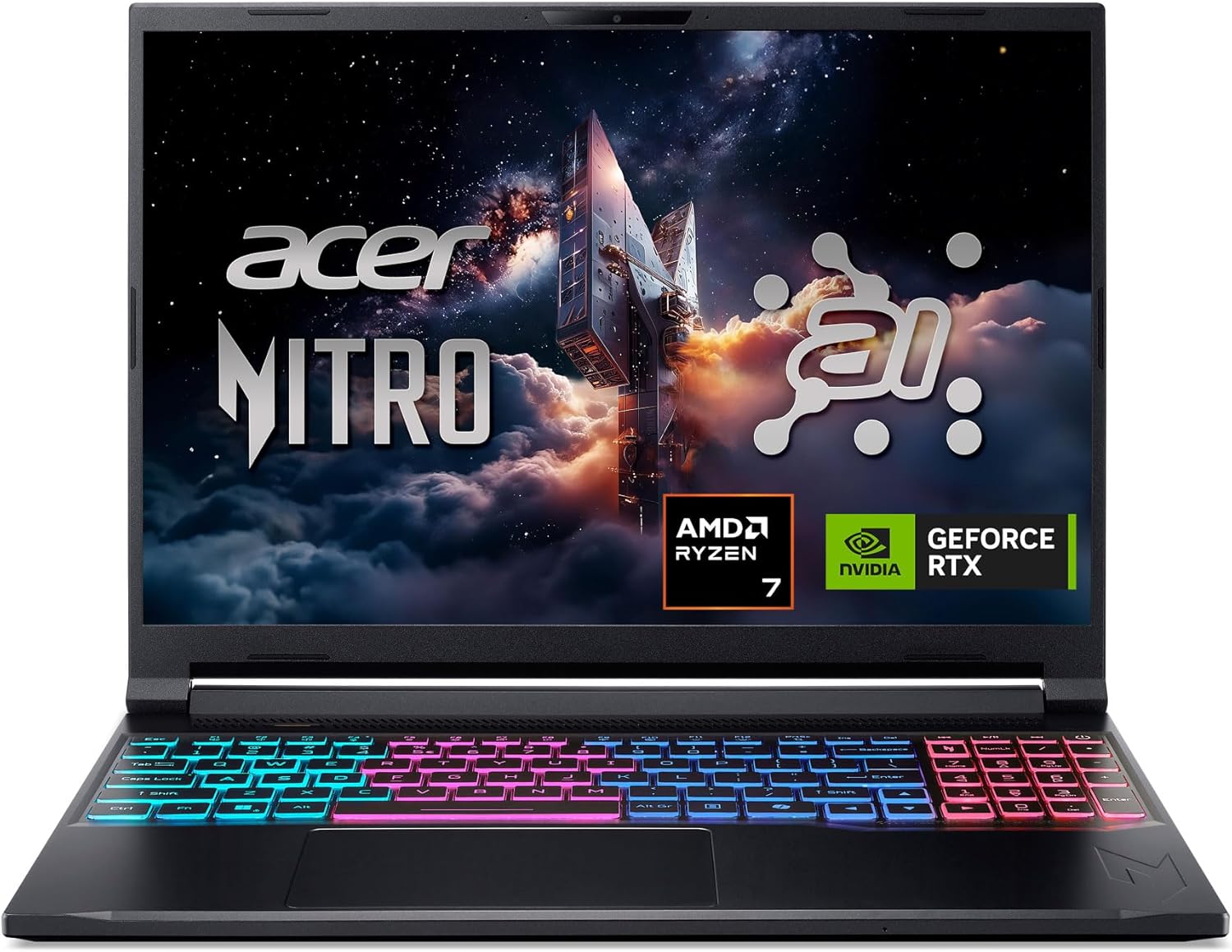 Acer Nitro V 16S AI: Ryzen 7 + RTX 5060 Gaming Laptop
|
7.4/10 | Buy | ||
| Best Premium |
 Alienware 16 Aurora RTX 5050 Gaming Laptop
|
7.6/10 | Buy | |
| Best Budget |
 Acer Nitro V 15 RTX 5050 Gaming Laptop
|
7.6/10 | Buy | |
| Best Value |
 ASUS TUF Gaming F16 (2025) 16-Inch 165Hz Gaming Laptop
|
7.4/10 | Buy | |
 Acer Nitro V 15 RTX 5050 Gaming Laptop
|
7.2/10 | Buy | ||
 Acer Nitro 5 AN515-58 Gaming Laptop (i5/RTX 3050 Ti)
|
6.5/10 | Buy | ||
 ASUS TUF Gaming F16 RTX 4050 16-inch Laptop
|
6.2/10 | Buy |
ASUS ROG Strix G16 Gaming Laptop
A powerful 16-inch gaming laptop built for serious gamers, featuring an Intel Core i7-14650HX, RTX 5060 GPU, and a 165Hz display for smooth competitive play. The advanced cooling system and build quality justify the price for those seeking reliable high-performance gaming.
Pros
- Exceptional refresh rate and response time create competitive advantage in fast-paced games
- Robust cooling system maintains performance stability during long gaming marathons
- Upgradeable memory and storage allow cost-effective future improvements
- Dolby Atmos audio and premium display enhance immersive gaming experience
- Strong build quality and thermal design justify the investment for serious gamers
Cons
- RTX 5060 may require settings adjustments for ultra-high-end AAA titles at maximum graphics
- 16GB DDR5 is adequate now but may feel limiting for heavy multitasking or future demanding applications
- Premium pricing positions it above budget gaming laptops, though feature set justifies the cost
Acer Nitro V 16S AI: Ryzen 7 + RTX 5060 Gaming Laptop
A slim 16-inch gaming laptop built for portability without sacrificing power. The Ryzen 7 260 CPU and RTX 5060 GPU with 572 AI TOPS handle modern games and AI tasks smoothly, while the 180Hz WUXGA display delivers fluid visuals. Best suited for gamers and creators who prioritize mobility and want current-generation ray tracing performance.
Pros
- Compact, slim chassis designed for gaming on the go without bulk
- Strong GPU performance with RTX 5060 and DLSS 4 support for smooth frame rates and ray tracing
- High refresh 180Hz display with 100% sRGB accuracy for vibrant, responsive gaming
- Generous 32GB DDR5 RAM and 1TB SSD for multitasking and content creation
- Solid 4.4-star rating from 282 verified buyers
Cons
- 16-inch WUXGA resolution is standard, not cutting-edge for a premium gaming laptop
- Single available M.2 slot limits storage upgrade flexibility
- Ryzen 7 260 CPU performance details sparse; unclear how it compares to Intel alternatives in non-AI workloads
Alienware 16 Aurora RTX 5050 Gaming Laptop
A 16-inch gaming laptop built for sustained performance with Intel Core 7 and RTX 5050 graphics, paired with a 120Hz WQXGA display and premium aluminum design. The Cryo-Chamber cooling system and upgradeable memory/storage make it solid for gamers who want portability without sacrificing thermal stability. Best suited for players prioritizing comfort and long gaming sessions over ultra-compact form factors.
Pros
- Advanced Cryo-Chamber cooling with dual fans and copper heat pipes keeps thermals efficient during extended play
- Upgradeable DDR5 memory and dual PCIe Gen 4 SSD slots allow future expansion up to 2TB storage
- 120Hz WQXGA display with 300 nits brightness and 100% sRGB provides clear visuals for competitive gaming
- Streamlined design with anodized aluminum lid and magnesium frame balances premium build with reasonable portability
- NVIDIA RTX 5050 with DLSS 4 and Reflex 2 delivers competitive-grade performance for modern titles
Cons
- RTX 5050 is entry-level for the RTX 50 series, limiting performance at maximum settings in demanding AAA games
- 16GB DDR5 RAM is baseline for modern gaming and content creation, requiring upgrade for heavy multitasking
- 4.2-star rating from 262 reviews suggests mixed real-world satisfaction, with potential thermal or build quality concerns worth investigating
Acer Nitro V 15 RTX 5050 Gaming Laptop
A mid-range gaming laptop built around Intel's 13th-gen i5-13420H and RTX 5050 graphics, designed for 1080p gaming and content creation. The 165Hz IPS display and solid port selection including Thunderbolt 4 make it versatile for both gaming and productivity, while the lightweight 4.66 lb build keeps it portable enough for travel.
Pros
- Fast 165Hz IPS display for smooth gaming and reduced motion blur
- Dedicated RTX 5050 8GB GDDR7 with DLSS 4 support for modern game optimization
- Comprehensive connectivity: Thunderbolt 4, Gigabit Ethernet, multiple USB-A 3.2 ports
- Lightweight at 4.66 lbs with slim 0.93 inch profile for portability
- Wi-Fi 6 and DTS X audio for fast connectivity and immersive sound
Cons
- 512GB SSD is modest for gaming libraries and large projects, likely requiring external storage expansion
- No user reviews available yet, making real-world performance assessment difficult
- RTX 5050 sits at entry-level for dedicated graphics, limiting performance in demanding AAA titles at high settings
ASUS TUF Gaming F16 (2025) 16-Inch 165Hz Gaming Laptop
A mid-range gaming laptop built for durability and consistent performance, pairing an Intel Core i5 13450HX with RTX 5050 graphics and a fast 165Hz display. The military-grade construction and efficient cooling system make it reliable for extended gaming sessions, though storage and RAM are entry-level for the category.
Pros
- 165Hz FHD+ display with 100% sRGB and Adaptive-Sync for smooth, tear-free gameplay
- Military-grade durability (MIL-STD-810H) means reliable performance in demanding conditions
- 2nd Gen Arc Flow Fans with full-width heatsink deliver effective cooling without excessive noise
- DDR5 memory and PCIe Gen4 SSD provide solid multitasking and load times
- Dolby Atmos and Hi-Res audio enhance immersion for games and media
Cons
- 512GB SSD is modest for modern game libraries, likely requiring early upgrades or external storage
- RTX 5050 is entry-level for high-end AAA titles at max settings on this refresh rate
- 16GB DDR5 is adequate now but may feel limiting as games become more demanding
Acer Nitro V 15 RTX 5050 Gaming Laptop
This 15.6-inch gaming laptop pairs a 13th-gen Intel i5-13420H with an RTX 5050 GPU and 165Hz display, targeting mid-range gamers who want solid 1080p performance without breaking the bank. The 16GB RAM and 512GB SSD provide adequate multitasking capacity, while Thunderbolt 4 and Wi-Fi 6 keep connectivity modern. At under 5 pounds, it's reasonably portable for its class.
Pros
- 165Hz IPS display delivers smooth visuals for competitive gaming and everyday use
- RTX 5050 handles modern games at 1080p with decent settings and DLSS4 support
- Lightweight at 4.66 lbs with compact 0.93-inch profile for a 15.6-inch machine
- Thunderbolt 4 and Gigabit Ethernet provide flexible connectivity options
- Windows 11 Pro and backlit keyboard suit both gaming and productivity work
Cons
- 512GB SSD is modest for gaming libraries; users will likely need external storage quickly
- 16GB DDR4 RAM is adequate but not upgradeable in most modern gaming laptops
- No user reviews available yet, making real-world reliability and thermal performance unverified
Acer Nitro 5 AN515-58 Gaming Laptop (i5/RTX 3050 Ti)
A mid-range gaming laptop that pairs a 12th Gen Intel Core i5 with an RTX 3050 Ti GPU for solid 1080p performance. The 144Hz IPS display delivers smooth visuals for competitive gaming, while 16GB DDR4 and 512GB SSD handle most modern titles and creative work. Best suited for budget-conscious gamers who prioritize refresh rate over maximum frame rates.
Pros
- 144Hz 1080p IPS display provides fluid, responsive gaming without excessive motion blur
- RTX 3050 Ti with dedicated 4GB VRAM handles 1080p gaming at high settings in most titles
- Dual-fan cooling with quad-exhaust design keeps thermals in check during extended sessions
- Expandable memory and storage (up to 32GB DDR4, dual M.2 slots) for future upgrades
- Killer Wi-Fi 6 and Ethernet prioritization for stable online gameplay
Cons
- RTX 3050 Ti struggles with demanding AAA titles at ultra settings above 100 fps
- 5.51 lbs and 1.06 inch thickness is respectable but not ultraportable for frequent travel
- 16GB base RAM is adequate but DDR4 is aging compared to DDR5 alternatives in newer models
ASUS TUF Gaming F16 RTX 4050 16-inch Laptop
A solid mid-range gaming laptop that balances performance and durability. The 16-inch 144Hz display and RTX 4050 GPU handle modern games well, while military-grade construction and efficient cooling make it reliable for extended use. Best suited for gamers prioritizing build quality over cutting-edge performance.
Pros
- 144Hz FHD display with 100% sRGB and Adaptive-Sync reduces visual tearing and stuttering
- Military-grade durability (MIL-STD-810H) reviewed for harsh conditions
- Efficient cooling system with Arc Flow Fans, 5 heat pipes, and anti-dust filter keeps thermals in check without excessive noise
- 16GB DDR5 RAM and 512GB PCIe Gen4 SSD enable smooth multitasking and fast load times
- Dolby Atmos and Hi-Res audio enhance immersion for gaming and media
Cons
- RTX 4050 is entry-level for demanding AAA titles at high settings
- 16-inch form factor with gaming specs may be bulkier than ultraportable alternatives
- 512GB storage may require expansion for large game libraries
Gaming Laptops Under $1500 Buying Guide
Picking a gaming laptop at this price point requires balancing several competing priorities. A higher-wattage GPU means better sustained performance but also more heat and fan noise. A sharper display means more GPU load.
More RAM future-proofs your rig but costs money that could otherwise go toward a faster chip. The sections below break down the factors that matter most, in the order you should think about them.
GPU: The Single Most Important Spec

At this budget tier, the GPU is the component that will define your experience for the next three to five years.
The RTX 5060 Laptop GPU represents the current-generation sweet spot, offering a significant generational jump in rasterization and AI-assisted rendering (DLSS 4) over its RTX 4060 predecessor.
The RTX 5050 occupies the value segment of the new lineup, while the older RTX 4050 and RTX 3050 Ti are still viable at lower price points but will age faster.
One detail buyers frequently overlook is Total Graphics Power (TGP). Two laptops can carry the same GPU model yet deliver noticeably different frame rates if their TGP limits differ by 20W or more.
Always cross-reference the manufacturer spec sheet or dedicated hardware review sources before buying. A 70W RTX 5060 will underperform a 95W RTX 5060 in sustained workloads, regardless of what the box says.
If you are primarily interested in competitive multiplayer titles where raw frame rates matter above all else, our guide to gaming laptops for esports focuses specifically on that use case and covers GPU choices optimized for high refresh rates over visual fidelity.
Display: Resolution, Refresh Rate, and Panel Size

The displays in this price bracket have improved dramatically.
You will find 144Hz, 165Hz, and 180Hz panels across the lineup, and the shift to 16:10 aspect ratios on 16-inch screens gives a meaningful extra strip of vertical real estate for both games and productivity work.
FHD+ (1920×1200) remains the most GPU-friendly choice because it requires less rendering horsepower than WQXGA or QHD, letting your GPU hit higher frame rates more consistently.
Response time matters for fast-paced play. A 3ms response time at the panel level reduces ghosting on moving objects, which is relevant in shooters and action games.
IPS-level panels generally provide better viewing angles and color accuracy than older TN alternatives, making them a better all-around choice for users who mix gaming with content consumption or light creative work.
Pay attention to whether the display supports Adaptive Sync or G-Sync Compatible certification. At variable frame rates, screen tearing and stutter can undermine an otherwise solid GPU, and a certified variable refresh rate panel eliminates both without meaningful overhead.
Processor and Platform: Intel vs. AMD
The CPU in a gaming laptop handles physics, AI-driven game logic, background tasks, and in CPU-bound titles, directly affects frame rates.
Intel Core i7 and Core i5 HX-class processors (like the i7-14650HX) deliver strong multi-core throughput and handle simultaneous streaming or recording without throttling the GPU.
AMD Ryzen 7 series processors, such as the Ryzen 7 260, offer competitive single-core performance and tend to be more power-efficient under mixed workloads.
For most gaming scenarios, both Intel and AMD options at this price tier are capable enough that the GPU choice matters more. Where the CPU distinction becomes meaningful is in content creation workflows, large modded game sessions, and streaming scenarios.
If you regularly pair your laptop with external monitors or peripherals, pairing strong CPU performance with adequate DDR5 RAM speeds can further reduce frame time variance in demanding titles.
Memory and Storage Configuration

16GB of DDR5 is now the baseline for gaming laptops in this class, and it is sufficient for most current titles.
However, several models in this roundup ship with 32GB configurations, which provides meaningful headroom for memory-hungry games, browser-heavy workflows, and longer upgrade cycles.
DDR4 still appears on a small number of machines and is not a dealbreaker, but DDR5 offers better bandwidth for GPU-intensive workloads and is the standard going forward.
On storage, Gen 4 NVMe SSDs deliver noticeably faster load times and asset streaming compared to Gen 3 drives.
A 1TB drive is the practical minimum if you plan to keep several modern AAA titles installed simultaneously, most of which now exceed 80GB each.
Verify whether the laptop has an accessible secondary M.2 slot, as this is one of the easiest and most cost-effective upgrades you can make post-purchase.
Thermal Design and Build Quality

Thermal management determines whether the spec sheet performance you pay for actually survives a two-hour gaming session. Laptops in this tier vary significantly in how well they sustain peak performance under sustained load.
More heat pipes, larger vapor chambers, and dual fan configurations generally indicate better sustained performance.
Thin and light gaming laptops often throttle more aggressively under load than thicker chassis designs, a trade-off worth considering if portability is not your primary concern.
Fan noise at full load is a real factor for daily use.
Some models in this roundup are notably louder under load than others, and expert consensus notes that ASUS ROG and TUF chassis designs tend to manage sustained clock speeds more consistently than comparably priced thinner alternatives.
Build quality also varies: magnesium alloy and reinforced plastic combinations hold up better over time than all-plastic hinges, especially for laptops carried in bags regularly.
Connectivity and Peripheral Ecosystem

Wi-Fi 7 and Wi-Fi 6E are now appearing even at entry-level price points in this bracket, delivering significantly lower latency and higher throughput than Wi-Fi 6, which matters most in dense wireless environments.
Thunderbolt support, available on select models in this roundup, enables high-bandwidth docking, fast external storage, and eGPU expansion for users who want desktop-grade peripherals at their desk while retaining portability.
A solid built-in audio experience matters less in gaming if you plan to pair your laptop with a dedicated gaming headset, but the quality of the built-in microphone array has become relevant for remote play and casual calls.
USB-A port count is still a practical consideration for mouse, keyboard, and controller connections, particularly for desktop replacement setups.
Check the port layout on each side of the chassis before committing, because a single-side port cluster is a real ergonomic irritant at a desk.
Why You Should Trust Us
REMOVU is an independent review publication. We do not conduct our own product trials; our evaluations are grounded in research, published data, expert review consensus, and verified buyer feedback.
Every laptop in this roundup was assessed against a consistent set of criteria spanning GPU performance, display quality, thermal management, memory and storage configuration, build quality, and connectivity.
Each model receives a REMOVU Score on a 0 to 10 scale, where higher scores reflect a stronger aggregate performance across all criteria relative to the current market.
Our scoring process draws on published hardware benchmarks, manufacturer specification sheets, and the aggregated consensus from experienced hardware reviewers across the industry.
We also factor in verified buyer feedback to surface real-world durability and satisfaction patterns that benchmarks alone cannot capture. This multi-source methodology helps us identify models that perform well not just on paper but also in sustained, everyday use.
REMOVU may earn a commission if you purchase through links on this page. That affiliate relationship has no influence on our rankings, scores, or editorial selections. Products are ranked on assessed quality, not on commission rates.
We do not sell products, process orders, or handle returns; for those matters, please contact the retailer directly.
Final Thoughts
The $985.00 – $1,393.65 gaming laptop segment is dense with genuinely capable machines, and the right choice depends heavily on which trade-offs matter most to you.
If you want the absolute strongest current-generation GPU performance in a well-built chassis, the ASUS ROG Strix G16 sits at the top of our rankings.
If your priority is getting the latest RTX 50-series hardware at a lower outlay, both Acer Nitro options and the ASUS TUF F16 2025 offer strong value propositions.
For buyers who want a premium brand heritage and solid DDR5 foundation, the Alienware 16 Aurora is worth a serious look. Here is how we award our editorial honors for this roundup:
- Best Overall: ASUS ROG Strix G16 (2025) earns the top REMOVU Score in this roundup on the strength of its RTX 5060 GPU, high-refresh 16:10 display, Wi-Fi 7 connectivity, and a chassis design that sustains peak performance under load better than most competitors in this price range.
- Best for Budget-Conscious Buyers: Acer Nitro V 15 (RTX 5050, Win 11 Home) delivers a current-generation GDDR7-backed RTX 5050 and a 165Hz display at one of the most accessible price points in the segment, making it the strongest entry-level option in this roundup.
- Best Premium Pick: Alienware 16 Aurora combines RTX 5050 graphics, a WQXGA 120Hz display, DDR5 RAM, and Wi-Fi 7 in Alienware’s distinctive chassis, offering a polished experience for buyers who prioritize brand build quality and ecosystem alongside raw performance.
- Best for Content Creators Who Also Game: Acer Nitro V 16S AI pairs an RTX 5060 with 32GB of DDR5 and a 180Hz WUXGA display, making it the most memory-forward option in the roundup and a natural fit for users who need headroom beyond gaming.
Whichever model you choose, consider rounding out your setup with a quality gaming microphone for in-game communication and a reliable peripheral arrangement. You can also explore our broader laptops category if you want to compare gaming options alongside mainstream and ultraportable alternatives.
Frequently Asked Questions
Is RTX 5060 Worth It Over RTX 4060 in a Laptop?
For buyers purchasing new in 2026, yes. The RTX 5060 Laptop GPU offers improved rasterization performance, GDDR7 memory bandwidth, and hardware support for DLSS 4 Multi Frame Generation, which meaningfully increases frame rates in supported titles.
The RTX 4060 is still a capable GPU, but the RTX 5060 provides a better three-to-five-year outlook at a similar or only slightly higher price point in the current market.
The caveat is TGP variance. A high-TGP RTX 4060 can outperform a thermally constrained RTX 5060 in sustained workloads. Always verify the wattage configuration for the specific laptop model, not just the GPU model name.
How Much RAM Do I Need in a Gaming Laptop Under $1500?
16GB DDR5 is sufficient for the majority of current AAA titles and esports games. 32GB becomes beneficial if you run background applications simultaneously, stream your gameplay, work in video editing software, or play heavily modded games.
Several models in this roundup offer 32GB at no significant price premium over their 16GB counterparts, making it worth comparing configurations carefully before buying.
Should I Prioritize a Higher Refresh Rate or a Higher Resolution Display?
For competitive gaming, a higher refresh rate (165Hz or 180Hz) at FHD+ resolution is the better choice.
Your GPU can hit frame rates that take advantage of the high refresh panel more easily at FHD+ than at QHD or WQXGA, resulting in a smoother, more responsive experience.
For single-player narrative games and media consumption, a higher resolution panel produces a noticeably sharper image and may be worth the trade-off in raw frame rate headroom.
Are Gaming Laptops Good for Work and School as Well as Gaming?
Modern gaming laptops are genuinely capable all-purpose machines. The same GPU that handles games also accelerates creative workloads in applications that support CUDA or hardware-accelerated encoding. High-refresh IPS panels are comfortable for long writing and browsing sessions.
The main trade-offs versus a dedicated productivity laptop are battery life (gaming laptops typically deliver four to six hours of light use away from the plug) and chassis weight.
If portability is a priority, our guide to lightweight laptops covers thinner alternatives for travel-heavy users.
What Connectivity Features Should I Look for in 2026?
Wi-Fi 7 or Wi-Fi 6E offers lower latency and higher bandwidth than Wi-Fi 6, which matters in crowded wireless environments and for online multiplayer.
Thunderbolt 4 support is valuable if you plan to connect to a dock, high-speed external storage, or a high-resolution monitor.
USB-A ports remain practical for gaming peripherals, and an HDMI 2.1 port ensures you can drive a 4K 144Hz external display without an adapter if you want a desktop-replacement setup.
For voice communication during sessions, pairing your laptop with a streaming-grade microphone is a meaningful upgrade over built-in arrays.
Can I Upgrade a Gaming Laptop After Purchase?
RAM and SSD upgrades are the most accessible post-purchase improvements on most gaming laptops. Many models in this roundup ship with one populated RAM slot and one open M.2 slot, allowing straightforward capacity upgrades.
The GPU is soldered to the motherboard in virtually all consumer gaming laptops and cannot be upgraded. This makes the GPU choice the single most important long-term decision at the point of purchase.
Choosing a current-generation GPU with a clear architectural roadmap is the best insurance against premature obsolescence.
About the author
Kylie covers processors for REMOVU, balancing core count, clock speed, and platform cost against what readers actually run. She helps builders pick a CPU that fits their workload and budget.