The 11 Best PSUs
Choosing the right PSU protects every component in your build. Our research covers wattage, ATX 3.1 compliance, efficiency ratings, and long-term reliability to find the top picks.
 By Jamie Allen
Updated July 26, 2026
By Jamie Allen
Updated July 26, 2026

A power supply unit is the one component most builders underestimate until something goes wrong.
It sits at the foundation of every PC, converting wall power into the clean, stable voltages that keep your CPU, graphics card, and storage running reliably.
Choose too little wattage or a unit with poor voltage regulation and you invite system crashes, component damage, and a far shorter hardware lifespan.
The right PSU, by contrast, runs quietly, wastes little energy, and simply disappears into the background for years.
Whether you are powering a modest home-office rig or a high-end gaming machine built around the latest GPU, picking the correct unit requires navigating wattage ratings, efficiency certifications, connector standards, and brand reliability all at once.
This guide cuts through the noise. REMOVU’s editorial team researched every model below by synthesizing published specifications, expert review consensus from the enthusiast community, and verified buyer feedback gathered across thousands of real-world purchases.
We do not conduct our own product trials; our evaluations are grounded in research, published data, and consistent scoring criteria so you get a clear, unbiased picture before you spend a cent.
The lineup covers PSUs from budget-friendly options to flagship Titanium-rated units, with picks for every major use case. Read on for our top recommendations, then scroll down for a detailed buying guide.
| Award | Product | REMOVU Score About REMOVU ScoreThe REMOVU Score is our own rating from 0 to 10, based on performance, design and build, ease of use, and value. It reflects independent research and is never influenced by manufacturers, retailers, or affiliate commissions. Learn more › | Price | |
|---|---|---|---|---|
| Best Overall |
 Seasonic PRIME TX-1600 Noctua Edition 1600W PSU
|
8.9/10 | Buy | |
| Best Value |
 Corsair RM850e 850W Fully Modular PSU
|
8.6/10 | Buy | |
| Best Budget |
 Corsair RM750e 750W Fully Modular PSU
|
8.4/10 | Buy | |
| Best Premium |
 Corsair HX1000i 1000W Fully Modular PSU
|
8.3/10 | Buy | |
 ASUS ROG Strix 1000W Platinum Modular PSU
|
8.1/10 | Buy | ||
 Corsair RM850x 850W Fully Modular PSU
|
7.9/10 | Buy | ||
 be quiet! Pure Power 13 M 850W Gold PSU
|
7.8/10 | Buy | ||
 Lian Li EDGE1000W Gold Modular PSU
|
7.6/10 | Buy | ||
 NZXT C850 Gold Core 850W ATX 3.1 PSU
|
7.3/10 | Buy | ||
 Corsair RM850x 850W Gold Power Supply
|
7.2/10 | Buy | ||
 Skylzor 850W Fully Modular 80+ Gold PSU
|
6.2/10 | Buy |
Seasonic PRIME TX-1600 Noctua Edition 1600W PSU
A premium 1600W power supply engineered for silence, pairing Seasonic's flagship PRIME TX platform with Noctua's acclaimed NF-A12x25 fan. Runs passively up to 50% load and operates at whisper-quiet levels even under full stress, making it ideal for high-end gaming and workstation builds where noise matters. Backed by 80 Plus Titanium efficiency and ATX 3.1/PCIe 5.1 support for next-gen GPUs.
Pros
- Exceptional acoustic performance: Cybenetics Lambda A++ rating with ~13 dB(A) average noise, 8-10 dB(A) quieter than standard PRIME TX-1600
- Semi-passive operation keeps fan off until 50% load at typical room temps, enabling nearly silent operation for less demanding workloads
- 80 Plus Titanium efficiency (94% at 50% load) reduces heat output and power waste
- Full ATX 3.1 and PCIe 5.1 compliance with 12V-2×6 connector for high-power graphics cards like RTX 4090
- Fully modular Noctua-themed cabling for clean builds and visual consistency
Cons
- Premium positioning means significantly higher cost than standard PRIME TX-1600 or competing 1600W units
- 1600W capacity is overkill for most gaming builds, limiting the benefit of semi-passive cooling unless running power-hungry workstations
- Limited to US AC power cord included; regional power cord availability may vary
Corsair RM850e 850W Fully Modular PSU
A premium 850W power supply built for modern high-end gaming and workstation builds. The RM850e combines ATX 3.1 compliance with a quiet 120mm fan design and fully modular cabling, making it practical for clean builds while handling PCIe 5.1 GPUs without compromise.
Pros
- Fully modular cabling reduces clutter and improves airflow in your case
- ATX 3.1 and PCIe 5.1 certified, ready for next-generation graphics cards
- 120mm rifle bearing fan with optimized curve keeps noise minimal even at full load
- 105°C-rated capacitors provide stable power delivery and long-term reliability
- Modern Standby mode improves low-load efficiency and wake times
Cons
- 850W capacity limits headroom for extreme multi-GPU or server workloads
- Premium positioning means higher cost than comparable non-modular alternatives
- Fully modular design requires more initial cable management effort during setup
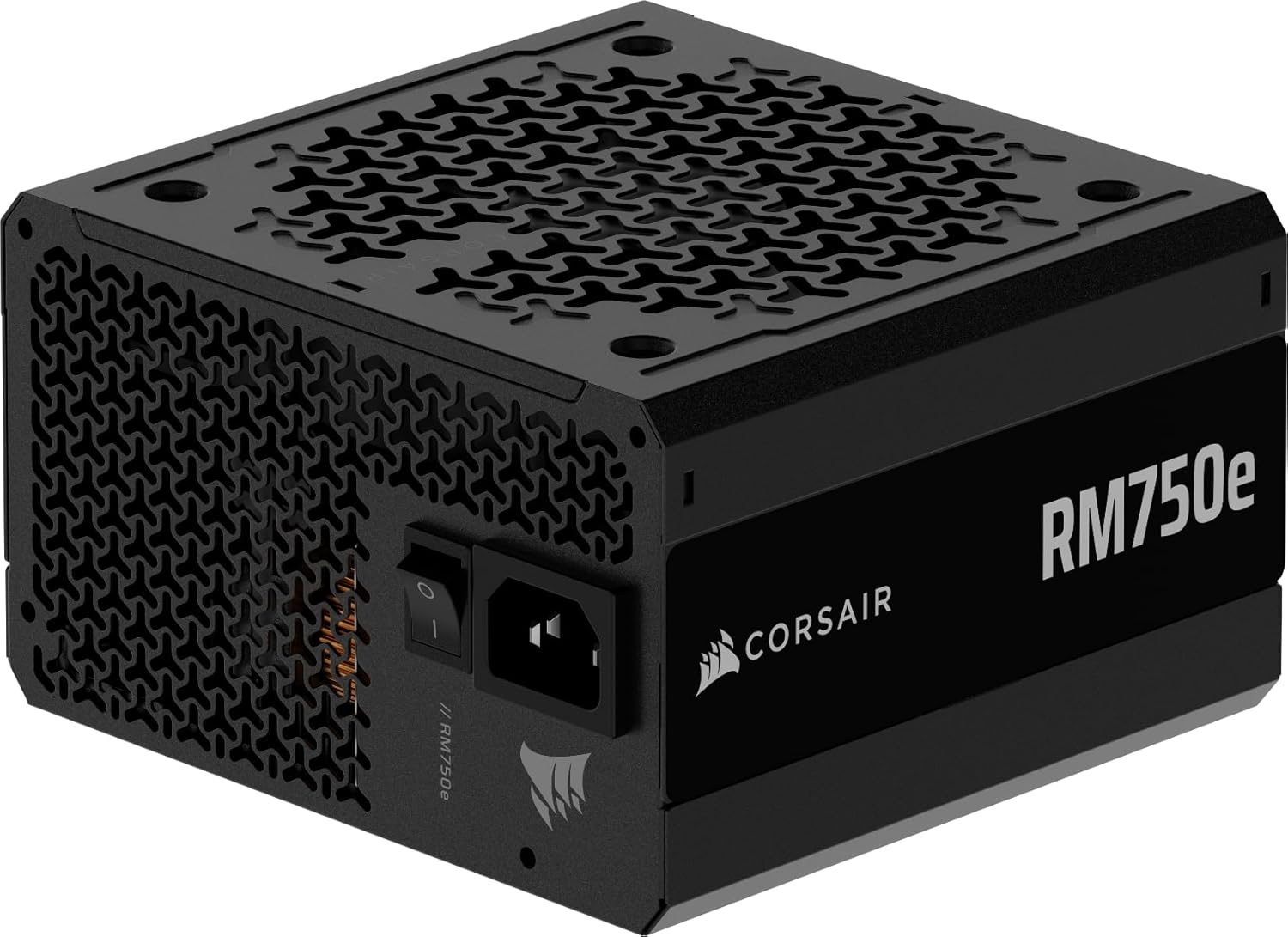
Corsair RM750e 750W Fully Modular PSU
A premium power supply built for modern high-end systems, the Corsair RM750e delivers ATX 3.1 and PCIe 5.1 compliance with fully modular cabling to reduce clutter. Its 120mm rifle bearing fan and optimized curve keep noise minimal under load, while 105°C-rated capacitors ensure stable long-term performance for demanding builds.
Pros
- ATX 3.1 and PCIe 5.1 certified, ready for next-gen GPUs with dual transient power support
- Fully modular design lets you connect only necessary cables for cleaner builds
- 120mm rifle bearing fan with tuned curve maintains low noise even at full load
- Modern Standby mode improves efficiency during low-power states and sleep
- High 4.7-star rating from 315 verified buyers reflects consistent reliability
Cons
- 750W capacity may be tight for extreme multi-GPU or heavily overclocked systems requiring more headroom
- Premium positioning means higher cost compared to standard non-modular alternatives
- Fully modular design adds complexity during initial cable management versus semi-modular units
Corsair HX1000i 1000W Fully Modular PSU
A premium 1000W power supply built for high-end systems that demand stable, efficient power. The HX1000i combines 80 Plus Platinum efficiency with a quiet 140mm fluid dynamic bearing fan and full ATX 3.1 compliance for next-gen GPUs. Best suited for enthusiasts running demanding multi-GPU or CPU-intensive workloads who value silent operation and long-term reliability.
Pros
- 80 Plus Platinum efficiency reduces energy waste and operating costs over time
- Zero RPM fan mode keeps the unit nearly silent during light to moderate loads
- Fully modular cabling simplifies cable management and reduces clutter
- ATX 3.1 and PCIe 5.1 certified for compatibility with current and upcoming high-power components
- CORSAIR iCUE software integration allows real-time monitoring and custom fan curve adjustment
- 10-year warranty and Japanese 105°C capacitors support long-term durability
Cons
- Premium pricing positions it above mid-range alternatives, limiting appeal to budget builders
- 1000W capacity may exceed the needs of many single-GPU systems, adding unnecessary cost
- iCUE software dependency for advanced features like OCP switching requires additional setup
ASUS ROG Strix 1000W Platinum Modular PSU
A premium 1000W power supply engineered for high-end gaming rigs, built on GaN MOSFET technology and featuring ASUS's GPU-First voltage stabilization to deliver cleaner power to graphics cards. The unit combines 80 Plus Platinum efficiency with Cybenetics Lambda A+ noise certification, making it a solid choice for builders prioritizing stability and quiet operation over budget constraints.
Pros
- GaN MOSFET technology delivers up to 30% higher efficiency with reduced heat output and organized internal layout
- GPU-First intelligent voltage sensor improves voltage stability by up to 45%, benefiting demanding gaming workloads
- Dual ball fan bearings rated for 80,000 hours of operation with 0dB fan stop below 40% load for silent light use
- High-performance copper pins reduce connector temperatures by up to 29 degrees Celsius for improved reliability
- 10-year warranty and ATX 3.1 compliance future-proof the investment for next-generation hardware
Cons
- Premium positioning means higher cost compared to Gold-rated alternatives with similar wattage
- Fully modular design adds complexity during initial setup despite DIY-friendly cable identification features
- No RGB lighting included, limiting aesthetic customization compared to some competing models
Corsair RM850x 850W Fully Modular PSU
A premium power supply built for modern high-end builds, the RM850x combines ATX 3.1 compliance with a native 12V-2x6 connector for next-gen graphics cards. Its fully modular design and Gold efficiency rating deliver clean power with minimal noise, backed by a decade-long warranty that reflects Corsair's confidence in reliability.
Pros
- Fully modular cabling reduces clutter and simplifies cable management for custom builds
- Native 12V-2x6 connector eliminates the need for adapters with latest-generation GPUs
- Cybenetics Gold efficiency (up to 91%) lowers power draw and heat output
- 140mm FDB fan and 105°C Japanese capacitors designed for sustained quiet operation
- 10-year warranty demonstrates strong product confidence and long-term support
Cons
- Premium positioning means higher cost compared to standard 850W alternatives
- ATX 3.1 and PCIe 5.1 features may exceed needs for systems not using cutting-edge components
- Fully modular design adds complexity during initial setup versus semi-modular units
be quiet! Pure Power 13 M 850W Gold PSU
An 850W fully modular power supply built for silent operation and next-gen systems. The semi-passive cooling keeps noise minimal during light loads, while the ATX 3.1 design with native 12V-2x6 connector supports current and future high-end GPUs. Best suited for builders prioritizing quiet performance over budget options.
Pros
- Exceptional 80 PLUS Gold efficiency up to 94.4%, reducing power consumption and heat
- Semi-passive zero-RPM fan mode for silent operation under low loads
- Future-proof ATX 3.1 compliance with PCIe 5.1 ready 12V-2x6 connector
- Handles transient power spikes up to double rated capacity for stable next-gen GPU support
- Fully modular cables improve airflow and cable management
- 10-year warranty and strong 4.8 rating from 147 verified reviews
Cons
- Premium positioning means higher cost than standard 850W alternatives
- Modular design adds slight complexity compared to hardwired cables
- 850W capacity may be overkill for mid-range gaming or office builds
Lian Li EDGE1000W Gold Modular PSU
A premium 1000W power supply built for next-gen graphics cards with native 12V-2x6 connectors and ATX 3.1 compliance. The EDGE Gold delivers low-noise operation (30.9dBA at 50% load), modular cabling, and includes a bonus USB/Fan Hub for RGB control. Best suited for high-end gaming and workstation builds where cable management and silence matter.
Pros
- Native 12VHPWR support ready for RTX 50/40 series without adapters
- Excellent noise control with Cybenetics Gold certification and 30.9dBA baseline
- Fully modular design reduces cable clutter in premium cases
- Integrated USB/Fan Hub with six 4-pin connectors (2A each) for flexible RGB and fan management
- ATX 3.1 and PCIe 5.1 compliant with transient spike protection
Cons
- Premium pricing positions it above budget and mid-range alternatives
- 1000W capacity may exceed needs for non-flagship GPU builds, adding unnecessary cost
- Limited real-world noise measurements beyond 50% load in available data
NZXT C850 Gold Core 850W ATX 3.1 PSU
A fully modular 850W power supply built for modern gaming PCs, this unit combines ATX 3.1 and PCIe 5.1 support with 80 Plus Gold efficiency and Cybenetics Platinum noise certification. Its dual 12V-2x6 connector handles next-gen GPUs reliably, while the Zero RPM fan mode keeps things silent during light loads, making it a solid fit for high-performance builds that demand both stability and quiet operation.
Pros
- PCIe 5.1 ready with 12V-2x6 connector, future-proofed for latest NVIDIA and AMD graphics cards
- Exceptional efficiency ratings: 80 Plus Gold plus Cybenetics Platinum, reducing heat and power waste
- Whisper-quiet performance with A++ noise certification (<15 dBA) and Zero RPM fan mode
- Fully modular cables with embossed design for clean cable management and easy routing
- Premium 105°C-rated capacitors and comprehensive 7-year warranty provide long-term reliability
Cons
- 850W capacity may be overkill for mid-range gaming builds, limiting value for budget-conscious users
- Limited information on specific form factor compatibility with compact PC cases
- Fully modular design means more connectors to manage, though cable quality mitigates this
Corsair RM850x 850W Gold Power Supply
A reliable 850W power supply built for high-performance systems that demand stable power delivery and quiet operation. The fully modular cables and Zero RPM fan mode appeal to builders seeking both aesthetics and low-noise performance, while the Gold certification and Japanese capacitors support long-term system stability.
Pros
- 80+ Gold efficiency reduces operating costs and heat output compared to lower-tier certifications
- Zero RPM fan mode delivers virtually silent operation during low to medium workloads
- Fully modular cables simplify case building and cable management for cleaner aesthetics
- 100% Japanese 105°C capacitors provide premium component quality and long-term reliability
- Ten-year warranty demonstrates manufacturer confidence in durability across multiple system builds
Cons
- 850W capacity may be overkill for mid-range or budget builds, adding unnecessary cost
- Fan will activate under sustained high loads, producing audible noise during demanding gaming or workstation use
- Premium pricing reflects the Gold certification and build quality, making it less accessible for budget-conscious buyers
Skylzor 850W Fully Modular 80+ Gold PSU
A fully modular power supply built for modern high-end systems with ATX 3.1 and PCIe 5.1 support. The 140mm smart fan and Japanese capacitors prioritize quiet operation and reliability, while the 80+ Gold certification keeps efficiency high. Best suited for enthusiasts planning PCIe 5.0 graphics cards or looking to minimize cable clutter in their build.
Pros
- Fully modular cables reduce clutter and improve airflow for cleaner builds
- 140mm smart fan auto-adjusts from silent idle to active cooling, minimizing noise during gaming
- ATX 3.1 and PCIe 5.1 ready with dual-color 16-pin connector for next-gen GPU compatibility
- 80+ Gold efficiency (up to 92%) reduces power draw and heat output
- Premium 105°C Japanese capacitors and DC-DC design support long-term stability
Cons
- No specifications for cable length, connector types, or rail amperage detailed in available data
- 850W capacity may be overkill for mid-range systems, limiting value for budget builds
- Limited availability of independent reviews beyond the 11 user ratings provided
PSUs Buying Guide
Buying a power supply feels straightforward until you are standing in front of a wall of nearly identical black boxes.
The sections below break down the six criteria that actually separate a great unit from a mediocre one, so you can match the right PSU to your specific build without overspending or cutting dangerous corners.
Wattage: How Much Power Do You Actually Need?

Wattage is the most visible spec on any PSU box, yet it is also the most misunderstood. Your system’s peak draw is driven primarily by the GPU and CPU combined.
A mid-range gaming build with a current-generation discrete GPU and a mainstream processor typically lands between 450W and 650W at peak load, leaving a 750W unit with plenty of headroom.
High-end systems pairing a flagship GPU like an RTX 5090 or RX 9070 XT with a power-hungry CPU can push past 800W to 1000W at sustained load, especially under workloads that hammer both components simultaneously.
The golden rule is to size your PSU so that real-world load sits between roughly 50 percent and 80 percent of rated capacity.
Units run most efficiently in this band and the extra headroom means transient spikes, which modern GPUs produce frequently under the new ATX 3.1 standard, never trip over-current protection.
Oversizing to a 1600W unit for a 400W system wastes money on idle efficiency and noise; undersizing causes instability or, worse, premature component failure.
Use an online power calculator with your actual component list, add roughly 20 percent headroom, then round up to the next standard wattage tier.
For most mid-range gaming PC builds a well-chosen 750W to 850W unit hits the sweet spot of headroom and cost without tipping into overkill territory. Workstation and content-creation rigs running dual GPUs or extreme overclocking configurations are the legitimate use case for anything above 1000W.
Efficiency Ratings: 80 Plus, Cybenetics, and Why They Matter

The 80 Plus certification program evaluations a PSU at three load points (20%, 50%, and 100%) and certifies units that hit minimum efficiency thresholds at each tier, from the baseline 80 Plus White through Bronze, Silver, Gold, Platinum, and Titanium.
Higher efficiency means less energy converted to heat, lower electricity bills over the unit’s lifespan, and a cooler, quieter system because the PSU fan spins up less often.
Gold is the practical sweet spot for most builds; Platinum and Titanium carry price premiums that only make financial sense for systems running continuously at high load, such as servers or crypto-mining rigs.
A newer and increasingly respected alternative is the Cybenetics rating system, which evaluations efficiency across a finer grid of load points and also rates acoustic performance under the Lambda standard.
Several models in our lineup carry Cybenetics Gold or Platinum alongside or instead of 80 Plus certification, providing a more nuanced picture of real-world efficiency.
When comparing two similar units, a Cybenetics Platinum badge alongside an 80 Plus Gold badge is worth noting as a signal of genuinely consistent efficiency rather than just peak-load performance.
ATX 3.1 and PCIe 5.1 Compliance
The ATX 3.1 specification, ratified in 2023, introduced stricter requirements for handling transient power excursions, which are the sudden brief spikes that modern high-end GPUs draw when moving from idle to full load.
A non-compliant PSU can trigger over-current protection during these spikes even if its rated wattage is theoretically sufficient. If you are pairing your build with a GPU released since late 2023, ATX 3.1 compliance is strongly advisable rather than merely optional.
Closely related is the PCIe 5.1 connector standard and the 12V-2×6 cable that replaces the older 12VHPWR. The 12V-2×6 connector improves the contact retention design to reduce the risk of the overheating failures that plagued some early 12VHPWR adapters.
If your GPU uses a native 12V-2×6 socket, prioritise a PSU that includes that cable natively rather than relying on an adapter.
Nearly all units in our lineup ship with the 12V-2×6 cable included, which is one reason they earned a place here rather than older-generation alternatives.
Pairing your build with quality motherboards that also adhere to current standards rounds out a reliable foundation.
Modularity: Full, Semi, or Non-Modular?

Every PSU on our list is fully modular, meaning you only attach the cables your build actually needs. That matters for two practical reasons: airflow and aesthetics.
A non-modular or semi-modular unit forces you to stuff unused cable bundles somewhere inside the case, restricting airflow paths and making the interior look cluttered.
Fully modular units let you route only the necessary cables cleanly, which is especially important in compact mid-tower or ITX builds where cable management space is tight.
For cable-managed PC cases with a glass side panel, the difference is immediately visible.
The trade-off is cost: fully modular units command a modest premium over equivalent semi-modular designs. For most builders that premium is worth it, particularly since PSUs are long-term investments that outlive several GPU generations.
If budget is the primary constraint, a semi-modular unit from a reputable brand is still preferable to a cheap non-modular alternative, but all of our picks here are fully modular because that is where the market has converged for quality units.
Our separate roundup of modular power supplies worth buying digs deeper into the trade-offs if you want to compare form factors more broadly.
Noise and Fan Behaviour

PSU fan noise is easy to overlook until you are sitting next to a system under load.
Quality units use semi-passive fan modes that keep the fan fully stopped at light and medium loads, only spinning up when temperatures climb under sustained heavy workloads.
The best units pair this semi-passive behaviour with a high-quality fan, whether a fluid dynamic bearing (FDB) design or, in the flagship Seasonic Prime TX-1600 Noctua Edition, an actual Noctua fan, which is widely regarded as the gold standard for acoustic performance in PC components.
Cybenetics Lambda ratings formalise acoustic performance into tiers from A++ (ultra-quiet) to C, giving you a comparable measure across brands.
When a unit carries both a strong efficiency rating and a Lambda A or A+ acoustic rating it signals that engineers genuinely optimised for both metrics rather than sacrificing one for the other.
For an open-bench workstation or a near-silent home-theater PC, this is worth seeking out. For a gaming rig already cooled by multiple case fans and a beefy CPU cooler, the PSU fan is rarely the loudest component regardless.
Warranty, Capacitor Quality, and Brand Reliability

A PSU warranty is one of the clearest signals of how much confidence a manufacturer has in its own product.
Budget units commonly offer three years; reputable mid-range units offer five to seven years; the best units on our list carry ten-year warranties, which for a component running continuously is a meaningful real-world guarantee.
A long warranty also tends to correlate with higher-grade internal components because offering a decade of support would be financially ruinous if failure rates were high.
Internal capacitor quality deserves special attention. Capacitors rated to 105 degrees Celsius tolerate heat significantly better than the older 85-degree-rated parts still found in cheaper units, translating directly into longer operational life in a warm case environment.
Japanese-branded capacitors (made by companies like Nippon Chemi-Con, Nichicon, or Rubycon) carry a well-established reputation for longevity in the enthusiast community and are standard fare on the premium picks in our lineup.
For a component that directly controls power delivery to every other part of your build, including sensitive RAM and solid-state drives, the internal quality of the PSU matters more than the external branding.
Why You Should Trust Us
REMOVU is an independent review publication. We have no manufacturer relationships, receive no review samples, and are not compensated by brands to alter rankings.
Every product in this guide was evaluated against a consistent, multi-criteria framework and assigned a REMOVU Score on a 0 to 10 scale.
We do not conduct our own product trials; our evaluations are grounded in research, published data, expert review consensus, and verified buyer feedback.
That means we synthesise what professional hardware reviewers, electrical engineers, and thousands of real-world buyers have documented rather than relying on a single point of view or a single evaluation environment.
Our scoring framework for power supplies weights wattage accuracy and voltage regulation most heavily, followed by efficiency certification, build quality indicators (capacitor grade, fan bearing type, internal platform), compliance with current ATX and PCIe standards, acoustic performance, warranty length, and aggregated long-term reliability data from verified purchasers.
Products are re-evaluated periodically as new firmware, price changes, or significant accumulation of user feedback shifts the picture.
Transparency note: REMOVU may earn an affiliate commission if you purchase through links on this page. That relationship does not influence scores, rankings, or editorial selections in any way. Our recommendations are determined solely by evaluation quality, not by commission rates.
Final Thoughts
The power supply market in 2026 is genuinely strong.
Brands including Corsair, Seasonic, ASUS ROG, be quiet!, Lian Li, and NZXT have pushed the standard upward, making ATX 3.1 compliance, native 12V-2×6 connectors, and semi-passive fan modes table stakes rather than premium features.
That competition benefits builders at every price tier. Below are our top picks by use case, drawn from the full lineup scored above.
- Best Overall: Seasonic Prime TX-1600 Noctua Edition earns the top REMOVU Score in this roundup by combining a 80 Plus Titanium efficiency rating, ATX 3.1 compliance, and an iconic Noctua fan into a flagship unit that sets the benchmark for noise, efficiency, and build quality simultaneously.
- Best Value for Money: CORSAIR RM850e (2025) delivers ATX 3.1 and PCIe 5.1 compliance, 105-degree-rated capacitors, and Cybenetics Gold efficiency at a budget-friendly price point that undercuts most of the competition without compromising on the specs that matter most.
- Best Budget Pick: CORSAIR RM750e ATX 3.1 brings the same core feature set as the RM850e into a 750W package at an even lower price, making it the easiest recommendation for mid-range gaming builds that do not need the extra wattage headroom.
- Best for High-End Gaming Builds: Corsair HX1000i combines ATX 3.1 and PCIe 5.1 compliance with Fluid Dynamic Bearing fan technology, 80 Plus Platinum efficiency, and deep CORSAIR iCUE software integration, making it the natural choice for enthusiast rigs where monitoring and cable management both matter.
- Best for Builders Who Prioritise Warranty: ASUS ROG Strix 1000W Platinum backs its GaN MOSFET platform and GPU-First intelligent voltage stabilisation with a ten-year warranty, giving long-term peace of mind that most units in this category cannot match.
Whatever build you are putting together, pairing a quality PSU with well-chosen PC components ensures every dollar spent on your GPU, CPU, and storage is protected by stable, clean power delivery for years to come.
Frequently Asked Questions
How Much Wattage Do I Need for a Gaming PC?
Most mid-range gaming builds land in the 550W to 750W range at peak load.
A system pairing a current-generation mid-tier GPU with a mainstream eight-core CPU rarely exceeds 450W under real gameplay, but sizing up to 750W gives comfortable headroom for transient spikes and future upgrades.
High-end systems with flagship GPUs and overclocked processors can push past 800W, making a 1000W unit sensible.
The safest approach is to calculate your specific component draw using a reputable online wattage calculator and then add around 20 percent buffer before selecting a unit.
Pairing the right PSU with a capable gaming PC build under a tight budget means prioritising wattage accuracy over brand prestige.
Is 80 Plus Gold Good Enough, or Should I Pay for Platinum?
For the vast majority of home users, 80 Plus Gold is the practical efficiency ceiling where the efficiency gains of stepping up to Platinum or Titanium no longer offset the price difference in reduced electricity costs within a reasonable timeframe.
Gold-rated units typically achieve 87 to 90 percent efficiency at typical load, which translates to minimal wasted heat and very reasonable operating costs for a desktop PC running several hours per day.
Platinum and Titanium make better financial sense for systems running continuously, such as home servers or workstations under sustained load around the clock.
When in doubt, Gold from a reputable platform is the right call for gaming and productivity rigs alike.
What Is the 12V-2×6 Connector and Do I Need It?
The 12V-2×6 connector is the updated GPU power cable introduced alongside the PCIe 5.1 specification to address safety and reliability concerns with the original 12VHPWR design used on first-generation PCIe 5.0 GPUs.
It features improved contact retention that reduces the risk of partial seating, which was responsible for some high-profile melting incidents with early 12VHPWR adapters.
If your GPU shipped with a native 12V-2×6 socket, buying a PSU that includes the matching cable natively is strongly recommended over using an adapter.
Even if your current GPU does not use this connector, choosing an ATX 3.1 unit with the cable included is future-proofing that costs nothing extra on a quality unit at this price tier.
How Long Should a Quality PSU Last?
A quality PSU from a reputable brand with Japanese capacitors rated to 105 degrees Celsius should realistically last eight to twelve years in a well-ventilated case under normal usage.
The warranty offered by the manufacturer is one of the most reliable indicators: units backed by a ten-year warranty, such as the ASUS ROG Strix and be quiet!
Pure Power 13 M models in our lineup, are engineered to that standard because the warranty liability would be untenable otherwise.
The most common failure modes are electrolytic capacitor degradation, fan bearing wear, and connector fatigue, all of which are mitigated by higher-grade components and good case airflow.
Replacing a PSU proactively every seven to ten years, or when symptoms like unstable voltages appear, is good practice regardless of warranty status.
Does PSU Brand Matter, or Are They All Made by the Same OEMs?
Brand does matter, though the enthusiast community is correct that many PSUs share underlying platforms manufactured by a small number of OEM designers, including Seasonic, Great Wall, Channel Well Technology, and Flextronics.
What varies between brands using the same platform is the component selection above the platform minimum (capacitor grades, fan quality, cable quality), quality-control stringency, firmware tuning for voltage regulation, and, crucially, the warranty and after-sales support the brand actually stands behind.
Corsair, Seasonic, ASUS ROG, be quiet!, and Lian Li all have strong reputations for standing behind their products and maintaining consistent quality control across generations, which is why they dominate the picks in this guide.
Lesser-known brands selling on price alone carry more risk, even when their spec sheets look competitive on paper.
For a complete picture of how modularity affects cable routing and build quality, our guide to modular power supplies covers that angle in more depth.
About the author
Jamie covers DACs and headphone amps for REMOVU, focusing on output power, features, and which pairings actually improve the sound of demanding headphones. He guides both desktop and portable listeners toward worthwhile upgrades.