The 9 Best Modular Power Supplies
Modular PSUs cut cable clutter and simplify future upgrades. We analyzed efficiency ratings, connector standards, fan engineering, and verified buyer feedback to find the best options from Corsair, be quiet!, Thermaltake, and more.
 By Phyllis Holmes
Updated July 26, 2026
By Phyllis Holmes
Updated July 26, 2026

The power supply unit sits at the heart of every PC build, yet it is often the most overlooked component.
A modular power supply takes that foundation a step further by letting you attach only the cables you actually need, which cuts clutter, improves airflow through your case, and makes future upgrades far less painful.
Whether you are assembling a compact mid-tower for everyday work or a high-wattage gaming rig that hungers for a modern graphics card, the cable management advantages of a modular PSU pay dividends for the lifetime of the build.
REMOVU researched the current market by synthesizing manufacturer specifications, expert review consensus across the enthusiast hardware community, and verified buyer feedback to identify the modular power supplies that offer the best combination of efficiency, reliability, safety certifications, and value.
Our picks range from budget-friendly semi-modular options to fully modular platinum-rated flagships suited to demanding workloads. Scroll down to see our top picks, each evaluated on the REMOVU 0 to 10 scoring scale.
| Award | Product | REMOVU Score About REMOVU ScoreThe REMOVU Score is our own rating from 0 to 10, based on performance, design and build, ease of use, and value. It reflects independent research and is never influenced by manufacturers, retailers, or affiliate commissions. Learn more › | Price | |
|---|---|---|---|---|
| Best Premium |
 Corsair HX1000i 1000W Fully Modular PSU
|
8.3/10 | Buy | |
| Best Overall |
 be quiet! Pure Power 12 M 1000W Modular PSU
|
8.3/10 | Buy | |
 Thermaltake Toughpower GF1 850W Gold Power Supply
|
7.5/10 | Buy | ||
| Best Budget |
 Rosewill VMG 750W 80+ Gold Modular PSU
|
7.6/10 | Buy | |
| Best Value |
 MONTECH Century II 850W Gold Modular PSU
|
7.6/10 | Buy | |
 ASUS ROG Strix 750W Gold Modular PSU
|
7.2/10 | Buy | ||
 MSI MAG A650BE 650W Semi-Modular PSU
|
6.8/10 | Buy | ||
 Corsair CX750M 750W 80 Plus Bronze Modular PSU
|
6.2/10 | Buy | ||
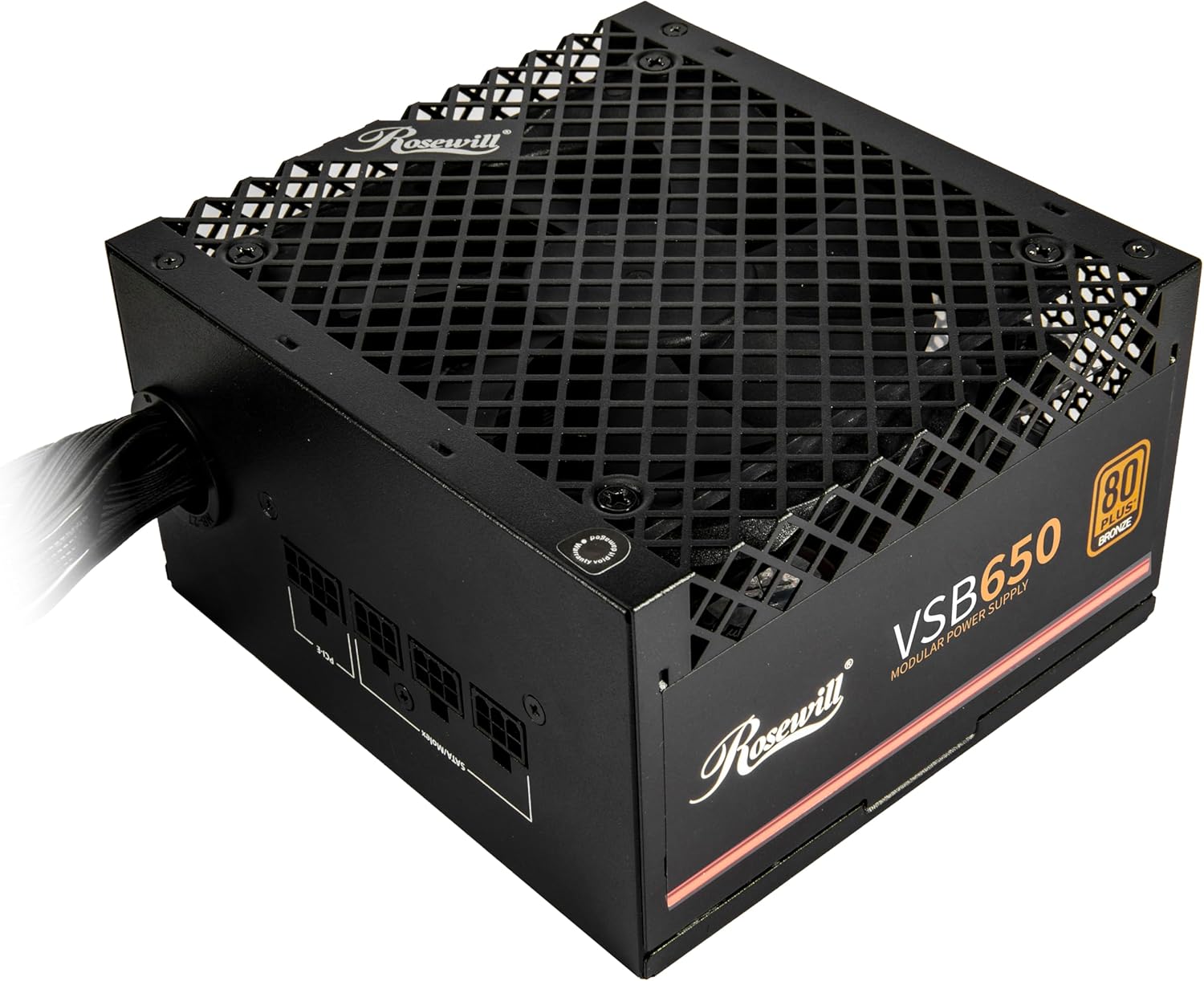 Rosewill VSB 650W Semi-Modular 80+ Bronze PSU
|
6.2/10 | Buy |
Corsair HX1000i 1000W Fully Modular PSU
A premium 1000W power supply built for high-end systems that demand stable, efficient power. The HX1000i combines 80 Plus Platinum efficiency with a quiet 140mm fluid dynamic bearing fan and full ATX 3.1 compliance for next-gen GPUs. Best suited for enthusiasts running demanding multi-GPU or CPU-intensive workloads who value silent operation and long-term reliability.
Pros
- 80 Plus Platinum efficiency reduces energy waste and operating costs over time
- Zero RPM fan mode keeps the unit nearly silent during light to moderate loads
- Fully modular cabling simplifies cable management and reduces clutter
- ATX 3.1 and PCIe 5.1 certified for compatibility with current and upcoming high-power components
- CORSAIR iCUE software integration allows real-time monitoring and custom fan curve adjustment
- 10-year warranty and Japanese 105°C capacitors support long-term durability
Cons
- Premium pricing positions it above mid-range alternatives, limiting appeal to budget builders
- 1000W capacity may exceed the needs of many single-GPU systems, adding unnecessary cost
- iCUE software dependency for advanced features like OCP switching requires additional setup
be quiet! Pure Power 12 M 1000W Modular PSU
A 1000W power supply built for silence and next-gen hardware compatibility. The 80 Plus Gold efficiency and temperature-controlled 120mm fan make it ideal for quiet builds, while native 12VHPWR and PCIe 6+2 connectors support current and upcoming graphics cards without compromise.
Pros
- Exceptional efficiency at 93% reduces heat and operating costs, benefiting long-term system stability
- Native 12VHPWR connector and dual 12V rails with 2000W transient handling ensure seamless PCIe 5.0 GPU support
- Temperature-controlled fan with optimized blade design delivers near-silent operation even under sustained loads
- Fully modular cabling simplifies cable management and improves airflow for cleaner builds
- 10-year warranty reflects manufacturer confidence in component reliability
Cons
- 1000W capacity is overkill for mid-range systems, potentially representing unnecessary premium spend
- Limited independent review data on real-world noise performance across different load scenarios
- Modular design adds slight complexity to initial setup compared to non-modular alternatives
Thermaltake Toughpower GF1 850W Gold Power Supply
A fully modular 850W power supply with 80 Plus Gold efficiency and a compact design that appeals to PC builders prioritizing quiet operation and cable management. The Smart Zero Fan technology keeps noise minimal during light loads, while the 10-year warranty reflects confidence in long-term reliability.
Pros
- 80 Plus Gold efficiency reduces power waste and heat output
- Smart Zero Fan minimizes noise by staying off until load threshold is reached
- Compact dimensions (150x86x140mm) with fully modular cables for flexible cable routing
- Fluid bearing 120mm fan provides consistent, quiet cooling performance
- 10-year warranty offers strong consumer protection
Cons
- Single 12V rail design may be less flexible than multi-rail alternatives for certain configurations
- No information on modular cable quality or connectors in available specs
- Limited to 850W capacity; users needing higher wattage must step up to different model
Rosewill VMG 750W 80+ Gold Modular PSU
A compact 750W power supply built for next-gen GPUs with PCIe 5.1 support and ATX 3.0/3.1 compatibility. The full modular design, 80+ Gold efficiency, and 35% smaller chassis make it practical for small-form-factor builds, while the 120mm silent fan and six-layer protection keep noise and heat in check. Best suited for builders upgrading to current-gen graphics cards without sacrificing space.
Pros
- PCIe 5.1 12V-2x6 connector delivers 600W direct power for next-gen GPUs
- Full modular cables reduce clutter and improve airflow in tight cases
- Compact 140×150×86mm chassis fits small-form-factor builds with room to spare
- 80+ Gold certification balances efficiency with real-world pricing
- Six-protection suite (OCP/OPP/OTP/OVP/SCP/UCP) covers major failure modes
- 4.6-star rating from 178 verified reviews reflects consistent user satisfaction
Cons
- 750W capacity limits headroom for high-end CPU and GPU pairings in power-hungry setups
- Compact design may reduce cable routing flexibility compared to full-size units
- Limited information on fan noise levels under sustained load despite FDB bearing claims
MONTECH Century II 850W Gold Modular PSU
A fully modular 850W power supply built for next-gen systems with ATX 3.1 and PCIe 5.1 support. It pairs 80 Plus Gold efficiency with Japanese capacitors and a quiet 135mm fan, making it a solid choice for high-end gaming rigs seeking reliability without unnecessary premium pricing.
Pros
- Future-proof with ATX 3.1 and PCIe 5.1 compatibility plus 12V-2x6 cable support
- 80 Plus Gold efficiency rating for consistent power delivery and lower heat output
- Fully modular design reduces cable clutter and improves airflow in builds
- Comprehensive protection suite: OCP, OVP, UVP, SCP, OTP, OPP with 10-year warranty
- 135mm FDB silent fan with zero RPM mode keeps noise minimal during light loads
Cons
- No Titanium or Platinum efficiency certification, limiting power savings versus higher-tier units
- Limited detailed specifications provided; full modular connector compatibility details unclear
- Premium positioning may face competition from established brands in the same wattage and efficiency tier
ASUS ROG Strix 750W Gold Modular PSU
A premium 750W power supply built for silent operation and long-term reliability. The 0dB fan shuts down under light loads, while Japanese capacitors and ROG heatsinks keep thermals in check. Best suited for high-end gaming and workstation builds where noise matters and uptime is non-negotiable.
Pros
- 0dB fan stop technology below 40% load reduces noise during everyday use
- 80 Plus Gold efficiency with Japanese capacitors for stable power delivery
- Fully modular cables embedded with capacitors to minimize voltage ripple
- Dual ball bearing fan rated for twice the lifespan of sleeve bearing alternatives
- 10-year warranty and IP5X dustproof rating for durability
Cons
- Premium pricing compared to standard 750W Gold units without ROG branding
- No RGB lighting on base model, limiting aesthetic appeal for windowed cases
- 750W capacity may feel tight for future GPU upgrades in high-end systems
MSI MAG A650BE 650W Semi-Modular PSU
A budget-friendly 650W power supply built for compact builds and everyday systems. The 80+ Bronze efficiency rating keeps power draw reasonable, while the semi-modular design reduces cable clutter without the premium price tag. Best suited for builders prioritizing cost savings over full modularity.
Pros
- 80+ Bronze certification delivers solid efficiency for the price tier
- 120mm low-noise fan with sleeve bearing keeps acoustic output minimal
- Industrial-grade protection covers OVP, OCP, OPP, OTP, and SCP scenarios
- Semi-modular design balances cable management with affordability
- 5-year warranty provides reasonable coverage for the segment
Cons
- Bronze efficiency means higher energy consumption compared to Gold or Platinum units
- Semi-modular design leaves some permanently soldered cables for larger builds
- No verified user reviews available to assess real-world reliability feedback
Corsair CX750M 750W 80 Plus Bronze Modular PSU
A semi-modular power supply built on proven architecture, the CX750M delivers solid efficiency for mid-range gaming and workstation builds. Japanese capacitors and dual EPS12V cables ensure stable power delivery, though as a renewed unit, condition varies by seller.
Pros
- 80 Plus Bronze efficiency reduces power waste and operating costs
- Semi-modular design minimizes cable clutter while keeping costs reasonable
- Dual EPS12V and dual/quad PCIe 8-pin connectors handle modern GPU demands
- Japanese 105°C-rated capacitors provide long-term reliability
- Strong 4.7-star rating from verified buyers
Cons
- Renewed condition means no original packaging or full warranty coverage
- Semi-modular design leaves some fixed cables, less clean than fully modular units
- Bronze efficiency tier trails Gold and Platinum models in power savings
Rosewill VSB 650W Semi-Modular 80+ Bronze PSU
A compact 650W power supply built for next-gen GPUs with native PCIe 5.1 support and ATX 3.0/3.1 compatibility. The semi-modular design and 35% smaller chassis make it ideal for small-form-factor builds, while the 80+ Bronze certification and Japanese capacitors ensure reliable long-term operation.
Pros
- Native PCIe 5.1 12+4 pin connector with dedicated 450W GPU power delivery for latest graphics cards
- Compact 140×150×86mm chassis enables flexible small-form-factor and ITX integration
- Semi-modular design reduces cable clutter while maintaining practicality
- Comprehensive six-point protection suite (OCP/OPP/OTP/OVP/SCP/UCP) for system safety
- High 4.6-star rating from 191 verified reviews reflects consistent user satisfaction
Cons
- 80+ Bronze efficiency is adequate but trails 80+ Gold or Platinum units in power conversion
- 650W capacity may limit headroom for high-end GPU and CPU combinations in demanding workloads
- Semi-modular design means some cables remain permanently attached, unlike fully modular units
Modular Power Supplies Buying Guide
Choosing a modular PSU involves more than picking the highest wattage you can afford. Efficiency ratings, connector ecosystems, form factor compatibility, and long-term reliability all play a role.
The subsections below walk through every meaningful criterion so you can match a unit to your specific build, rather than overspending on headroom you will never use or under-buying and throttling your system down the road.
If you are also spec-ing out the rest of your build, our guides to processors and motherboards cover the complementary components worth pairing with a quality PSU.
Wattage and Headroom

The single most common PSU purchasing mistake is either drastically over-buying on wattage or cutting it too close to the system’s peak draw.
A useful rule of thumb: total up the Thermal Design Power (TDP) of your CPU and GPU, add roughly 100 to 150 watts for the rest of the system, then buy a unit rated at least 20 percent above that figure.
Operating a PSU at 50 to 70 percent of its rated capacity tends to land squarely in its peak efficiency band, meaning lower heat output, quieter fans, and a longer service life.
For mainstream gaming builds pairing a mid-range CPU with a current-generation GPU, 750W to 850W is typically the sweet spot. Enthusiast builds stacking a high-core-count processor with a flagship GPU can demand 1000W or more, especially under transient spikes.
The PSUs in this roundup cover that entire range, from mid-wattage semi-modular units to the 1000W fully modular flagship from Corsair.
Always account for future upgrades: adding a second storage drive or a more powerful GPU later is much easier when the PSU already has adequate headroom.
Pairing the right PSU with capable solid state drives and adequate RAM ensures your build is balanced end to end rather than bottlenecked at the power delivery stage.
Efficiency Rating: 80 Plus Tiers Explained

The 80 Plus certification program evaluations PSUs at 20, 50, and 100 percent load and verifies that the unit converts at least 80 percent of AC wall power into usable DC power at each point.
The tiers climb from 80 Plus (basic) through Bronze, Silver, Gold, Platinum, and Titanium, with each step representing higher efficiency at load.
Gold-rated units are the current sweet spot for most builders: they deliver efficiency improvements over Bronze that are meaningful over years of continuous use, without the steep price premium of Platinum or Titanium.
In practice, moving from Bronze to Gold at a 500W sustained load can save several watts of heat continuously, which reduces thermal stress on components and lowers electricity costs over the system’s lifespan.
Platinum-rated units like the Corsair HX1000i justify their premium in workstations or rigs that run at high load for extended periods.
For a typical gaming PC that spikes to full load during sessions but idles for much of the day, Gold is usually the most sensible investment.
Several Cybenetics efficiency ratings are also beginning to appear alongside 80 Plus labels, as seen on the MONTECH Century II, offering an independently verified cross-check.
Fully Modular vs. Semi-Modular
A fully modular PSU has no permanently attached cables whatsoever. Every single connector, including the essential 24-pin ATX motherboard cable, plugs into the PSU chassis only when needed.
This gives maximum flexibility for cable routing and makes it practical to use custom sleeved cables for a cleaner aesthetic. The trade-off is a slightly higher unit price compared to equivalent semi-modular models.
Semi-modular units permanently attach the 24-pin ATX and the CPU EPS cables, since virtually every build uses them. The remaining peripheral and PCIe cables are detachable.
For most builders, semi-modular represents a sensible balance: you avoid bundling cables you will never use while keeping the cost lower than a fully modular equivalent.
The MSI MAG A650BE and Rosewill VSB in this roundup demonstrate that semi-modular designs can deliver solid value at budget-friendly price points. Whichever format you choose, a well-organized PSU makes fitting components into your chosen PC case significantly easier.
ATX Standards and PCIe 5.x Compatibility

Intel’s ATX 3.0 specification introduced tighter requirements for handling power spikes from modern graphics cards, and ATX 3.1 refined those requirements further.
If you are building around a current-generation GPU that draws significant power through a 16-pin 12VHPWR or 12V-2×6 connector, choosing a PSU that is natively ATX 3.1 compliant and ships with the correct cable eliminates adapter daisy-chains that have caused reliability concerns in the enthusiast community.
All of the top-scoring units in this guide, including the be quiet! Pure Power 12 M and the MONTECH Century II, either ship with a 12VHPWR or 12V-2×6 cable or are natively ATX 3.1 compliant.
PCIe 5.1 compliance, offered by the Corsair HX1000i and the Rosewill VMG among others, goes a step further in validating safe power delivery for the most demanding graphics cards.
If your GPU uses an older 8-pin connector scheme, ATX 2.x PSUs remain fully compatible, but buying an ATX 3.x unit future-proofs the system for your next GPU upgrade without requiring a PSU swap.
Fan Behavior: Zero RPM and Noise

Modern modular PSUs increasingly offer a zero-RPM or semi-passive fan mode, where the internal fan stays completely off under light-to-moderate loads and only spins up when thermals demand it.
This results in a silent system during everyday tasks such as web browsing, video playback, and light productivity work. For a gaming PC that idles frequently, a zero-RPM mode can meaningfully reduce ambient noise over a typical day of use.
Fan bearing type also matters for longevity. Fluid dynamic bearing (FDB) fans, as found in the Corsair HX1000i, generate less friction and noise over time compared to sleeve-bearing alternatives.
Axial-tech fan designs used in the ASUS ROG Strix 750 optimize for static pressure, helping push air through the dense internals of a high-efficiency PSU more effectively.
If your build sits near your workspace and noise is a priority, prioritize units with FDB fans and zero-RPM modes. Pairing a quiet PSU with a low-noise CPU cooler creates a genuinely quiet system rather than simply relocating the bottleneck.
Warranty Length and Capacitor Quality

A PSU warranty is a direct signal of the manufacturer’s confidence in its internal components. Ten-year warranties, offered by the ASUS ROG Strix 750, be quiet!
Pure Power 12 M, Corsair HX1000i, and MONTECH Century II, indicate that the manufacturer is willing to back the product for the realistic lifespan of two full PC build cycles.
Five-year warranties are acceptable at the budget tier but represent a meaningful differentiation point at mid-range prices.
Capacitor quality underpins warranty confidence. Japanese electrolytic capacitors rated for higher operating temperatures (commonly 105°C) maintain their capacitance and ESR characteristics longer under sustained thermal stress than lower-spec alternatives.
The Rosewill VMG and Rosewill VSB both specify 100 percent Japanese capacitors, which is a noteworthy callout for budget-oriented units.
When comparing PSUs at similar price and efficiency tiers, capacitor origin and temperature rating are the internal quality indicators most worth scrutinizing in manufacturer documentation and teardown reviews from trusted hardware publications.
Why You Should Trust Us
REMOVU is an independent review platform.
Every product on this list was evaluated against a consistent set of criteria, including efficiency certification, connector standards compliance, fan engineering, capacitor quality disclosures, warranty terms, and real-world reliability signals drawn from verified buyer feedback.
Each unit receives a REMOVU Score on a 0 to 10 scale reflecting how well it performs across all relevant criteria relative to its price tier and category competition.
We do not conduct our own product trials; our evaluations are grounded in research, published data, expert review consensus, and verified buyer feedback.
This approach lets us assess a broader set of products and cross-reference multiple independent data sources rather than relying on a single usage scenario.
Our goal is to surface the units that hold up across diverse build configurations and usage patterns, not just the ones that perform impressively in a single narrow use case.
REMOVU may earn a commission if you purchase through links on this page. That affiliate relationship has no influence on which products are included, how they are ranked, or what REMOVU Score they receive.
Rankings are determined solely by research quality and merit. We do not accept payment for placement and are not affiliated with any of the brands reviewed here.
Final Thoughts
After synthesizing specifications, efficiency data, expert review consensus, and verified buyer feedback across the full lineup, the picture that emerges is encouraging: the modular PSU market in 2026 offers strong options at every price tier, from capable semi-modular Bronze-rated units for budget builders to platinum-efficiency fully modular flagships for demanding workstations.
Here are the standout performers from this roundup, each recognized for a specific strength.
- Best Overall: Corsair HX1000i Fully Modular ATX Power Supply. With the highest REMOVU Score in this roundup, the HX1000i earns its flagship status through 80 Plus Platinum efficiency, native ATX 3.1 and PCIe 5.1 compliance, a fluid dynamic bearing fan, and full integration with CORSAIR iCUE software for real-time power monitoring. It is the unit to buy when reliability and efficiency are non-negotiable.
- Best Mid-Range Pick: be quiet! Pure Power 12 M 1000W. Earning the second-highest REMOVU Score in the group, this fully modular unit pairs ATX 3.1 compliance and a bundled 12VHPWR cable with be quiet!’s reputation for near-silent operation and a reassuring ten-year warranty, all at a significantly more accessible price than the platinum tier.
- Best for Quiet Builds: Thermaltake GF1 Fully Modular 850W. The GF1’s zero-RPM mode and ultra-quiet fan profile make it a standout choice for home office or bedroom builds where ambient noise matters as much as raw performance. Its 80 Plus Gold efficiency adds long-term running cost savings on top of the acoustics story.
- Best Value Fully Modular: Rosewill VMG 750W 80+ Gold. For builders who want a fully modular design with 80 Plus Gold efficiency, PCIe 5.1 readiness, and 100 percent Japanese capacitors without stepping up to a premium brand price, the VMG delivers a compelling package at a budget-conscious price point.
- Best Budget Semi-Modular: Rosewill VSB 650W. The VSB makes ATX 3.1 compatibility and 105°C Japanese capacitors accessible at an entry-level price, making it a sensible foundation for first-time builders or secondary machines where spend needs to stay lean without sacrificing basic safety and longevity features.
Whichever unit you choose, pairing it with quality gaming RAM and a suitable storage solution rounds out a well-balanced build. For a broader look at everything that goes into a PC, our PC components hub is a good starting point.
Frequently Asked Questions
What is the difference between a fully modular and semi-modular power supply?
A fully modular PSU has no permanently attached cables: every connector, including the main 24-pin ATX cable, is detachable from the unit itself.
A semi-modular PSU permanently attaches the cables used in virtually every build (typically the 24-pin ATX and CPU EPS cables) while leaving PCIe and peripheral cables removable.
Fully modular units offer the cleanest cable routing and the most flexibility for custom cable aesthetics, while semi-modular units tend to cost slightly less for equivalent specifications and are a practical choice for most standard builds.
How many watts do I actually need for a gaming PC?
The answer depends almost entirely on your CPU and GPU combination.
A useful starting point is to add the TDP values of both chips, add around 100 to 150 watts for drives, fans, and other components, then select a PSU rated at least 20 percent higher than that total to ensure you land in the unit’s efficient operating band.
For mid-range gaming builds, 650W to 750W is often sufficient. High-end builds with enthusiast-class GPUs from the current generation typically need 850W to 1000W, particularly given the transient power spikes that modern graphics cards can draw.
When in doubt, buying slightly more headroom is almost always worth it for the stability and longevity benefits.
Is 80 Plus Gold worth paying more for compared to Bronze?
For most builders, yes. The efficiency gap between Bronze and Gold translates into real savings on electricity costs and meaningfully lower heat output over years of use.
At mid-to-high sustained loads, a Gold-rated unit wastes noticeably less power as heat, which reduces thermal stress on internal components and typically correlates with a longer operational lifespan.
The price difference between Gold and Bronze has narrowed considerably in recent years, making Gold the sensible default for any build that will see regular use.
Platinum is worth the additional investment primarily for workstations or rigs that sustain high loads for many hours per day.
Do I need a PSU with a 12VHPWR or 12V-2×6 connector for a modern GPU?
It depends on your GPU. Current-generation high-performance graphics cards from NVIDIA and AMD increasingly ship with or require the 16-pin 12VHPWR or the updated 12V-2×6 connector.
If your GPU uses this connector natively, buying a PSU that includes the matching cable (rather than relying on an adapter that chains multiple 8-pin connectors) is the recommended approach for long-term reliability.
Several units in this roundup, including the be quiet! Pure Power 12 M and MONTECH Century II, ship with this cable included.
If your GPU still uses traditional 8-pin connectors, a standard ATX 2.x or ATX 3.0-compliant PSU is perfectly adequate and often available at a lower price.
How long should a quality modular PSU last?
A well-built modular PSU from a reputable manufacturer, operated within its rated load and in a reasonably ventilated case, can reliably last ten years or more.
The warranty length offered by the manufacturer is a practical proxy for expected lifespan: units backed by ten-year warranties, such as the ASUS ROG Strix 750, be quiet!
Pure Power 12 M, Corsair HX1000i, and MONTECH Century II, signal that the manufacturer has engineered the internal components for that service life. Higher-quality capacitors, robust fan bearings, and stricter quality control all contribute to longevity.
Keeping the PSU fan clear of dust accumulation through periodic cleaning is the single most important maintenance step you can take to extend its lifespan.
Pair your PSU choice with solid 32GB RAM kits and a reliable SSD for a build that ages gracefully across multiple upgrade cycles.
About the author
Phyllis writes about security cameras for REMOVU, comparing video quality, smart alerts, and fair storage costs. She helps readers pick indoor and outdoor cameras they can rely on.