The 12 Best Solar Chargers for Backpacking
Solar charging for backpackers has never been more capable. Find out which folding panels and power combos keep your devices alive on the trail, from ultralight day hikers to multi-day expedition setups.
 By Hannah Mitchell
Updated July 26, 2026
By Hannah Mitchell
Updated July 26, 2026

Keeping your devices charged in the backcountry used to mean rationing battery life or hauling bulky power banks on every trip.
Solar chargers for backpacking have matured considerably, and the current generation offers genuine utility even on multi-day routes where wall outlets are days away.
Whether you rely on a GPS device, a smartphone for navigation, or a satellite communicator, a capable solar panel means one less thing to worry about when you’re deep in the wilderness.
The market now spans everything from ultralight pocket panels under a pound to high-wattage folding arrays with USB-C Power Delivery, and picking the wrong one for your style of travel can mean slow trickle charging or unnecessary pack weight.
This guide cuts through the noise. REMOVU’s research team analyzed specifications, cross-referenced expert review consensus across the outdoor and gear community, and weighed verified buyer feedback from confirmed purchasers to surface the most reliable solar chargers for backpackers right now.
We cover a range of wattages, form factors, and price points, from budget-friendly ultralight options to full power-station kits for extended expeditions, so you can find the right fit before you hit the trail. Our top picks are ranked below.

Anker SOLIX C200 DC 192Wh Portable Power Station with 60W Solar Panel
A compact 192Wh power station with LiFePO4 battery and included 60W solar panel, designed for camping and off-grid use. Seven charging ports and multiple recharge methods make it versatile for phones, laptops, and small appliances, though it requires a separate wall charger for full-speed charging.
Pros
- Includes 60W solar panel and XT60 cable in the box, ready to set up immediately
- Fast USB-C charging to 80% in 1.3 hours using PD 3.1, or 1.7 hours full charge
- Compact and lightweight (11.6 lbs) with 39% smaller footprint than comparable stations
- Seven total ports (two USB-C, one USB-C 140W input/output, two USB-A) handle multiple devices simultaneously
- 3-year LiFePO4 battery warranty and proven durability in field use (camping, military field conditions)
- Can power Starlink Mini continuously in full sun with solar panel attached
Cons
- No wall charger included; 140W USB-C PD charger sold separately for approximately 100 dollars extra
- Solar panel efficiency varies significantly with cloud cover and requires positioning management in tree-heavy areas
- 192Wh capacity limits runtime for high-power devices (roughly 5-6 hours powering Starlink Mini alone without solar)
- Not compatible with older Anker solar panels (PS30, PS200, PS400); panels over 100W risk device malfunction

BigBlue 35W Portable Solar Panel Charger
A lightweight, foldable solar charger with dual USB-C and USB-A ports designed for outdoor adventures. It delivers real-world charging performance even on cloudy days and pairs well with devices supporting PPS technology, though it requires direct sunlight and has limitations with certain power banks.
Pros
- Fast charging via USB-C with PD 25W and PPS technology that intelligently adjusts voltage to reduce heat
- Genuinely portable at 1.54 lbs and folds to backpack-friendly dimensions
- Dual parallel circuit design maintains output even when partially shaded, improving real-world outdoor performance
- Verified buyers confirm actual 22-24W output in field conditions, sufficient to recharge phones and small devices
- IP68 waterproof rating and 2-year warranty for durability in harsh environments
Cons
- No electricity storage; only works under direct sunlight, limiting flexibility in low-light or indoor situations
- USB junction box is not waterproof, so care needed when handling in wet conditions
- Type-C1 port incompatible with Apple devices, requiring USB-A fallback for some iPhones; some power banks struggle with voltage drops and require PPS support for reliable charging

BigBlue 28W Solar Panel Charger
A compact, foldable solar charger with dual USB-C and USB-A ports designed for outdoor adventures and emergency power. It delivers reliable charging in direct sunlight but requires optimal conditions and doesn't store energy, making it best suited for supplemental charging rather than rapid power replenishment.
Pros
- Lightweight and highly portable at 1.5 lbs, folds to 11x6x1.4 inches for easy backpack storage
- Triple ports (dual USB-C plus USB-A) enable simultaneous multi-device charging with 25.4% solar-to-energy conversion efficiency
- Performs adequately even under cloud cover and partial sunlight, not just direct sun
- IP68 waterproof rating and durable construction with included carabiners for secure attachment
- Works reliably with smartphones, tablets, power banks, and small electronics across major brands
Cons
- No internal battery means it cannot store electricity and requires direct sunlight connection to devices for operation
- USB junction box is not waterproof despite IP68 panel rating, and flexible fabric backing can crack under pressure after repeated use
- Charging speed is significantly slower than wall outlets, with performance heavily dependent on sunlight angle, cloud cover, and ambient temperature
- New waffle-pattern design traps dust and dirt, making cleaning difficult compared to older smooth-panel versions

FlexSolar 40W Foldable Solar Panel with USB-C, USB-A & DC
A lightweight, portable solar charger that delivers 24-37W in direct sunlight via monocrystalline cells and three simultaneous output ports. Best for campers and hikers seeking compact emergency power without sacrificing real-world charging speed.
Pros
- Compact when folded (8.0 x 11.1 x 1.8 inches) and ultralight at 1.76 lbs, fitting easily into backpacks
- Triple output ports (USB-A QC 3.0, USB-C PD2.0, DC 19V) allow charging two devices simultaneously
- Monocrystalline cells achieve 24% conversion efficiency; verified buyers report 30-37W sustained output in full sun
- IP67 waterproof rating and ETFE coating provide durability in rain, dust, and rugged conditions
- Smart IC chip automatically optimizes charge speed per device and includes overcurrent/overheat protection
Cons
- Rated 40W output often reaches only 30-37W in practice, with some users reporting 17-22W depending on sun angle and atmospheric conditions
- Junction box is not fully waterproof; requires indoor storage during heavy rain despite panel's IP67 rating
- Performance drops up to 70% in shade or partial cloud cover, limiting usefulness on overcast days; DC port cannot be used simultaneously with USB ports

BoltStar ES40 40W Foldable Solar Charger
A lightweight, foldable solar panel that delivers up to 36W output with dual USB-C and USB-A ports, designed for camping and hiking. Works immediately in sunlight with no battery storage, requiring direct sun for optimal charging speed.
Pros
- Extremely portable at 1.48 lbs, folds to notebook size for easy backpack packing
- Fast charging in direct sunlight with dual port compatibility (USB-C, USB-A) for phones, tablets, and power banks
- IP67 weatherproof rating handles rain, dust, sand, and mud without damage
- High 25% conversion efficiency delivers strong power output in outdoor conditions
- Includes mounting bracket, D-ring clips, storage pouch, and charging cables
Cons
- No built-in battery means power is lost if not immediately used, and charging slows significantly on cloudy days
- Requires direct sunlight placement for stable output, reducing utility on overcast trips
- Direct-charging-only design means you must keep device plugged in during charging rather than storing energy for later use

GEYOTO 35W Solar Panel Charger with Dual USB Ports
A 25.4% efficient foldable solar charger weighing 1.5 lbs that can simultaneously charge two devices via USB-C PD (20W) and USB-A QC (18W) ports. Best suited for multi-day outdoor trips where consistent sunlight access justifies the weight trade-off against capacity.
Pros
- Fast charging in direct sunlight: one verified review reported 21% to 100% in 115 minutes on a sunny day
- Genuinely portable for backpacking with compact fold size and low weight
- Dual simultaneous charging eliminates choosing between devices
- Rugged build with IP68 rating and puncture-resistant PET fabric handles rough outdoor conditions
Cons
- Solar charging is inherently slow and weather-dependent; one reviewer noted it only justifies weight for trips 4+ days long
- Performance varies significantly with sunlight intensity, angle, and cloud cover, not ideal for partly cloudy regions
- At 1.5 lbs it weighs as much as two portable power banks, making it heavier than some alternatives for short trips
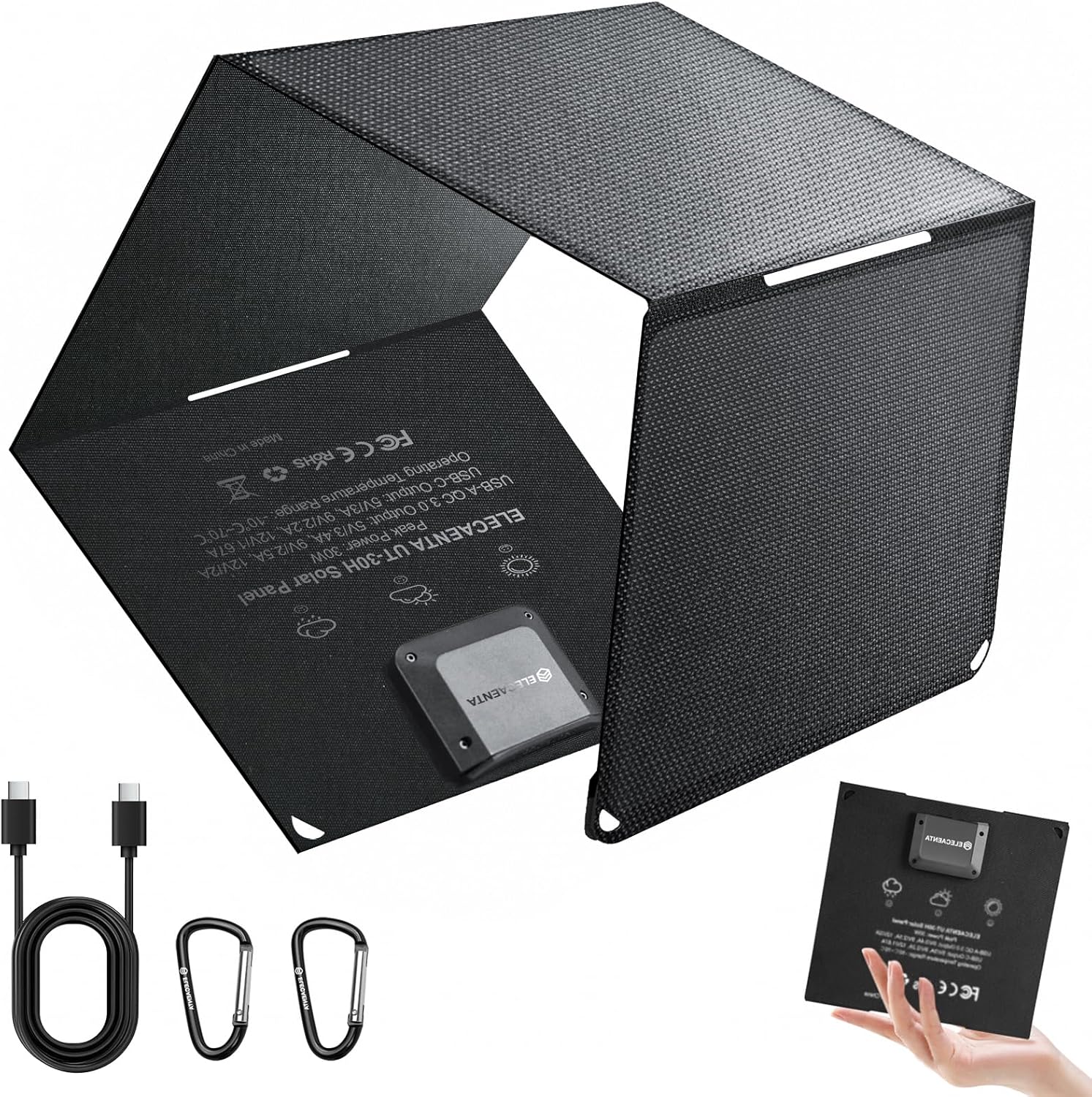
ELECAENTA UT-30H 30W Solar Panel
A lightweight solar charger with 25.4% conversion efficiency and dual USB-C/USB-A outputs, designed for camping and outdoor trips. Reviewers consistently report solid charging performance in sunlight, though real-world output depends on weather and panel positioning.
Pros
- Exceptionally lightweight and compact, highly portable for backpacking
- Delivers consistent 15-20W USB-C output in direct sunlight per verified buyers
- HPBC cells perform better than traditional panels on cloudy days and in heat
- Dual output ports allow charging two devices simultaneously without switches
- Durable ETFE laminate withstands outdoor conditions and mishandling
Cons
- Charging stops or significantly drops when partially shaded, requiring full sun exposure
- No carrying case included despite compact design
- Power output is slower than wall chargers; requires daylight and clear positioning to work optimally

RynoTuff 21W Foldable Solar Charger
A compact solar panel charger using high-efficiency SUNPOWER cells to deliver 22-25% energy conversion for two devices simultaneously via USB. Best suited for camping, hiking, and off-grid trips where direct sunlight is consistently available.
Pros
- Superior solar conversion efficiency compared to standard panels (22-25% vs typical 16-18%)
- True portability with minimal weight and fold-down design for travel
- Dual 2.4A USB outputs charge two devices at full speed simultaneously
- Weather-resistant construction holds up in outdoor conditions
Cons
- No internal battery means charging only works in direct sunlight, not viable for cloudy days or nighttime use
- Requires intentional positioning toward sun for optimal charging, adding setup friction
- Single Micro USB cable included limits charging flexibility without additional cables

ELECOM NESTOUT Solar-1 28W Dual USB Solar Charger
A compact, well-designed 28W solar charger with dual USB-A ports and high-efficiency SunPower cells, ideal for backcountry trips where weight matters. The integrated storage pouch and adjustable stands make it practical for camping and hiking, though the USB-A-only output limits compatibility with modern devices.
Pros
- Lightweight and compact when folded, packs efficiently into backpacks
- Built-in pouch and modular ecosystem integrate well with NESTOUT batteries
- Real-time power output display helps optimize panel angle and placement
- Durable water-resistant construction suitable for daily outdoor use
- Verified users report reliable fast charging on extended trips (10+ days)
Cons
- USB-A only, no USB-C port limits compatibility with newer phones and tablets
- Maximum advertised power (28W) only achieved when both ports are actively used
- Instructions provided in Japanese, not English, creating setup friction

FlexSolar 25W Portable Solar Panel Charger
A lightweight foldable solar charger designed for outdoor adventures and emergency backup power, featuring dual USB ports and 23.2% conversion efficiency. Real-world output varies with sunlight conditions, but reviewers confirm reliable performance for charging phones and power banks during camping and hiking trips.
Pros
- Ultracompact and light at 1.2 lbs with integrated carabiner system for easy backpack attachment
- Dual USB-A and USB-C ports allow simultaneous charging of two devices at 5V/3A each
- IP67 weatherproof rating withstands dust immersion, 1m water submersion, and heavy rain
- Triple-layer protective construction with 2000+ fold-cycle durability evaluation and hidden busbar technology reduces micro-cracks
- Folds to tablet-size dimensions making it practical for backcountry expeditions and emergency kits
Cons
- Real-world power output significantly lower than 25W spec in non-ideal conditions. Verified buyers measured 15W in moderate sun and note the rating applies only to perfect conditions
- Plastic connector box feels flimsy according to some reviewers and represents a potential failure point under field use
- Actual folded dimensions larger than marketing images suggest, with less neat panel alignment than depicted in product photos
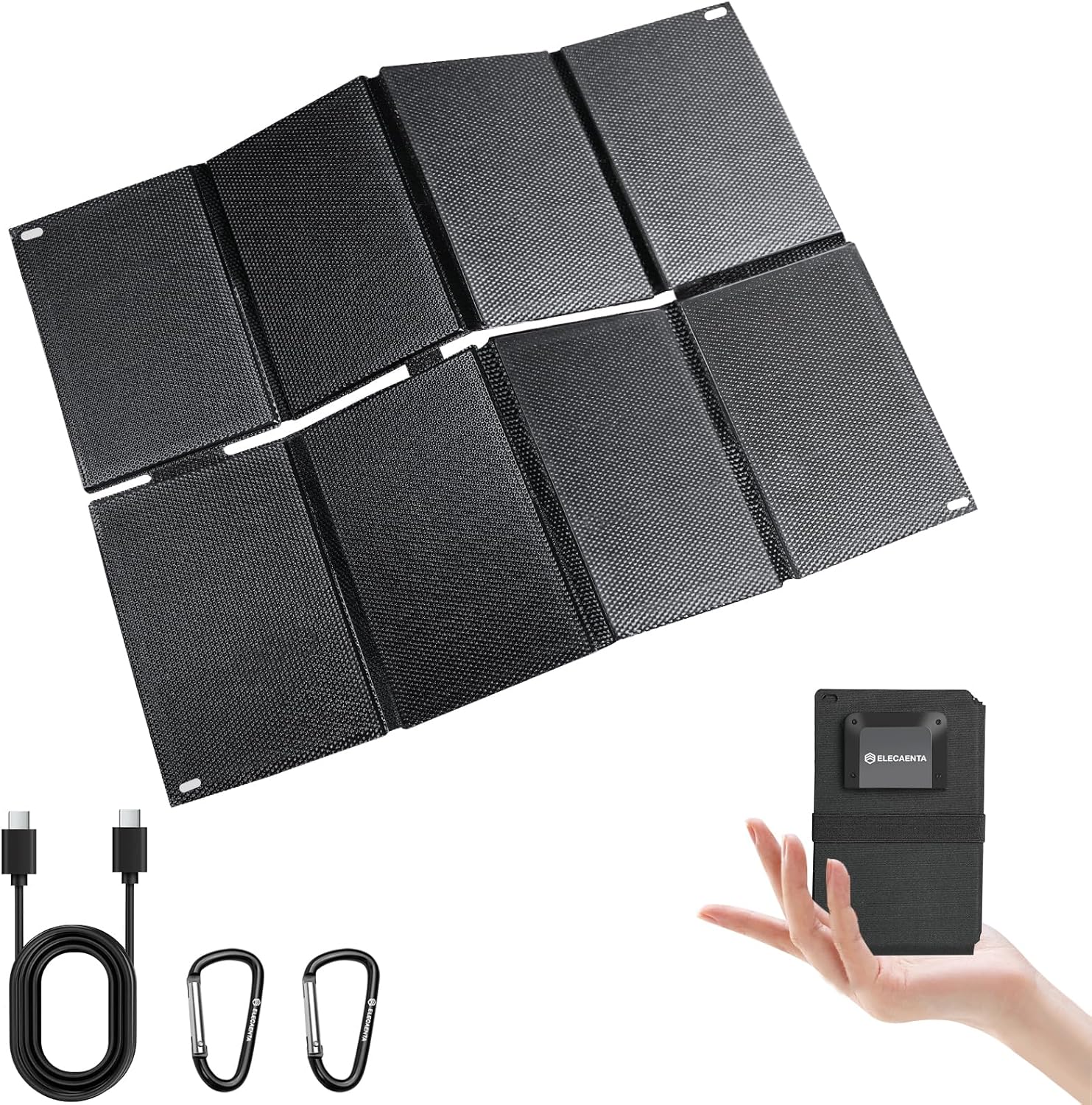
ELECAENTA UT-25H 25W Foldable Solar Charger
A genuinely portable solar panel at under a pound that delivers 18-19W real output in ideal sunlight, making it practical for outdoor trips and emergency backup. Best suited for supplemental charging rather than rapid power gains, and requires direct sun to be effective.
Pros
- Impressively light and compact for serious backpackers and campers prioritizing pack weight
- Real-world output of 18-19W via USB-C in direct sunlight is respectable for the form factor
- Well-built construction with heavy copper flex circuits suggests long-term durability
- Waterproof design handles light rain and outdoor conditions without damage
- Reasonably quick setup process with included carabiners for secure positioning
Cons
- Advertised 25W is peak power only; actual sustained output ranges 8-19W depending on sun angle and cloud cover, requiring realistic expectations
- Highly dependent on direct, uninterrupted sunlight; performance drops significantly with cloud cover or shade, limiting usability on overcast days
- Stiff flex circuits make panels curl when first unfolded, requiring rocks or weights to maintain proper sun alignment

FEELLE SPB2603 50000mAh Solar Power Bank with Hand Crank
A rugged 50000mAh solar charger built for extended outdoor trips and emergencies, featuring four solar panels, hand crank backup, built-in cables, and compass. Best for camping and multi-device scenarios where grid power is unavailable, though solar charging is slow and the unit is notably heavy.
Pros
- Massive 50000mAh capacity charges multiple devices (up to 6 simultaneously) and keeps phones charged for days on a single full charge
- Comprehensive connectivity with 4 built-in cables (USB-C, Lightning, Micro, USB-A) plus 3 ports eliminates need for separate cords
- Hand crank generator provides emergency backup power when sun and grid are unavailable
- Integrated compass, flashlight with SOS/strobe modes, and mounting hook add genuine outdoor functionality
- Durable construction with shockproof silicone bumpers, dustproof port covers, and 3-year warranty inspire confidence
- Fast USB-C charging delivers 0-60% on iPhone in 30 minutes via wall outlet
Cons
- Solar charging requires several hours in bright direct sunlight and produces minimal output on cloudy days, making it slower than wall charging
- Weighs 0.5kg and is bulky for daily carry, though manageable for dedicated camping trips
- Port cover is thin plastic with weak hinge design and can be fragile despite overall durability
Solar Chargers for Backpacking Buying Guide
Choosing a solar charger for backpacking is more nuanced than picking the panel with the highest wattage number. Output consistency in real-world conditions, packability, and port selection all matter as much as the spec sheet.
The subsections below walk through the criteria that most directly affect how useful a panel will actually be on the trail, based on the same framework our team uses when evaluating every product in this category.
Wattage and Real-World Charging Speed

Rated wattage is measured under Standard evaluation Conditions, a lab benchmark that assumes perfect perpendicular sunlight at a specific temperature and irradiance.
On the trail, output typically runs 60 to 80 percent of the rated figure on a clear day, and drops sharply under haze, partial cloud cover, or even a few degrees of off-angle mounting.
A panel rated at 25W might deliver a consistent 16 to 18W in practice, which is enough to top up a smartphone but may not keep pace with a large power bank.
As a practical rule, backpackers who want to charge a single smartphone during a day’s hike can work comfortably with a 20 to 28W panel.
Those managing multiple devices or a compact portable power station alongside their phone should look at 35W and above. Higher wattage panels are generally larger when unfolded, so balance speed against the physical footprint you’re willing to carry.
Pay attention to whether a panel uses standard monocrystalline cells or a newer HPBC (Hybrid Passivated Back Contact) architecture.
Panels from brands like ELECAENTA using HPBC cells advertise conversion efficiencies around 25.4 percent, which translates to more usable power from a smaller panel area. That efficiency premium matters most when pack space and weight are at a premium.
Weight and Packability

Weight is the single most contested tradeoff in backpacking gear, and solar chargers are no exception. A panel that lives strapped to the outside of your pack needs to be light enough that you actually keep it there all day.
The lightest options reviewed here come in under one pound, and a few HPBC-cell panels push below 0.9 lbs while still delivering 25W, which is genuinely impressive for a folding panel.
Heavier panels above 1.5 lbs are better suited to basecamp setups or car-camping trips where you can leave the panel deployed while you move around camp.
Folded dimensions matter too. A panel that folds down to roughly the size of a hardcover book can slip into a side pocket or lash flat to a pack.
Panels with more folds and a larger deployed area will pack smaller relative to their output. Check whether attachment points, such as carabiner loops or corner grommets, are included.
Attaching the panel to the back of your pack while hiking is the most efficient way to harvest daylight on the move, and flimsy attachment points are a common point of failure cited in verified buyer reports.
Port Selection and Output Protocols
The combination of ports on a panel determines which devices it can charge and how quickly. USB-A alone is increasingly limiting; many modern smartphones and tablets charge fastest over USB-C with Power Delivery.
Look for panels that include at least one USB-C port with PD support alongside a USB-A port.
Panels offering USB-C PD at 25W or higher can fast-charge compatible iPhones and Android flagships at near wall-speed, which is useful on longer lunch breaks.
Some panels also include a DC output, which is specifically useful if you’re pairing the panel with a power bank or a small portable generator that accepts a dedicated solar input.
DC input typically allows higher charging current than USB, reducing the time needed to top up a larger battery. If you plan to charge anything beyond phones and earbuds, confirm DC output is available before purchasing.
For users managing a mix of devices, panels with independent charge controllers on each port prevent a slow device from dragging down the output to a fast-charging one.
Water and Weather Resistance

Weather in the backcountry is unpredictable, and a solar charger that stops working the moment clouds roll in and mist starts falling is a liability. Look for an IP rating on the panel itself, not just the cable or ports.
IP67 and IP68 ratings indicate the panel can handle rain, splashing, and brief submersion without damage. Several of the picks here, including options from BigBlue and GEYOTO, carry IP68 certification, which is the highest practical standard for outdoor electronics.
Beyond IP ratings, evaluate the panel fabric. Ripstop nylon and reinforced PET laminates hold up better to repeated folding, abrasion against pack fabric, and the occasional thorn or branch.
Some panels use a hard-shell plastic housing for the folded unit, which protects the cells during transport but adds weight.
Softer textile-faced panels tend to be lighter and more packable, while the rigid formats are more durable when laid on rough ground.
Integrated Storage vs. Panel-Only Designs

Not all solar chargers are panels only. Some products combine a solar panel array with an integrated battery, giving you a charge buffer for times when the sun isn’t cooperating.
The FEELLE Solar Power Bank in this roundup, for example, pairs four solar panels with a 50000mAh battery and a hand-crank backup, which means you have stored energy to draw from after dark or during stretches of cloud cover.
This approach trades weight and bulk for self-sufficiency.
At the other end of the spectrum, a panel-plus-separate-power-bank setup gives you more flexibility: you can leave the bank charging while you hike, then use it at camp. This is the more weight-efficient approach for most backpacking trips.
If you’re planning longer expeditions or want a single all-in-one unit, an integrated solar generator like the Anker SOLIX C200 DC offers significantly more stored capacity alongside its panel, at a higher price and weight.
Match the format to the length and style of your trip rather than defaulting to the highest-capacity option.
Value and Long-Term Reliability
Solar panels degrade over time. Most quality monocrystalline panels retain around 80 percent of their original output after several hundred charge cycles and years of UV exposure, but lower-quality cells can degrade faster.
Buying from brands with established warranty programs and a track record of customer support matters more here than it might for a simple cable or case.
BigBlue, FlexSolar, and ELECAENTA have larger verified buyer pools and more documented long-term ownership experiences than some newer entrants, which helps when assessing reliability over years rather than weeks.
Value is not purely about price. A lighter, more efficient panel at a moderate price point often delivers better value for a serious backpacker than a heavier, cheaper option that adds meaningful grams to a carefully curated kit.
Consider cost-per-watt and cost-per-gram as secondary metrics alongside the absolute price. A well-built panel that works reliably across dozens of trips is cheaper in the long run than replacing a budget option every season.
If you rely on your phone for navigation the same way you’d rely on a dedicated action camera for documentation, your charger deserves the same level of investment.
Why You Should Trust Us
REMOVU is an independent review platform. We do not manufacture, retail, or take direction from brands.
Every product in this guide was assessed using the REMOVU Score, a consistent 0 to 10 rating scale applied across the same set of criteria: efficiency and real-world output, weight and packability, port configuration and charging protocols, weather resistance, build quality, and verified owner satisfaction.
Scores reflect the balance of all these factors, not a single headline specification.
We do not conduct our own product trials; our evaluations are grounded in research, published data, expert review consensus, and verified buyer feedback.
When expert reviewers in the outdoor gear community reach consistent conclusions about a panel’s real-world performance or a known failure mode, that consensus carries significant weight in our scoring.
Verified buyer feedback from confirmed purchasers surfaces practical issues, such as attachment loop durability or charge-controller inconsistency, that rarely appear in manufacturer specifications.
REMOVU may earn a commission if you purchase through a link on this page. That affiliate relationship has no bearing on which products are included, how they are ranked, or the scores they receive.
Our rankings reflect research merit, not commercial arrangements. If a product scores lower than a competing option, it appears lower in the list regardless of margin or brand relationship.
Final Thoughts
The solar chargers for backpacking in this roundup span a wide range of use cases, from ultralight single-device panels for minimalist hikers to full power-station setups for basecamp expeditions.
Here are the standout picks by use case, each linked to its Amazon listing for current pricing and availability.
- Best Overall: Anker SOLIX C200 DC Power Bank Station and 60W Solar Panel. The highest REMOVU Score in this roundup reflects its combination of serious stored capacity, a capable integrated panel, and LiFePO4 battery chemistry that holds up across hundreds of cycles. It is the pick for backpackers who want a complete off-grid power solution rather than a panel alone.
- Best Lightweight Panel: BigBlue 28W Solar Panel Charger. A consistently strong performer in the panel-only category, earning one of the highest REMOVU Scores among standalone folding panels. Its dual-port setup and proven reliability across a large verified buyer base make it a dependable everyday trail companion.
- Best for Ultralight Backpacking: BoltStar 40W Solar Panel Charger. Matching the BigBlue on REMOVU Score while delivering 40W in an ultra-lightweight form factor, this panel is the pick for backpackers who want higher wattage without sacrificing much on pack weight.
- Best Budget Pick: FlexSolar 25W Ultra-Portable Solar Panel Charger. The most affordable entry in the roundup, well suited to occasional day hikers or those new to solar charging who want a capable, no-fuss panel at an accessible price point.
- Best Solar Power Bank Combo: FEELLE Solar Power Bank 50000mAh. For backpackers who want stored energy on demand rather than pass-through charging, this integrated battery-and-panel unit with hand-crank backup offers the most self-sufficient package in the lineup.
Whatever your trail style, matching panel wattage to your actual device load, weight budget, and trip length will matter more than chasing the highest-rated option.
Use the buying guide above to calibrate, and refer back to the full ranked list for the complete picture on each pick. For broader power and charging coverage, browse our Power and Charging hub.
Frequently Asked Questions
How Many Watts Do I Actually Need to Charge My Phone While Backpacking?
For a single smartphone, a 20 to 28W panel is generally sufficient under good sun conditions. A 28W panel running at real-world efficiency can fully charge most phones in two to three hours of direct sun.
If you’re also charging a GPS unit, earbuds, or a small power bank alongside your phone, moving up to a 35W or 40W panel gives you the headroom to handle multiple devices without bottlenecking on a single port.
Can I Charge a Power Bank Directly from a Solar Panel?
Yes, and this is actually one of the most practical setups for backpacking. You lash the panel to the outside of your pack while hiking and let it slowly fill a power bank throughout the day.
At camp, you use the stored battery to charge devices quickly and reliably, even after sundown. Panels with a DC output port can charge compatible power banks faster than USB alone.
Confirm your power bank accepts solar input and check whether its charge controller supports variable-input sources before pairing the two.
Do Solar Chargers Work on Cloudy Days?
They produce power, but output drops significantly. Under heavy overcast, a panel may generate only 10 to 25 percent of its rated output. Light cloud cover or haze is less damaging, typically reducing output to around 50 to 70 percent.
For multi-day trips in regions with variable weather, this is a strong argument for using the panel to charge an intermediate power bank rather than charging devices directly.
The bank buffers the inconsistency and gives you reliable charge when you need it, regardless of current sky conditions.
Is an IP68 Rating Really Necessary for a Trail Solar Panel?
It is not strictly necessary for every hiker, but it meaningfully expands the panel’s useful life and reduces anxiety on trips where rain is possible. IP67 is adequate for most conditions, providing splash and rain resistance.
IP68 adds a margin of safety for river crossings, sudden downpours, or accidental drops in shallow water.
If you hike in the Pacific Northwest, mountain regions, or anywhere with afternoon thunderstorms, the extra investment in an IP68-rated panel is worth considering.
What Is the Difference Between a Solar Charger and a Solar Generator for Backpacking?
A solar charger (or solar panel) converts sunlight to electricity in real time and passes it directly to a connected device or battery.
A solar generator combines a solar panel with an integrated battery, an inverter, and multiple output ports, essentially a portable power station with a built-in charging source.
Solar generators like the Anker SOLIX C200 DC store significantly more energy and can power devices with higher wattage requirements, but they are heavier and larger.
For ultralight backpacking, a panel-only charger paired with a compact power bank is the more common choice. Solar generators make more sense for basecamp setups, overlanding, or emergency preparedness at home.
You can explore the broader category in our portable power stations guide.
How Should I Position a Solar Panel on My Pack for Best Results?
The goal is to keep the panel as close to perpendicular to the sun as possible throughout the day.
Lashing it flat against the back panel of your pack works reasonably well when the sun is high overhead, but output drops as the angle deviates.
Some hikers tilt the panel by tucking gear or a stuff sack underneath one edge.
Panels with built-in adjustable kickstands are useful during rest stops and lunch breaks when you can set the panel on a rock or log and dial in the angle manually.
Avoid shading even a small corner of the panel; partial shading can disproportionately reduce total output depending on how the cells are wired.
About the author
Hannah writes about video doorbells for REMOVU, comparing video quality, smart alerts, and subscription value. She helps readers keep an eye on the porch without overpaying for storage.