The 8 Best Ups Battery Backups for Gaming PC
Power outages and voltage spikes can damage a gaming PC fast. These UPS battery backups offer reliable runtime, pure sine wave output, and AVR to keep your rig protected.
 By Bobbie Silva
Updated July 26, 2026
By Bobbie Silva
Updated July 26, 2026
A sudden power outage or voltage spike can corrupt game saves, damage storage hardware, and shorten the life of expensive components inside a gaming PC.
Unlike a basic surge protector, an uninterruptible power supply gives your rig enough battery-backed runtime to save your progress and shut down safely, while also conditioning incoming power so your GPU and CPU never see a dirty electrical signal.
For high-wattage gaming systems, choosing the right UPS is one of the most practical investments you can make in protecting gear worth hundreds or thousands of dollars.
This guide pulls together the top-rated UPS battery backups suited for gaming PCs, evaluated through REMOVU’s research-based approach: we analyze published specifications, synthesize consensus from expert reviewers across the industry, and weigh verified buyer feedback to produce a REMOVU Score for each model.
Whether you’re running a mid-range build or a flagship rig with a power-hungry GPU, the picks below represent the most dependable options available right now.
| Award | Product | REMOVU Score About REMOVU ScoreThe REMOVU Score is our own rating from 0 to 10, based on performance, design and build, ease of use, and value. It reflects independent research and is never influenced by manufacturers, retailers, or affiliate commissions. Learn more › | Price | |
|---|---|---|---|---|
| Best Overall |
 CyberPower CP1500PFCLCD 1500VA Pure Sine Wave UPS
|
8.9/10 | Buy | |
| Best Premium |
 APC BR1500MS2 Back-UPS Pro 1500VA Pure Sine Wave UPS
|
8.4/10 | Buy | |
| Best Budget |
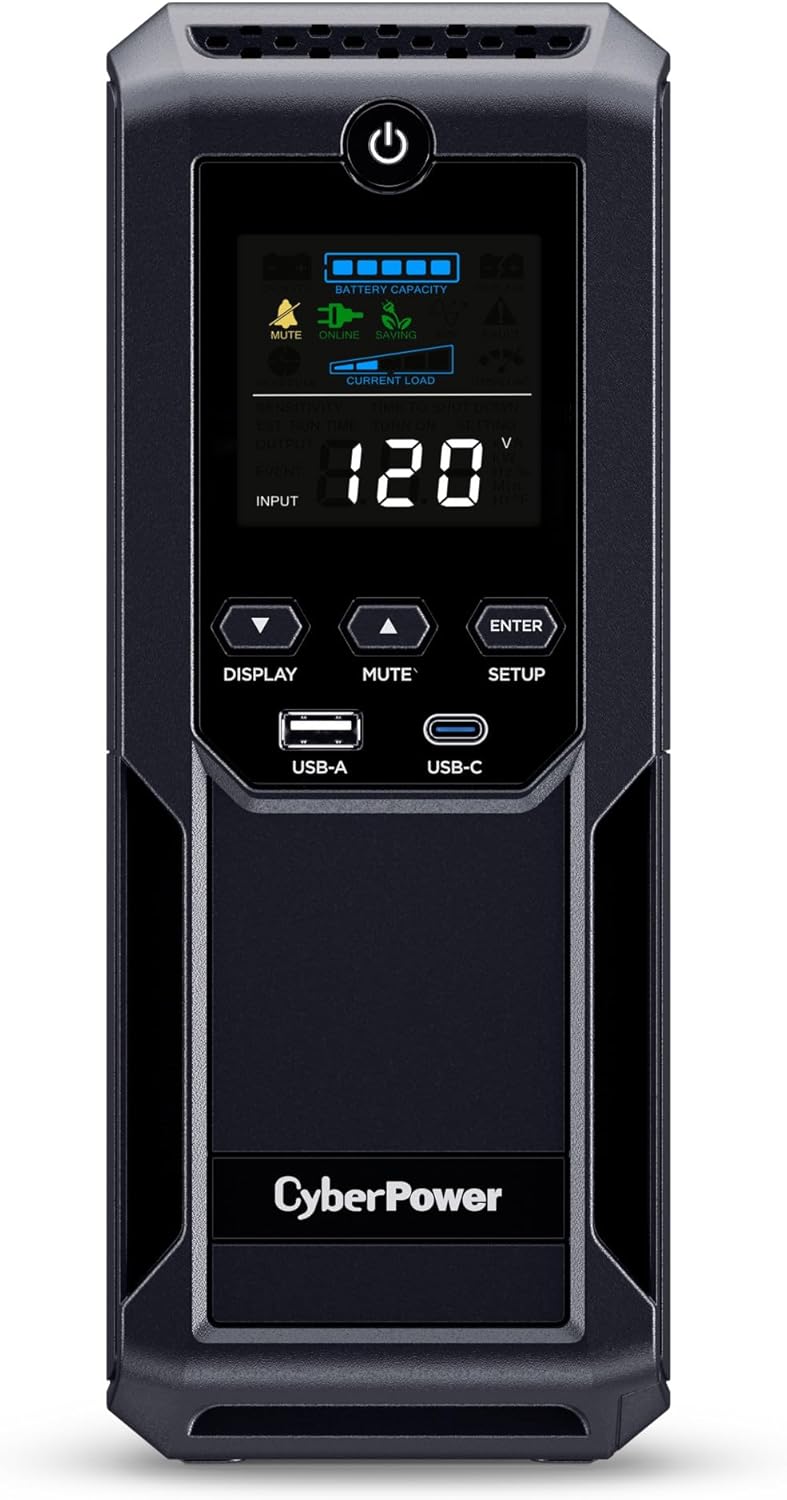 CyberPower CP1500AVRLCD3 1500VA UPS with LCD Display
|
8.6/10 | Buy | |
 APC Back-UPS Pro BX1500M 1500VA UPS
|
8.5/10 | Buy | ||
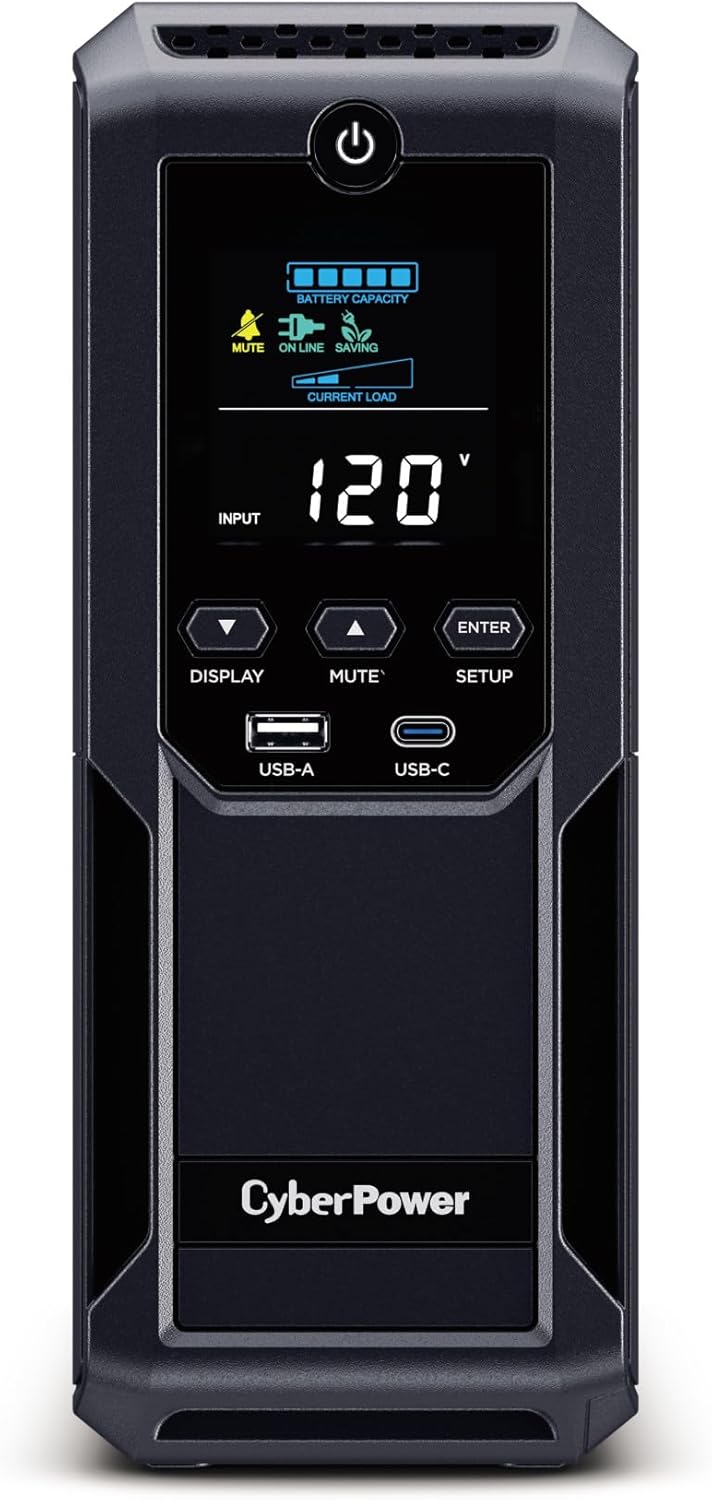 CyberPower BRG1500AVRLCD2 1500VA UPS with AVR
|
7.4/10 | Buy | ||
| Best Value |
 APC BX1350M 1350VA Back-UPS Pro
|
7.3/10 | Buy | |
 CyberPower PR1500LCD 1500VA Smart Sinewave UPS
|
6.2/10 | Buy | ||
 APC Back-UPS BE600M1 600VA Battery Backup
|
6.2/10 | Buy |
CyberPower CP1500PFCLCD 1500VA Pure Sine Wave UPS
A line-interactive UPS with pure sine wave output and AVR, designed for PFC-compatible equipment like gaming PCs, workstations, and network gear. Delivers 1000W capacity with 12 outlets (6 battery-backed, 6 surge-only), a color LCD display, and dual USB charging ports, backed by a 3-year warranty and strong user reliability ratings.
Pros
- Pure sine wave output compatible with active PFC power supplies, including high-end gaming and Mac systems
- Solid runtime at partial load, 10 minutes at half load, with real-time watt and runtime estimates on color LCD
- 12 total outlets with 6 battery backup and surge protection plus 6 surge-only outlets, plus USB-A and USB-C charging
- AVR reduces unnecessary battery drain during minor voltage fluctuations
- Affordable pricing relative to comparable pure sine wave UPS units, #1 best seller in its category
Cons
- Runtime significantly shorter at full load, only 2.5 minutes at 1000W draw, limiting use for sustained high-power scenarios
- Internal charging circuit can fail after several years of use, though batteries are user-replaceable
- Software must be downloaded separately from CyberPower website, not included, adding setup friction for users unfamiliar with UPS management
APC BR1500MS2 Back-UPS Pro 1500VA Pure Sine Wave UPS
A pure sine wave UPS designed for PCs, gaming setups, and home offices that delivers stable backup power with 1500VA capacity and 10 outlets. Includes automatic voltage regulation to protect against brownouts, an LCD display showing real-time runtime and load, and user-replaceable batteries for extended lifespan.
Pros
- Pure sine wave output protects sensitive electronics and modern PCs better than simulated sine wave units
- 10 outlets (6 battery-backed, 4 surge-only) plus coax and Ethernet surge protection covers most home setups
- Automatic voltage regulation (AVR) corrects voltage fluctuations without draining battery
- LCD display shows remaining runtime, wattage draw, and battery health in real time
- User-replaceable battery (APCRBC163) extends UPS lifespan beyond the typical 3-5 year battery life
- Active PFC compatible, works reliably with modern power supplies
Cons
- Runtime is limited to around 45 minutes at 150W load and shorter under heavier loads, requiring external power for extended outages
- Uses sealed lead-acid batteries instead of modern LiFePO4 chemistry, requiring replacement every 3-5 years depending on usage
- Some units have reported electrical component odor on startup that may persist, though affected customers received replacements via strong warranty support
CyberPower CP1500AVRLCD3 1500VA UPS with LCD Display
A mid-range UPS designed for home offices and small server setups, offering 12 outlets (6 battery-backed) and a color LCD panel to monitor power conditions. Delivers adequate runtime for graceful shutdowns during outages and voltage regulation to prevent power fluctuations.
Pros
- Solid runtime on half load (12 minutes) provides adequate time to save work and shut down systems gracefully
- AVR feature extends battery life by avoiding unnecessary battery drain during minor power fluctuations
- Easy setup with batteries pre-charged and straightforward front-panel controls
- Comprehensive warranty with $500,000 Connected Equipment Guarantee offers financial protection
- Reviewers report reliable performance across multiple outages with negligible interruption to connected devices
Cons
- Only 3-minute runtime at full load limits usefulness during extended outages for high-power systems
- Outlet spacing is tight, preventing simultaneous use of all 6 battery-backed outlets for bulky power plugs
- Simulated sine wave output may cause compatibility issues with sensitive audio/video equipment compared to pure sine wave models
APC Back-UPS Pro BX1500M 1500VA UPS
A reliable 1500VA battery backup with 10 outlets and LCD display, designed for home offices and small business setups needing protection against outages and power fluctuations. Delivers up to 68 minutes of runtime at 100W load, with automatic voltage regulation to handle brownouts without draining the battery.
Pros
- Strong runtime performance and capacity suitable for powering computers, routers, and networking gear simultaneously
- AVR feature extends battery life by stabilizing voltage fluctuations rather than relying on battery power alone
- Trusted APC brand with long user history; many reviewers report years of reliable operation
- Compact tower design fits on desks without taking excessive space
- Built-in Ethernet and coaxial surge protection for modems and network equipment
Cons
- Lead-acid battery has shorter lifespan (approximately 3-5 years) compared to lithium alternatives, requiring eventual replacement at additional cost
- Some users report intermittent false battery depletion alerts and loud alarms during self-reviews, though power cycling typically resolves the issue
- Runtime varies significantly based on connected load; rated 68 minutes only at 100W, dropping substantially with heavier loads
CyberPower BRG1500AVRLCD2 1500VA UPS with AVR
A line-interactive UPS designed for home networks, PCs, and entertainment systems, offering 1500VA/900W capacity with automatic voltage regulation to protect against power fluctuations. Six battery-backed outlets, color LCD display, and included PowerPanel management software make it suitable for users in areas prone to outages or brownouts.
Pros
- AVR effectively handles voltage fluctuations without draining battery, beneficial for areas with unstable power
- Dual USB ports (Type-A and Type-C) charge mobile devices during outages
- Color LCD display shows detailed power conditions and alerts before problems affect equipment
- Strong verified buyer feedback on protecting home networks, NAS systems, and internet connectivity during outages
- Compact mini-tower form factor fits easily in home office setups
Cons
- Short runtime at full load (2 minutes), limiting use to graceful shutdowns rather than extended operation of power-hungry devices
- Not recommended for sump pumps, laser printers, or other high-power equipment due to 900W capacity constraint
- Simulated sine wave output (not pure sine) may be incompatible with certain sensitive electronics
APC BX1350M 1350VA Back-UPS Pro
A mid-range UPS designed for home offices and small workstations, offering 10 outlets with automatic voltage regulation and 54 minutes of backup runtime at 100W load. Best suited for users needing reliable protection for PCs, routers, and networked devices without heavy industrial demands.
Pros
- AVR technology stabilizes voltage fluctuations (brownouts and surges up to +/-13%) without using battery power, extending runtime during blackouts
- 10 outlets with coaxial and Ethernet surge protection cover most home office setups in one unit
- User-replaceable battery cartridge (sold separately) avoids costly full unit replacement and downtime
- LCD display provides clear visibility into battery status and runtime remaining for peace of mind
- Compact tower design and 3-Year Warranty with $75,000 Equipment Protection offer solid assurance
Cons
- 54-minute runtime at 100W load is modest for higher-wattage loads (runtime scales down significantly with increased power draw)
- No user reviews available to evaluate real-world reliability and customer satisfaction
- Sealed Lead Acid battery requires periodic replacement and does not support lithium alternatives for extended lifespan
CyberPower PR1500LCD 1500VA Smart Sinewave UPS
Line-interactive UPS with pure sine wave output and automatic voltage regulation, designed to protect servers, networking equipment, and sensitive electronics during power outages. Offers 15+ minutes runtime at half load with 8 battery-backed outlets, extendable LCD display, and management software included.
Pros
- True sine wave power delivery prevents motor noise and equipment damage compared to simulated waveforms
- AVR feature eliminates unnecessary battery drain during common voltage fluctuations
- Removable display panel allows convenient placement away from main unit for better visibility
- Robust build quality with metal enclosure and proven long-term reliability across verified owner accounts
- Estimated 15+ minute runtime at half load provides adequate window for safe shutdown or generator switchover
Cons
- Battery runtime drops to 4.7 minutes at full 1500W load, limiting protection window for sustained high-power demands
- Not recommended for devices with high inrush loads like laser printers, copiers, or space heaters
- Premium pricing reflects robust feature set; some users note cost is high relative to capacity compared to competing models
APC Back-UPS BE600M1 600VA Battery Backup
Compact UPS that keeps computers, routers, and modems running for about 23 minutes during outages at 100W load, with built-in surge protection across 7 outlets and USB charging. Rated 4.5 stars from nearly 30,000 verified buyers, with most praising reliability and quiet operation.
Pros
- Proven long-term reliability: multiple verified buyers report 8+ years of continuous use with minimal issues
- Quiet operation and instant failover prevents disruption to connected devices
- Well-spaced outlets accommodate larger power adapters without blocking adjacent sockets
- Straightforward setup with battery arriving pre-charged
- Responsive customer service with warranty replacements for out-of-warranty units
Cons
- Intermittent beeping occurs when operating on battery power, which some users find annoying (can be disabled)
- 23-minute runtime only sufficient for graceful shutdown at typical computer loads, not extended operation
- Must plug directly into wall outlet for optimal performance; extension cords can trigger battery mode unnecessarily
UPS Battery Backups for Gaming PC Buying Guide
Picking a UPS for a gaming PC involves more than just grabbing the highest VA rating on the shelf.
Gaming rigs draw variable loads depending on what’s happening on screen, and the components inside deserve clean, stable power at every wattage level.
The sections below walk through each criterion that separates a great UPS from a mediocre one for this specific use case.
VA Rating and Wattage: Match the Load, Not the Marketing

VA (volt-ampere) is the headline number on every UPS box, but the watt figure is what actually governs how long your system runs on battery.
Most gaming PCs draw somewhere between 300W and 700W at full load, depending on the GPU and CPU combination.
A general rule of thumb is to choose a UPS whose watt rating is at least 20 to 25 percent higher than your system’s measured peak draw, so the unit never operates at its ceiling.
For a mainstream gaming rig, a 1500VA/900W unit covers the majority of mid-range builds with headroom to spare.
High-end systems pairing a flagship GPU with a demanding CPU may need to step up to a 1500VA/1000W or higher model.
You can find your system’s real-world draw by checking the GPU manufacturer’s TDP specs and adding the rest of the system’s power budget, or by consulting your PSU’s efficiency curve at typical load.
Runtime on battery matters less for gaming than for workstations, since the main goal is safe shutdown rather than continued play.
Even so, a unit that delivers five to ten minutes at your system’s actual load gives you comfortable margin to save progress and power down gracefully.
Models that support external battery packs can extend this window significantly if your setup demands it.
Pure Sine Wave vs. Simulated Sine Wave
This distinction matters more for gaming PCs than almost any other device category. Modern gaming power supplies, particularly those with Active Power Factor Correction (PFC), are engineered to work with the smooth, continuous waveform of utility power.
When a simulated sine wave UPS switches to battery, it produces a stepped approximation of that waveform that some PFC PSUs tolerate poorly, leading to instability, unexpected shutoffs, or long-term efficiency losses.
A pure sine wave UPS outputs power on battery that is electrically identical to what comes from the wall.
For any gaming PC with a quality PSU, and especially for one with an 80 Plus Gold or Platinum certified unit, a pure sine wave model is strongly recommended.
Several of the picks in this guide are pure sine wave units specifically for this reason, including the top-rated CyberPower CP1500PFCLCD and the APC Back-UPS Pro BR1500MS2.
Simulated sine wave units are generally less expensive, and they work reliably with many older or simpler power supplies.
If budget is a genuine constraint and your PSU lacks Active PFC, a simulated sine wave model at the right wattage can still provide adequate surge and outage protection.
But for any modern gaming build, the pure sine wave premium is worth it.
Automatic Voltage Regulation
Automatic Voltage Regulation, or AVR, is the feature that corrects brownouts and overvoltages without switching to battery power.
In areas with unstable grid power, this is genuinely important: without AVR, every voltage sag forces the UPS to burn battery cycles, shortening the battery’s usable life and potentially leaving you without backup power when you actually need it.
All of the models in this roundup include AVR, which is now a baseline expectation for any UPS marketed toward PC use. What varies is the correction range.
Look for a unit that handles a wide input voltage window before switching to battery, ideally correcting from roughly 75V to 150V on the low end and up to around 150V on the high end, depending on your regional grid voltage.
CyberPower and APC both publish these ranges in their datasheets, and it’s worth cross-referencing them against the power quality in your area.
For gaming PCs paired with high-refresh-rate displays, AVR also smooths out the micro-fluctuations that can cause monitor flicker or audio hum through connected speakers or headsets. It’s a background benefit that pays dividends even on days when there’s no outage at all.
Outlet Count, Layout, and USB Charging
A gaming PC setup typically involves the PC itself, one or two monitors, speakers or a DAC, a router or switch, and various peripherals.
The UPS needs enough outlets to cover every device you want protected, and ideally separates battery-backed outlets from surge-only outlets so you can prioritize which devices actually draw from the battery during an outage.
Most 1500VA models in this category offer 10 to 12 outlets.
The better-designed units, like the CyberPower CP1500AVRLCD3 and the APC BX1500M, give you a mix of battery plus surge outlets and surge-only outlets, letting you plug your monitors and router into surge protection without running down the battery on devices that don’t need runtime.
This layout discipline can meaningfully extend how long your PC stays live during an outage.
Integrated USB charging ports have become a standard feature on newer models, and some units now include both USB-A and USB-C ports. For a gaming desk where you’re also charging controllers, headsets, or a phone, this is a convenient bonus.
Just verify that the UPS’s USB ports remain powered during an outage if you intend to rely on them for charging while the battery is active.
Display, Software, and Monitoring

An LCD panel on the front of the UPS gives you real-time visibility into load percentage, estimated runtime, input voltage, and battery health.
For a gaming setup where the UPS may sit under a desk or beside a tower, a clear display with readable numbers in ambient lighting is genuinely useful rather than just decorative.
Models with color LCDs, such as the CyberPower CP1500PFCLCD, make it easier to spot anomalies at a glance.
Companion software is worth considering if you want the UPS to trigger an automatic safe shutdown when battery drops to a set threshold.
Both CyberPower’s PowerPanel and APC’s PowerChute provide this capability, and they log power events over time so you can identify patterns in your local grid quality. Connection is typically via USB, and setup on Windows is straightforward with either platform.
For users who want network-level monitoring, select models support SNMP management cards, which allow the UPS to be integrated into a home network management setup.
This is overkill for most gaming PCs but relevant for gamers who also run local servers or NAS devices alongside their gaming rig.
Battery Replaceability and Warranty

The sealed lead-acid battery inside a UPS typically lasts three to five years under normal conditions. After that, the unit needs a fresh battery or it becomes a very expensive surge strip.
User-replaceable batteries matter a great deal here: models that allow hot-swap or tool-free battery replacement let you extend the UPS’s service life for the cost of a replacement cell rather than an entirely new unit.
APC’s Back-UPS Pro line has made user-replaceable batteries a selling point, and the BR1500MS2 explicitly markets this feature. CyberPower’s BRG1500AVRLCD2 backs its battery with a five-year warranty, which is among the best coverage in this price tier.
When comparing models at similar price points, warranty length and replacement battery availability are practical differentiators that affect the total cost of ownership over a five-year horizon.
When purchasing a UPS, also check whether the manufacturer offers a connected equipment guarantee, which covers damage to devices caused by a failure of the UPS during normal operation. Most reputable brands offer this, but the coverage limits vary widely.
For a gaming PC with an expensive GPU, it’s worth noting the dollar limit of that guarantee before committing to a model.
Why You Should Trust Us
REMOVU is an independent review publication. We do not sell the products we cover, and we have no commercial relationship with any manufacturer that influences our rankings or recommendations.
Every model in this guide was scored using the REMOVU Score, a 0 to 10 scale applied consistently across all UPS units we evaluate.
The criteria include power output and waveform quality, AVR capability, outlet configuration, battery replaceability, display and software, warranty terms, and the real-world experience reported by verified buyers.
We do not conduct our own product trials; our evaluations are grounded in research, published data, expert review consensus, and verified buyer feedback.
Where manufacturers publish technical datasheets, we cross-reference those against independent assessments from experienced reviewers across the industry and long-term ownership reports from buyers who have used these units through actual outages.
This approach lets us assess reliability and performance at a scale no single reviewer could achieve alone.
REMOVU may earn a commission if you purchase through a link in this article. That affiliate relationship has no effect on REMOVU Score, product ranking, or editorial selection. Products are ranked on the merit of our research findings, not on commission rate or commercial arrangement.
Final Thoughts
After evaluating the full field of UPS battery backups suited for gaming PCs, a handful of models stand out clearly for different budgets and use cases. Here are our top picks with the reasoning behind each award:
- Best Overall: CyberPower CP1500PFCLCD PFC Sinewave UPS earns the top REMOVU Score in this roundup by combining a true pure sine wave output, strong AVR, a practical 12-outlet layout, and a clear color LCD, making it the most complete UPS for gaming PC protection at a mid-range price.
- Best for High-End Gaming Rigs: APC Back-UPS Pro BR1500MS2 delivers pure sine wave power with USB-C charging and a user-replaceable battery in a polished package from one of the most trusted names in power protection, earning one of the highest REMOVU Scores in this group.
- Best Value Pick: CyberPower CP1500AVRLCD3 offers a competitive REMOVU Score at a budget-friendly price point, with 12 outlets, dual USB ports, and solid AVR performance that makes it an easy recommendation for gamers who want dependable protection without overspending.
- Best for Home Office Gaming Setups: APC Back-UPS Pro BX1500M balances a generous outlet count, long runtime at lighter loads, and a well-regarded APC pedigree, scoring strongly for setups that mix gaming hardware with work peripherals on the same desk.
- Best Entry-Level Option: APC BE600M1 UPS is the right starting point for gamers on a tight budget who need basic battery backup for a router, modem, or secondary PC, with a REMOVU Score that reflects its straightforward, reliable performance at a compact scale.
No matter which model you choose, pairing a quality UPS with the rest of your build is a smart long-term decision. A gaming rig assembled with care deserves protection that matches that investment.
If you’re still building or upgrading your system, our guide to SSDs for gaming covers another critical component worth choosing carefully, and DDR5 and DDR4 32GB RAM kits are worth reviewing if you’re planning a fresh build alongside your new UPS.
Frequently Asked Questions
Do I Really Need a Pure Sine Wave UPS for My Gaming PC?
For any gaming PC with a modern power supply, especially one with Active PFC, a pure sine wave UPS is strongly recommended.
Simulated sine wave units can cause instability or unexpected shutoffs with PFC-equipped PSUs when the unit switches to battery.
Pure sine wave models eliminate this risk entirely, and the price premium over simulated sine wave alternatives has narrowed significantly in recent years.
What Size UPS Do I Need for a Gaming PC?
A 1500VA/900W UPS covers the majority of mid-range gaming builds, including a monitor and peripherals, with comfortable headroom.
High-wattage systems, such as those pairing a flagship GPU with a top-tier CPU, may benefit from a 1500VA/1000W model or higher.
Always size your UPS based on the actual watt draw of your system at load, not the VA figure alone, and leave at least 20 percent headroom above your measured peak draw.
Can I Use a UPS With a Gaming Monitor as Well as My PC?
Yes, and it’s recommended. Plugging your gaming monitor into a battery-backed outlet on your UPS ensures your display stays active long enough to save and shut down properly.
Many 1500VA units with 10 to 12 outlets provide enough capacity to run both the PC and one or two monitors simultaneously during an outage. Just account for the monitor’s wattage when calculating your total load.
How Often Should I Replace the Battery in My UPS?
Most UPS sealed lead-acid batteries reach the end of their useful life after three to five years, depending on the number of discharge cycles, ambient temperature, and how deeply the battery is discharged during outages.
Many units will alert you via a front-panel indicator or companion software when battery health degrades.
Replacing the battery promptly keeps your protection fully functional; models with user-replaceable batteries make this process straightforward and cost-effective without requiring a full unit replacement.
Will a UPS Protect Against All Power Problems?
A UPS with AVR handles the most common power problems: outages, brownouts, overvoltages, and surges.
It does not protect against sustained, extreme events like direct lightning strikes to your home’s electrical panel, though surge protection within the unit provides a meaningful layer of defense for standard transient spikes.
For complete peace of mind, use the UPS in combination with a properly grounded outlet and, if you live in a lightning-prone area, consider a whole-home surge arrester at the breaker panel as an additional measure.
Does a UPS Work for Gaming Laptops or Consoles Too?
A UPS can protect any plug-in device, including gaming laptops and consoles, as long as the total load stays within the unit’s watt rating. Laptops draw far less power than desktop PCs, so a single UPS can often cover a laptop, a monitor, and a network switch simultaneously with runtime to spare.
Consoles pair well with a mid-capacity UPS for the same reason: they draw moderate wattage and benefit from surge protection and outage buffer just like any other system.
About the author
Bobbie covers sim racing wheels and pedals for REMOVU, comparing force feedback, build quality, and value. She helps racers find gear that transforms the driving experience.