The 10 Best Dacs Under $200
Cleaner audio starts with the right DAC. From palm-sized dongle adapters to fully balanced desktop preamps, these picks cover every source, headphone, and budget under $200.
 By Jamie Kuhn
Updated July 26, 2026
By Jamie Kuhn
Updated July 26, 2026
A good digital-to-analog converter does something deceptively simple: it turns the stream of 1s and 0s stored on your phone, laptop, or streamer into the analog waveform that your ears actually hear.
Yet the chip, power supply, and output stage inside that little box make an enormous difference to how music, movies, and games ultimately sound.
Whether you are upgrading from a laptop’s noisy onboard audio, feeding a pair of bookshelf speakers with cleaner signal, or driving a demanding pair of over-ear headphones that need real amplification, a dedicated DAC under $200 delivers audible gains without the audiophile-tier price tag.
The challenge is that the market for DACs under $200 has exploded. Dongle DACs, desktop DACs, Bluetooth-enabled desktop amps, and simple optical converters now compete side by side, making it genuinely hard to know which product fits your setup.
REMOVU’s editorial team researched this category by synthesizing published specifications, expert review consensus from across the audio community, and verified buyer feedback to narrow the field down to the ten most compelling options available today.
Every pick in the list below has been assessed and rated using the REMOVU Score system, giving you an objective starting point before you spend a cent.
Read on to find the right DAC for your budget, source, and listening style.
| Award | Product | REMOVU Score About REMOVU ScoreThe REMOVU Score is our own rating from 0 to 10, based on performance, design and build, ease of use, and value. It reflects independent research and is never influenced by manufacturers, retailers, or affiliate commissions. Learn more › | Price | |
|---|---|---|---|---|
| Best Premium |
 Fosi Audio ZH3 DAC Headphone Amp with AKM4493SEQ
|
7.8/10 | Buy | |
 Qudelix-5K Bluetooth DAC/AMP with Dual ES9219
|
8.2/10 | Buy | ||
 SMSL PS200PRO ES9039Q2M HiFi DAC
|
7.9/10 | Buy | ||
 Fosi Audio K7 DAC Headphone Amp with Balanced Output
|
7.6/10 | Buy | ||
 Fosi Audio Q6 Mini Desktop DAC, 32bit/768kHz
|
7.4/10 | Buy | ||
 Fosi Audio Q4 DAC and Headphone Amplifier
|
6.8/10 | Buy | ||
| Best Value |
 Fosi Audio DS2 USB-C Portable DAC Amp with Dual CS43131
|
8.4/10 | Buy | |
 PROZOR 192KHz Digital to Analog Audio Converter
|
6.2/10 | Buy | ||
| Best Overall |
 BZINKAudio USB-C to 3.5mm DAC Adapter, 32-Bit/384kHz
|
8.5/10 | Buy | |
| Best Budget |
 Kiwi Ears Allegro Mini USB-C DAC/Amp
|
7.3/10 | Buy |
Fosi Audio ZH3 DAC Headphone Amp with AKM4493SEQ
A versatile desktop audio hub combining DAC, headphone amplifier, and preamp functions in one compact unit. Built around premium AKM and XMOS chipsets with fully balanced circuitry, it delivers low noise performance (1.9μV floor) and substantial headphone power while supporting multiple input/output formats. Best suited for desktop HiFi setups where flexibility and sound quality matter equally.
Pros
- Exceptional versatility with four input types (USB, optical, coaxial, RCA) and four output formats (4.4mm balanced, 6.35mm single-ended, RCA, XLR)
- Powerful balanced headphone output delivering 2570mW per channel at 32 ohms, handling everything from IEMs to high-impedance over-ear headphones
- Low noise floor (1.9μV) and high SNR (121dB) for clean, detailed audio across headphones and speaker systems
- Customizable sound with bass/treble EQ, six filter types, bypass mode, and user-swappable op-amps for personalization
- Well-designed interface with responsive LCD display, volume memory, and remote control for convenient operation
Cons
- EQ adjustments only work in headphone output mode, not for preamp/speaker outputs, limiting tone shaping flexibility
- Requires Windows drivers for PCM 768kHz playback and DSD support, adding setup complexity for some users
- Some function limitations depend on input/output pairing (e.g., UAC switching unavailable with optical/coaxial to preamp output)
Qudelix-5K Bluetooth DAC/AMP with Dual ES9219
A compact Bluetooth DAC/amplifier for wired headphones that combines high-quality audio codecs (LDAC, aptX Adaptive, aptX HD) with dual ES9219 processors and a built-in parametric equalizer. Best suited for smartphone users seeking improved sound quality without switching to wireless earbuds, though it requires an additional investment in balanced cables to unlock full potential.
Pros
- Dual ES9219 SABRE HiFi DAC delivers audiophile-grade sound with balanced output reaching 4V RMS and unbalanced at 2V RMS
- Pro-grade 64-bit double-precision parametric equalizer works across all sources (Bluetooth, USB, streaming apps)
- Supports latest high-quality Bluetooth codecs including Sony LDAC, aptX Adaptive, and aptX HD for lossless-adjacent performance
- Ultra-low power consumption (65% reduction vs. previous generation) enables 6-20 hours of streaming per charge
- Compact and lightweight design (25g) with clip attachment, plus mobile app for real-time codec monitoring and EQ adjustment
Cons
- Only works as Bluetooth receiver with wired headphones/earphones, not compatible with Bluetooth wireless headsets
- iOS limited to AAC codec at 260kbps due to platform restrictions, cannot access LDAC or aptX Adaptive
- Balanced 2.5mm output requires purchasing separate balanced cables, adding to total cost
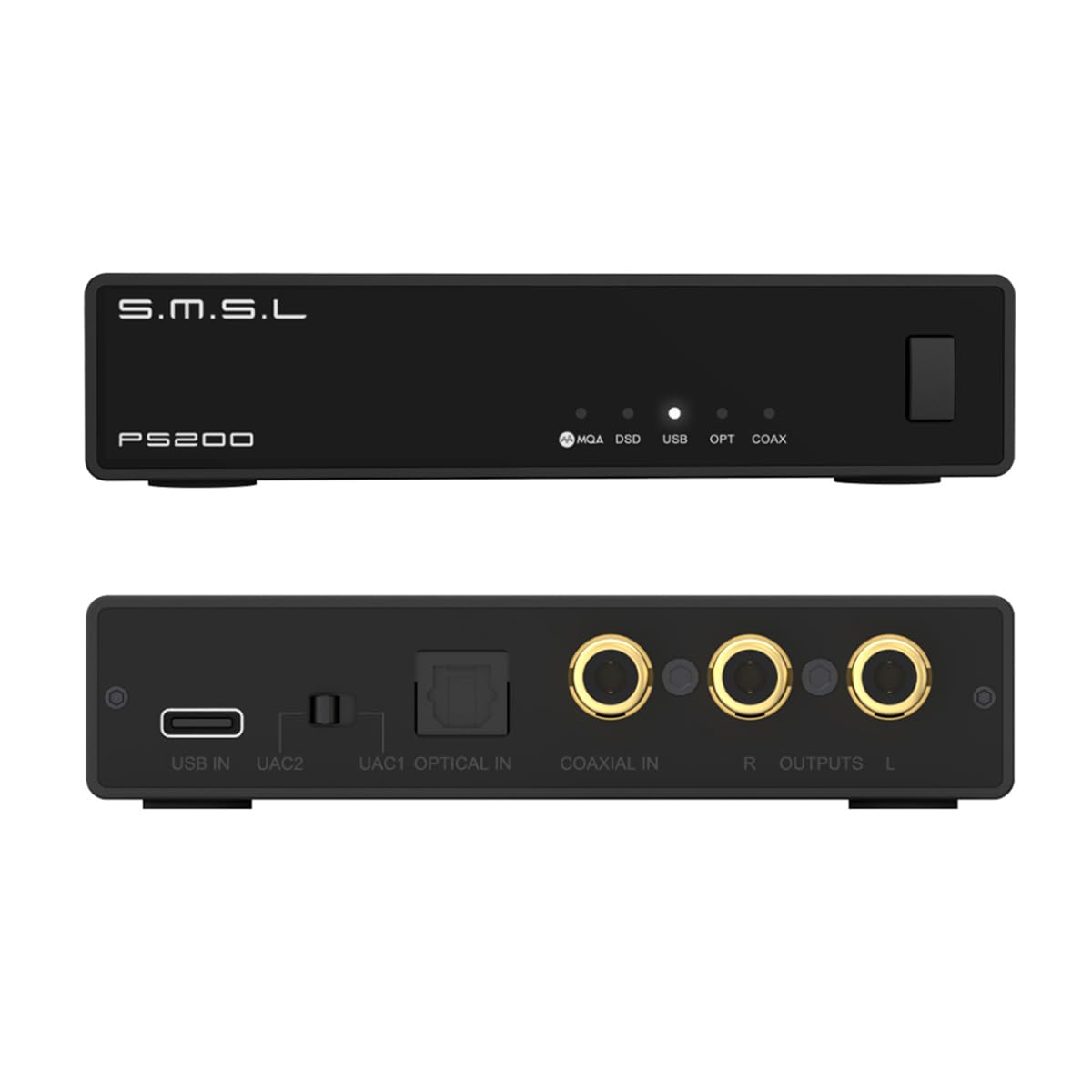
SMSL PS200PRO ES9039Q2M HiFi DAC
A compact desktop DAC built for audiophiles and console gamers seeking high-resolution audio support. The PS200PRO handles DSD512 and PCM up to 32-bit/768kHz across USB, optical, and coaxial inputs, with an aluminum chassis that improves durability and heat dissipation over its plastic predecessor. MQA decoding across all inputs adds appeal for streaming-era listeners.
Pros
- Excellent audio specs: 125dB SNR and 0.00009% THD+N ensure clean signal conversion
- Flexible connectivity with USB, optical, and coaxial inputs plus UAC1/2 mode switching for PS5/Switch compatibility
- Supports DSD512, high-resolution PCM (up to 768kHz), and MQA/MQA-CD decoding
- Aluminum alloy construction improves durability and thermal performance versus the PS200
- Compact form factor suits desktop setups and media centers
Cons
- UAC mode switching requires device restart, adding friction for users who alternate between platforms
- Optical and coaxial inputs limited to PCM 192kHz and DoP64, not matching USB's full resolution capability
- No built-in amplification; requires external amp or powered speakers for standalone use
Fosi Audio K7 DAC Headphone Amp with Balanced Output
An all-in-one desktop audio hub built for both audiophiles and gamers, the K7 combines a high-resolution DAC with a powerful headphone amplifier in a compact aluminum chassis. It delivers versatile connectivity through USB, optical, coaxial, and Bluetooth aptX HD, plus balanced and single-ended outputs, making it suitable for HiFi setups or gaming rigs that demand clean sound and multiple input options.
Pros
- Powerful amplification with 2100mW output on 4.4mm balanced connections, handling demanding headphones with ease
- High-resolution audio support up to PCM 384kHz/32bit and DSD256 via audiophile-grade chipset (AK4493S DAC, TPA6120 amp)
- Comprehensive connectivity including USB-C, optical, coaxial, Bluetooth aptX HD/LL with low latency (under 40ms), plus mic input for gaming and streaming
- Balanced circuitry with ultra-low distortion (0.0002% THD+N) and clean power delivery via multiple LDO regulators
- User-friendly design with dual large knobs, tactile buttons, 1.5-inch LCD display, and angled chassis for ergonomic desktop use
Cons
- Requires driver installation on Windows systems for full DAC functionality, though Mac and Linux work without drivers
- PS5 compatibility limited to USB 1.0 mode (UAC 1.0), which does not support higher sample rates due to protocol restrictions
- Potential hiss at low volumes with highly sensitive headphones (above 100dB), requiring gain adjustment or EQ tweaking to minimize
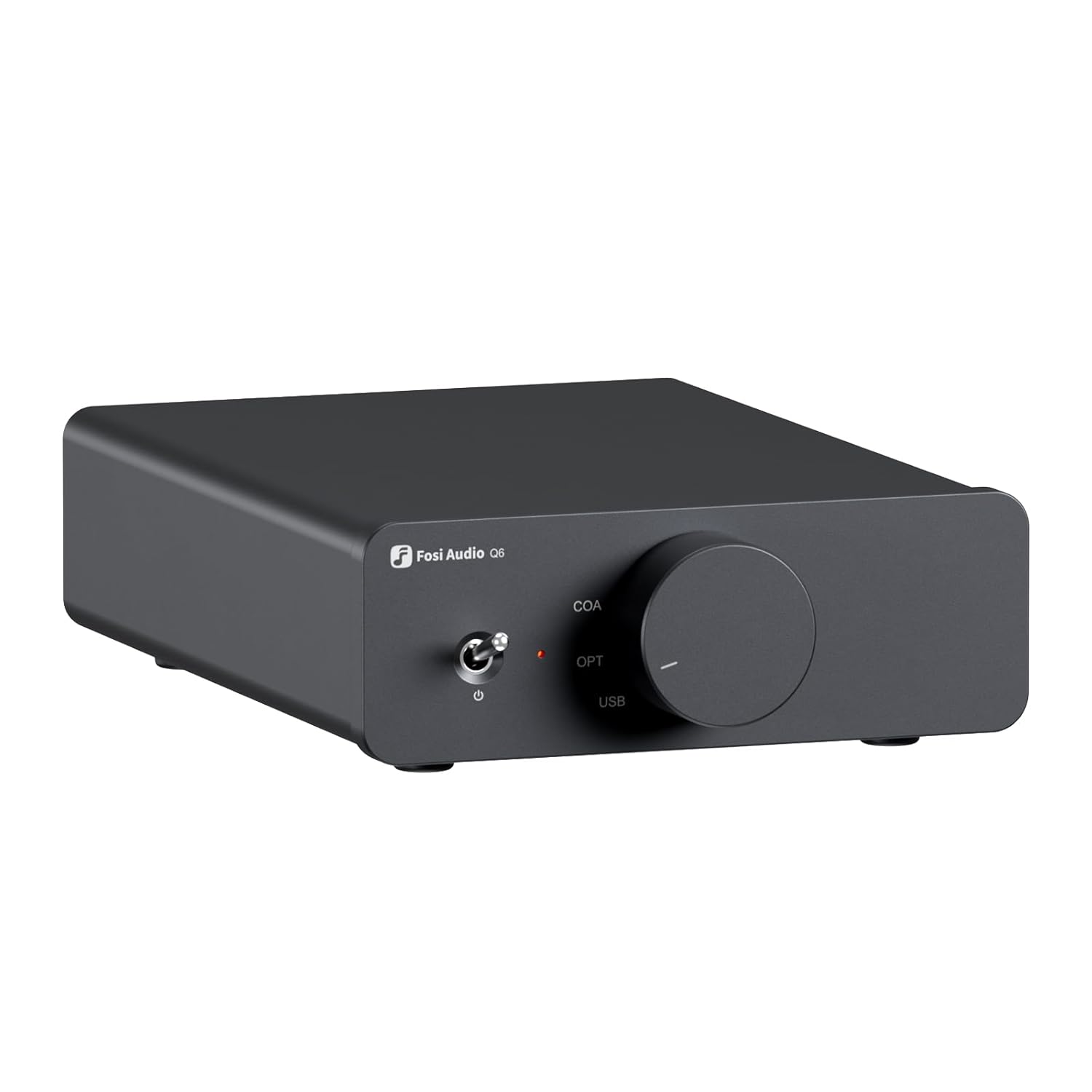
Fosi Audio Q6 Mini Desktop DAC, 32bit/768kHz
A compact desktop DAC built for serious listeners who want transparent digital-to-analog conversion without fuss. The Q6 combines audiophile-grade components (AKM AK4493S chipset, XMOS processor) with versatile connectivity (USB, optical, coaxial inputs and RCA/sub-out) to elevate streamer, TV, or computer audio. Best suited for those pairing it with an external amplifier rather than standalone headphone listening.
Pros
- Exceptional specs for the category: 0.00012% THD+N distortion, 121dB SNR, and support for hi-res formats up to DSD512 and 32bit/768kHz PCM
- Multiple input options (USB, optical, coaxial) make it flexible for different source devices and room setups
- Solid aluminum build with minimalist design fits neatly into desktop or living room environments
- Swappable op-amp design allows personalized audio tuning for those willing to experiment
- High user satisfaction: 4.7-star rating across 112 reviews reflects consistent performance and reliability
Cons
- No volume control or tone adjustment built-in; requires pairing with an amplifier or controlling volume from your source device
- Cannot function as a preamp or connect directly to analog sources like turntables, limiting flexibility for vinyl enthusiasts
- DSD file playback on Windows requires separate driver installation, adding a setup step for some users
Fosi Audio Q4 DAC and Headphone Amplifier
An entry-level desktop DAC and headphone amp with plug-and-play setup across Windows, Mac, and Linux. The Q4 combines USB, optical, and coaxial inputs with adjustable bass and treble controls, making it practical for PC audio, gaming, and home stereo integration without requiring driver installation.
Pros
- Plug-and-play operation with no driver needed across multiple operating systems
- Triple input options (USB, optical, coaxial) and dual outputs (RCA, 3.5mm headphone jack) for flexible system integration
- Adjustable bass and treble controls with metal knobs for sound customization
- Supports 24-bit/192kHz HD audio via optical and coaxial inputs with low distortion (THD 0.01%)
- Compact metal chassis design fits small desktop spaces
Cons
- Entry-level specs with SNR of 105dB, lower than comparable mid-range DAC amps in the lineup
- Headphone output mutes RCA output when plugged in, limiting simultaneous multi-zone audio
- Limited power output for demanding headphones, rated for 16-200 ohm impedance range
Fosi Audio DS2 USB-C Portable DAC Amp with Dual CS43131
This compact USB-C dongle combines dual flagship DAC chips with both 3.5mm and 4.4mm outputs, delivering high-resolution audio up to DSD256 for iPhone, iPad, and Android devices. It's built for listeners who want cleaner, more detailed sound from portable sources without sacrificing battery life on their phone.
Pros
- Dual Cirrus Logic CS43131 DAC chips with exceptional specs: <0.0001% THD, 130dB SNR, ultra-low 1μV noise floor
- Flexible dual outputs: 3.5mm single-ended (128mW) and 4.4mm balanced (172mW) for different headphone types
- High-resolution support: PCM up to 32bit/384kHz and DSD256 decoding
- 60-step independent volume control with memory function for convenient operation
- Broad device compatibility across iOS, Android, Mac, and Windows platforms
Cons
- Requires proper cable management and device compatibility checks; guide recommends keeping cables 30cm+ away from interference sources, adding setup complexity
- May generate heat during extended use at high output power, requiring well-ventilated conditions
- Dual DAC configuration doesn't translate to proportionally higher power output compared to some single-chip competitors at similar price points
PROZOR 192KHz Digital to Analog Audio Converter
A straightforward digital-to-analog converter that transforms optical or coaxial signals into RCA and 3.5mm outputs, designed for home theater and gaming setups. It handles high-resolution PCM audio up to 192KHz but requires your TV to output PCM format, making it best for users comfortable with audio settings. The aluminum housing and gold-plated connectors provide durability, though volume control limitations mean adjusting sound through TV menus rather than remote.
Pros
- Supports high-resolution audio up to 192KHz/24-bit with dual-channel RCA and 3.5mm outputs for flexible connectivity
- Aluminum alloy construction with EMI-reducing ferrite core cable delivers cleaner signal transmission and better shielding than plastic alternatives
- Gold-plated RCA connectors and detachable design allow cable customization without replacing the entire unit
- Wide device compatibility covers PS3, PS4, Blu-ray players, and home cinema systems with straightforward plug-and-play setup
- Highly rated by verified buyers (4.4 out of 5 stars across 42,893 reviews) with consistent feedback on reliability
Cons
- PCM-only decoding means no support for 5.1 Dolby or DTS surround audio; requires TV to downmix formats or users need a separate decoder
- Volume cannot be controlled via TV remote due to fixed-level optical output; adjustment only possible through TV settings or downstream audio device
- Requires specific 5V/1A power adapter (not included) and won't function properly with lower-amperage plugs, adding setup complexity
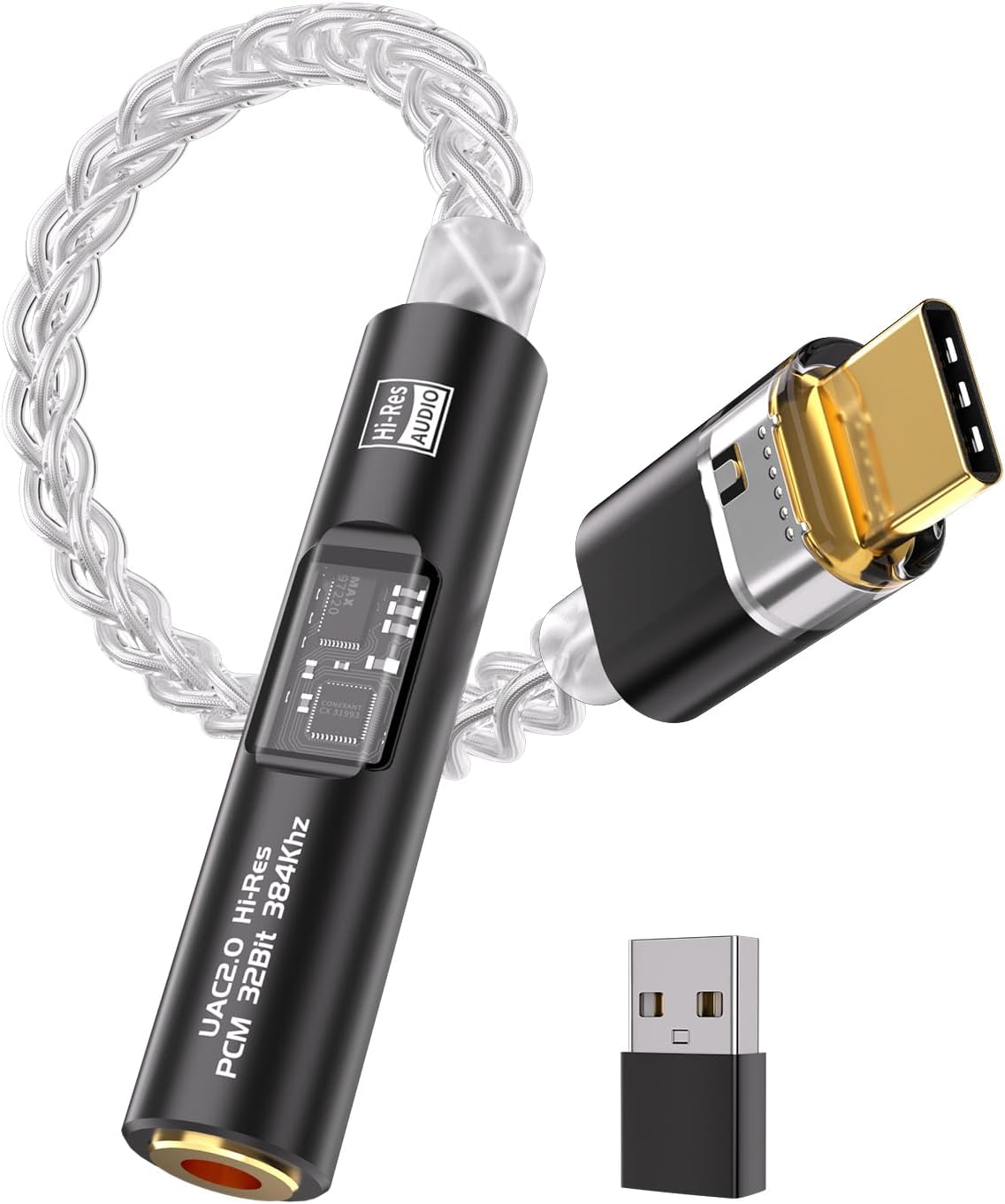
BZINKAudio USB-C to 3.5mm DAC Adapter, 32-Bit/384kHz
This USB-C to 3.5mm adapter pairs dual DAC chips (CX31993 and MAX97220) with a silver-plated copper cable to deliver high-resolution audio across Android phones, iPhones, and computers. It's built for audiophiles seeking lossless sound quality without sacrificing portability, though compatibility limitations apply to certain gaming consoles.
Pros
- Dual premium DAC chips with Hi-Res Gold certification support up to 32-Bit/384kHz audio with 124dB SNR for studio-grade clarity
- 8-strand single-crystal silver-plated copper cable balances warm lows and detailed highs across the frequency spectrum
- Includes USB-A adapter for broader device compatibility beyond USB-C phones and computers
- Microphone and call control support on most 3.5mm headphones with TRRS plugs
- Aluminum alloy casing and stable signal isolation design ensure durability and reliable connection
Cons
- Does not work with PS4 or PS5, limiting use for console gaming
- No volume control support for Apple EarPods despite general microphone functionality
- No verified buyer reviews available to assess real-world reliability and long-term performance
Kiwi Ears Allegro Mini USB-C DAC/Amp
A compact portable DAC/amplifier that plugs directly into USB-C devices without extra cables, delivering high-resolution audio up to 32bit/384kHz. Designed for smartphone and laptop users seeking better sound clarity and detail, it combines minimalist aluminum construction with dual output options (3.5mm and 4.4mm). Rated 4.4 stars from 855 reviews, though iPhone compatibility requires an adapter.
Pros
- Direct USB-C plug eliminates need for separate cable, making it truly pocket-friendly
- Supports high-resolution audio (PCM 32bit/384kHz, DSD up to DSD128) with excellent specs: THD+N under 0.004% and 114dB SNR
- Dual output flexibility with both 3.5mm single-ended and 4.4mm balanced connectors for various headphone types
- Noticeably improves smartphone and laptop audio with wider soundstage, better detail retrieval, and cleaner bass response
- Premium aluminum build with minimalist design that feels durable and portable
Cons
- iPhone users need a separate USB-C to Lightning adapter, which defeats some portability convenience
- Microphone functions on IEM cables may be impacted when used with this DAC/amp
- Premium positioning means it's an additional investment beyond your existing earbuds or headphones
DACs Under $200 Buying Guide
Shopping for a DAC under $200 is not just about finding the cheapest chip that does the job.
The right pick depends on what you are connecting it to, how you plan to listen, and which features will actually matter six months from now.
The six criteria below cover every decision point that separates a satisfying purchase from one you regret.
Form Factor: Desktop vs. Dongle vs. Converter Box

DACs under $200 come in three broad shapes, and picking the wrong one means fighting your own setup every day.
A desktop DAC/amp combo like the Fosi Audio Q4 or K7 sits on your desk, connects via USB-C, optical, or coaxial, and drives both headphones and powered speakers from a single unit.
That is the right choice if you have a permanent listening station and do not need portability.
Dongle DACs are thumb-drive-sized adapters that ride in your bag and plug directly into a smartphone or laptop.
Products like the Fosi Audio DS2 and the Kiwi Ears Allegro Mini offer high-resolution playback and balanced output from something that weighs only a few grams, which is ideal for commuters or anyone working across multiple locations.
The trade-off is that they depend entirely on the host device for power, so they will not drive power-hungry full-size headphones as convincingly as a desktop unit will.
Converter boxes like the PROZOR 192kHz unit sit between a source with only optical or coaxial output and a stereo amplifier or powered speakers that accept only analog RCA. They do not amplify; they simply translate the signal format.
If your only goal is to hook up a game console or TV to an older amp, a converter box is entirely sufficient and typically the lowest-cost route.
DAC Chip Quality and Supported Formats

The silicon at the heart of a DAC shapes its noise floor, dynamic range, and how faithfully it reconstructs fine musical detail.
Chips from ESS Technology (ES9039Q2M, ES9219C), AKM (AKM4493SEQ), and Cirrus Logic (CS43131) are the most commonly found in this price class, and each has its own tonal character as well as objective measured performance.
ESS chips tend to measure with extremely low distortion; AKM chips are widely praised for a natural, slightly warm character; Cirrus Logic parts balance efficiency with clean headphone amplification.
For most listeners, 24-bit/96kHz is the ceiling of what any streaming service delivers, so a DAC rated to 32-bit/768kHz or DSD512 is headroom rather than a practical necessity.
That said, paying a little more for a chip with higher native resolution headroom typically correlates with better measured performance at normal playback resolutions too, which is why flagship chips appear even in modestly priced desktop DACs.
MQA support, offered by the SMSL PS200PRO, is only relevant if you subscribe to a service that delivers MQA-encoded files.
USB interface quality matters as much as the DAC chip itself.
High-end implementations use dedicated USB receiver ICs such as the XMOS XU316 found in the Fosi Audio ZH3, which isolates the DAC from the electrically noisy USB bus and reduces jitter.
Budget products often rely on cheaper receiver silicon that can introduce subtle noise artifacts, especially on laptops with poor USB power delivery.
Output Stages: Balanced vs. Unbalanced, Headphones vs. Line Out
Balanced output connections use 2.5mm or 4.4mm Pentaconn jacks and XLR connectors, and they offer a measurable noise advantage over standard 3.5mm single-ended output.
The balanced circuit doubles the available voltage swing, which translates directly into more headroom and cleaner dynamics when driving demanding headphones.
If you own a pair of studio-oriented over-ear headphones with a balanced cable, a DAC/amp with balanced output is a meaningful upgrade.
For listeners who do not own balanced headphone cables, unbalanced 3.5mm or 6.35mm outputs deliver excellent results from the right product. What matters here is output power in milliwatts and output impedance.
A low output impedance, ideally under 1 ohm, ensures the amplifier controls the headphone driver cleanly rather than letting the driver’s impedance curve color the frequency response.
Line-level RCA outputs are standard on desktop DACs intended to feed an external amplifier or bookshelf speaker system.
Some products like the Fosi Audio Q6 Mini add a sub-out, which is useful if you are integrating a subwoofer into a compact desktop setup. Confirm the outputs match what your downstream equipment actually accepts before buying.
Input Connectivity and Source Compatibility
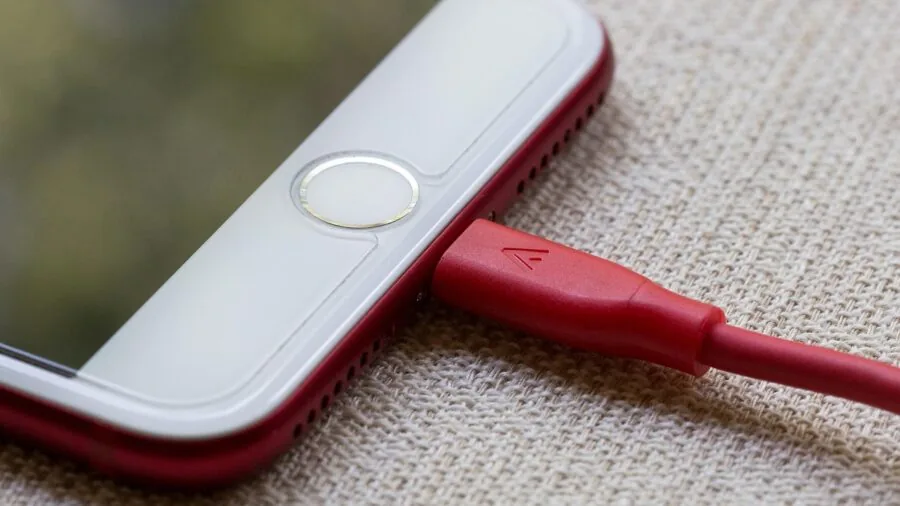
The more inputs a DAC offers, the more flexible it is as your setup evolves. USB-C input is now the baseline expectation and handles audio from PCs, Macs, Android phones, and recent iPads without a driver.
Optical (Toslink) and coaxial (S/PDIF) inputs let you connect televisions, game consoles like PS5 and Nintendo Switch, and legacy CD transports without converting formats.
Bluetooth input, available on products like the Fosi Audio K7 with aptX HD support, lets you cut the cable from a smartphone entirely.
Wireless DAC/amps with LDAC or aptX Adaptive support, such as the Qudelix-5K, deliver near-lossless Bluetooth performance that is genuinely difficult to distinguish from a wired 16-bit/44.1kHz stream in double-blind conditions according to published audio engineering research.
If you also want to use the same device for wireless earbuds or switch between multiple sources throughout the day, a Bluetooth-capable DAC removes the need for a separate device entirely.
Check for a microphone input if you game or video-call regularly. The Fosi Audio K7 includes a mic input alongside its gaming-friendly feature set, making it a genuine all-in-one solution for a PC desk.
Most pure DAC/amp dongles omit mic input, so pair them with a dedicated microphone if voice capture matters to you.
Amplifier Power and Headphone Compatibility

Output power is quoted in milliwatts at a specific load impedance, typically 32 ohms. A 100mW figure at 32 ohms sounds like plenty on paper but will leave high-impedance headphones (250 ohm or 300 ohm) noticeably under-driven, resulting in compressed dynamics and flat bass.
The Fosi Audio K7’s published 2,100mW figure positions it as a genuine contender for power-hungry full-size headphones, while compact dongle DACs are optimally matched with earphones and efficient in-ear monitors.
Sensitivity matters too. In-ear monitors often have sensitivity ratings above 105 dB/mW, meaning even a modest amplifier drives them loud.
The real concern with sensitive IEMs is background hiss: a high-powered desktop amp may inject audible noise into extremely sensitive in-ears, making a low-noise dongle DAC like the BZINKAudio CX31993 adapter or the Kiwi Ears Allegro Mini a smarter pairing choice.
If you are unsure which headphones to pair with a new DAC, our roundup of wireless noise-cancelling headphones and our over-ear headphone category can help you match listening style to hardware.
Build Quality, Software, and Long-Term Value

At this price tier, build quality varies widely.
Products from Fosi Audio and SMSL typically use aluminum alloy enclosures that feel solid and resist vibration, while the most affordable converter boxes use ABS plastic shells that are functional but less premium.
Read verified buyer reviews carefully for reports of channel imbalance at low volumes, RF interference, or USB disconnections, as these are the most commonly cited complaints in the DAC category according to aggregated Amazon review data.
Software and parametric EQ support is a meaningful differentiator for DAC/amps aimed at IEM users.
The Qudelix-5K pairs with a dedicated smartphone app that offers ten-band parametric EQ, a feature that audio engineering communities consistently single out as a major advantage for tuning in-ear monitors to personal preference.
No competing product at a similar price point offers the same depth of onboard EQ. If you value tuning flexibility over raw output power, this distinction is decisive.
Finally, consider driver requirements. True plug-and-play USB audio class 2 compliance means zero driver installation on Windows, macOS, iOS, and Android. Some desktop DACs require a dedicated Windows driver for DSD playback or high-sample-rate modes.
For a truly friction-free setup on any operating system, verify USB audio class 2 compliance in the product specifications before purchasing.
Why You Should Trust Us
REMOVU is an independent editorial platform. We have no manufacturing relationships, no products of our own to sell, and no customer service function. Our sole purpose is to give you the most accurate, useful buying guidance possible for the products we cover.
Every product in this roundup was assessed against a consistent set of criteria and rated on the REMOVU Score scale of 0 to 10.
We do not conduct our own product trials; our evaluations are grounded in research, published data, expert review consensus, and verified buyer feedback.
Scores reflect how well a product performs across all evaluated dimensions relative to competing options in its price class, not how enthusiastically a brand markets itself.
Transparency matters to us. REMOVU may earn a commission if you purchase a product through a link on this page.
That affiliate relationship has absolutely no influence on which products are included, how they are ranked, or what REMOVU Score they receive. Products are ranked on merit alone.
If a product scores poorly, we say so clearly, and it will not appear on a top-pick list regardless of commercial considerations.
Final Thoughts
The ten products in this roundup cover every realistic use case for a DAC under $200, from a $13 optical converter that simply gets your TV talking to your amp, all the way to a fully balanced desktop preamp with remote control that competes with units costing considerably more.
Here is how we would summarize the standout picks.
- Best Overall: BZINKAudio USB-C to 3.5mm DAC Adapter earns the top REMOVU Score in this roundup thanks to its CX31993 and MAX97220 chip combination, an eight-strand single-crystal silver-plated copper cable, and exceptional value relative to competing dongle adapters in this category.
- Best Compact Dongle for IEM Listeners: Fosi Audio DS2 delivers DSD256 capability, a 4.4mm balanced output, and a CS43131 chip in a pocketable form factor, making it the strongest portable option among Fosi Audio’s lineup and a natural companion for high-resolution in-ear monitors.
- Best for Bluetooth and Wireless Flexibility: Qudelix-5K stands apart with its LDAC and aptX Adaptive wireless support, dual ES9219 chips, balanced output, and full parametric EQ app, making it uniquely capable for listeners who switch between wired and wireless sources regularly.
- Best Fully Balanced Desktop Upgrade: Fosi Audio ZH3 brings an AKM4493SEQ DAC chip, XMOS XU316 USB receiver, fully balanced preamp architecture, remote control, and XLR plus 4.4mm outputs into a package that sits just under the $200 ceiling, offering a feature set rarely found this close to the budget tier.
- Best Budget Starting Point: Kiwi Ears Allegro Mini offers 32-bit/384kHz resolution and dual 3.5mm/4.4mm output in an accessible, compact package, making it the easiest entry point for listeners stepping up from their phone’s built-in audio for the first time.
Whichever option fits your setup, upgrading your digital-to-analog conversion is one of the most cost-effective improvements you can make to a headphone or desktop speaker system.
If you are also considering what to pair a new DAC with, our guides to wireless over-ear headphones, home theater speakers, and wireless gaming headsets can help you build a complete listening chain.
Frequently Asked Questions
Do I really need a DAC if my phone or laptop already has one built in?
Every device that plays digital audio already contains a DAC, but the quality varies enormously.
Built-in DACs in laptops and smartphones share a circuit board with Wi-Fi radios, CPUs, and power regulators, all of which inject electrical noise into the audio path.
A dedicated external DAC isolates the conversion stage from those noise sources, resulting in a lower noise floor and cleaner signal.
The audible difference is most obvious through sensitive in-ear monitors or high-impedance over-ear headphones, and it is essentially guaranteed if you currently hear hiss, buzzing, or distortion from your existing headphone jack.
What is the difference between a DAC and a DAC/amp combo?
A standalone DAC converts digital signal to analog line-level output suitable for feeding a separate amplifier or powered speakers.
A DAC/amp combo adds a headphone amplifier stage to the same chassis, letting you drive headphones directly without a separate amp. Most products in this roundup are DAC/amp combos.
If you only need to feed an integrated amplifier or active speakers with a clean analog signal, a DAC-only unit is sufficient. If headphones are part of your chain, a DAC/amp saves desk space and simplifies the signal path.
Is a more expensive DAC chip always better?
Not necessarily. The implementation around the chip, including power supply filtering, output stage design, and PCB layout, often matters more than the chip itself. A well-implemented mid-tier chip can outperform a flagship chip surrounded by poor support circuitry.
That is why expert review consensus and verified buyer feedback are essential inputs alongside raw specifications when evaluating any DAC purchase. Look for measured benchmarks from reputable audio engineering sources rather than relying on chip model numbers alone.
Can a DAC improve sound quality for gaming, not just music?
Absolutely. Gaming audio benefits from the same improvements a DAC brings to music listening: lower noise floor, cleaner imaging, and more defined bass.
Positional audio cues in competitive games are easier to distinguish when background hiss is eliminated and the stereo field is rendered cleanly.
Desktop DAC/amps with optical or coaxial inputs, such as the Fosi Audio K7, connect directly to PS5 and Nintendo Switch consoles without any additional adapters.
Pair the right DAC with a quality pair of gaming headsets and the difference in in-game awareness is immediately noticeable.
How do I connect a DAC to my TV or game console?
Most modern TVs and game consoles output digital audio via optical Toslink.
A DAC with optical input, or a dedicated optical converter box like the PROZOR unit in this roundup, accepts that signal and converts it to analog RCA or 3.5mm output for connection to speakers or headphones.
Coaxial S/PDIF is also common on older AV equipment. Some newer consoles and streaming sticks output only via HDMI, in which case you may need an HDMI audio extractor upstream of the DAC.
Check your device’s audio output options before purchasing.
Does Bluetooth DAC quality compare to wired?
With modern high-bitrate codecs, the gap has narrowed significantly. LDAC at 990 kbps and aptX Adaptive both transmit enough data to represent 24-bit/96kHz audio with minimal perceptible compression.
Published audio engineering research and expert review consensus broadly agree that LDAC at its highest bitrate is transparent or near-transparent compared to a standard 16-bit/44.1kHz wired source for most listeners in normal listening conditions.
The practical caveat is that Bluetooth connection stability depends on radio environment, and a congested wireless space will degrade codec performance more than a wired connection ever would.
If your listening environment has heavy Wi-Fi and Bluetooth traffic, wired connectivity remains the more reliable choice.
About the author
Jamie is REMOVU's gaming monitor writer, comparing refresh rate, response time, and motion clarity across panel types. He helps players find smooth, responsive displays at every budget.