The 11 Best Smart Glasses with Camera
Smart glasses have grown into a genuinely useful category. Here are the top picks across price ranges, from Meta's polished Ray-Ban line to capable budget options under $100.
 By Glen Simmons
Updated July 26, 2026
By Glen Simmons
Updated July 26, 2026
Smart glasses with built-in cameras have quietly moved from science-fiction novelty to genuinely useful everyday wearables.
Whether you want hands-free video recording during a hike, AI-powered real-time translation on a business trip, or simply a stylish pair of frames that can capture a moment without pulling out your phone, the category has matured enough to offer compelling options at almost every price point.
The challenge is sorting through a crowded field of products that range from polished, fashion-forward designs backed by major brands to budget-friendly alternatives packed with surprising features.
To help you find the right pair, our team at REMOVU researched and evaluated eleven models currently available, comparing published specifications, expert review consensus from across the tech press, and verified buyer feedback.
Every product in this guide received a REMOVU Score on our 0-to-10 scale before being ranked.
Scroll down for our full top picks, then read the buying guide below to understand exactly what separates a great pair of smart glasses from a frustrating one.

Ray-Ban Meta Gen 2 Wayfarer Smart Glasses with 3K Camera
These AI-powered smart glasses deliver discreet hands-free video capture in 3K resolution and integrate Meta AI for voice commands, real-time translation, and hands-free calls. The 8-hour battery life and classic design appeal to creators and professionals seeking wearable tech that doesn't look gimmicky.
Pros
- Video and photo quality is sharp and clear for a wearable form factor
- Significantly improved battery life from previous generation, with fast-charging case providing up to 48 hours total
- Microphone performance is strong, with 90 percent wind and street noise reduction for call clarity
- Comfortable for extended wear without headaches despite the added weight
- Seamless hands-free documentation and AI assistance in professional settings
Cons
- No built-in display screen limits visual feedback and AI interaction potential
- AI features have inconsistent performance, including unreliable voice command execution and live translation requiring loud, clear speech
- Continuous video recording drains battery quickly (about 30 minutes), and USB-C charging cable not included despite premium price
- Low-light video quality is noticeably degraded, and no protective coating on lenses makes them prone to smudging from breath and adjustments

Meta Oakley HSTN Smart AI Glasses with 12MP Camera
These smart glasses blend Oakley's athletic design with Meta AI, offering hands-free video capture up to 3K, open-ear audio, and voice-activated assistance. They suit active users who want wearable tech that integrates camera, music, and AI without needing to reach for a phone.
Pros
- 8-hour battery life plus 48-hour case charging provides all-day use without frequent recharging
- 12MP camera with 100° field of view captures 3K video, appreciated by users for clear quality
- Open-ear speakers and hands-free calling let you stay aware of surroundings while using features
- Meta AI integration answers questions and provides real-time info like weather or surf reports via voice command
- Garmin and Strava integration adds performance metrics to shared content
Cons
- Limited water resistance (IPX4 sweat and splash only) causes failure in light rain, per verified buyer experience
- Frames are snug fitting and may require nose cushion accessories for comfort during extended wear
- No zoom capability on camera, limiting versatility compared to some competing smart glasses
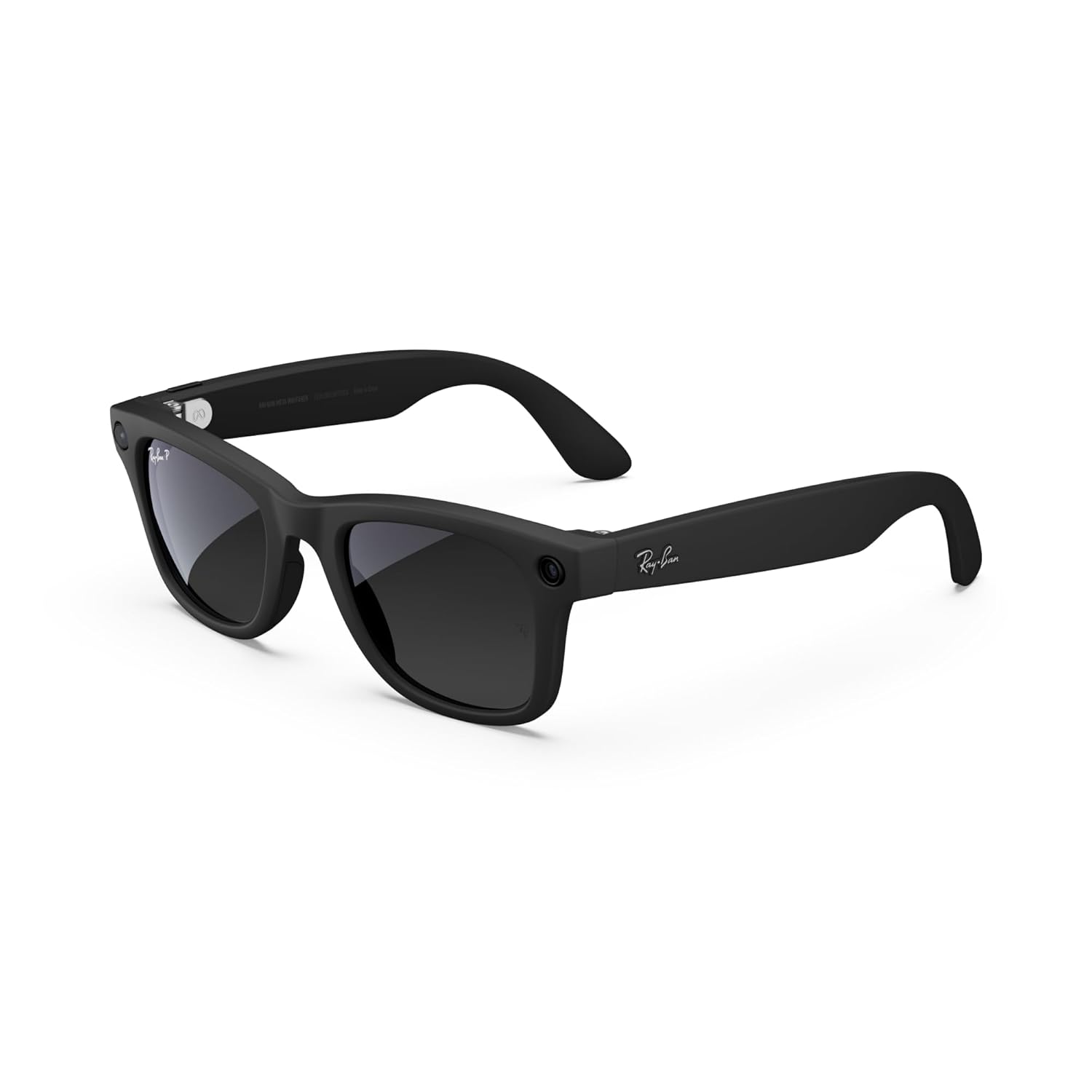
Ray-Ban Meta Wayfarer Smart Glasses, 12MP Camera
These AI-powered smart glasses combine classic Ray-Ban styling with hands-free photo/video capture, open-ear audio, and Meta AI integration. Best for content creators and users who want wearable tech without the obvious gadget look, though battery life and voice assistant reliability have real limitations.
Pros
- Exceptional video and photo quality from first-person POV, ideal for content creation and travel documentation
- Clear, immersive audio through discreet open-ear speakers that won't block conversations
- Timeless Wayfarer design with polarized lenses offers genuine sun protection and style without appearing like smart glasses
- Reliable hands-free calling and messaging with responsive Bluetooth connectivity
- Slim, comfortable fit suitable for extended daily wear
Cons
- Battery lasts only up to 4 hours on glasses alone, requires frequent charging for all-day use without case
- Meta AI voice assistant is unreliable in recognition and execution, drains battery rapidly when enabled
- Transition lenses adapt too slowly to bright sunlight; polarized option strongly recommended for outdoor use

Dohelly MT3 AI Smart Glasses with 8MP Camera and Real-Time Translation
These AI-powered smart glasses combine a hands-free 8MP camera, real-time translation, and open-ear audio in a lightweight form factor designed for travel and daily wear. The photochromic lenses and IP65 waterproofing make them practical for outdoor use, though video recording requires smartphone pairing and battery life is moderate for extended sessions.
Pros
- Open-ear audio design maintains situational awareness while listening to audio or taking calls
- Hands-free camera and voice control work well for travel vlogging without constantly pulling out your phone
- Photochromic lenses eliminate need for separate sunglasses when moving between indoors and outdoors
- Real-time translation and object recognition features provide genuine utility for travelers
- Quick Bluetooth pairing and intuitive app controls make setup and operation straightforward
Cons
- Video recording requires active smartphone app pairing, not fully standalone functionality
- Battery life of 1 hour continuous use is limited for extended recording sessions or all-day heavy use
- AI translation and object recognition features work as helpful tools rather than perfect replacements for dedicated apps, with accuracy varying by conditions

SURPAO AI Smart Glasses with 4K Camera & Real-Time Translation
First-person wearable combining 4K video recording, AI-powered translation across 139 languages, and open-ear audio for hands-free use during travel and daily activities. Photochromic lenses and IP65 water resistance make it practical for everyday wear, though AI features perform best in clear conditions with good network quality.
Pros
- Easy Bluetooth pairing and smartphone app integration across Android and iOS devices
- Lightweight at 45g and comfortable design suitable for extended daily wear
- Dual-mic noise cancellation improves call clarity in noisy environments
- Adaptable photochromic lenses reduce need for separate sunglasses
- Strong verified buyer feedback praising design, battery durability, and ease of use
Cons
- AI translation and object recognition accuracy varies with network quality, accents, and background noise, not designed for professional-grade precision
- One-size frame may not fit very large head sizes; comfort depends on individual face shape and nose bridge fit
- 2GB built-in memory limits continuous recording; longer sessions require offloading files via app

Coucur G1 AI Smart Glasses with 1200P Video, 8MP Camera
All-in-one smart glasses combining 1200P stabilized video, 8MP AI-enhanced photos, real-time translation in 139 languages, and open-ear audio in a lightweight frame. Comfortable for all-day wear with a 3600mAh charging case providing up to 7 days of typical use.
Pros
- 6-axis EIS and OIS stabilization reduces motion blur effectively in video recording
- AI multi-frame processing delivers up to 32MP photo output from 8MP sensor
- Real-time translation across 139 languages with voice activation
- Open-ear audio design allows environmental awareness while listening
- Interchangeable lens options for different lighting scenarios and activities
- Lightweight 38g frame comfortable for extended wear without ear fatigue
- 3600mAh charging case extends usage to approximately 7 days
Cons
- Requires smartphone app connection for advanced features like translation, file management, and meeting notes
- Device warms noticeably during high-performance video recording mode
- Open-ear audio design creates sound leakage at higher volumes, affecting privacy
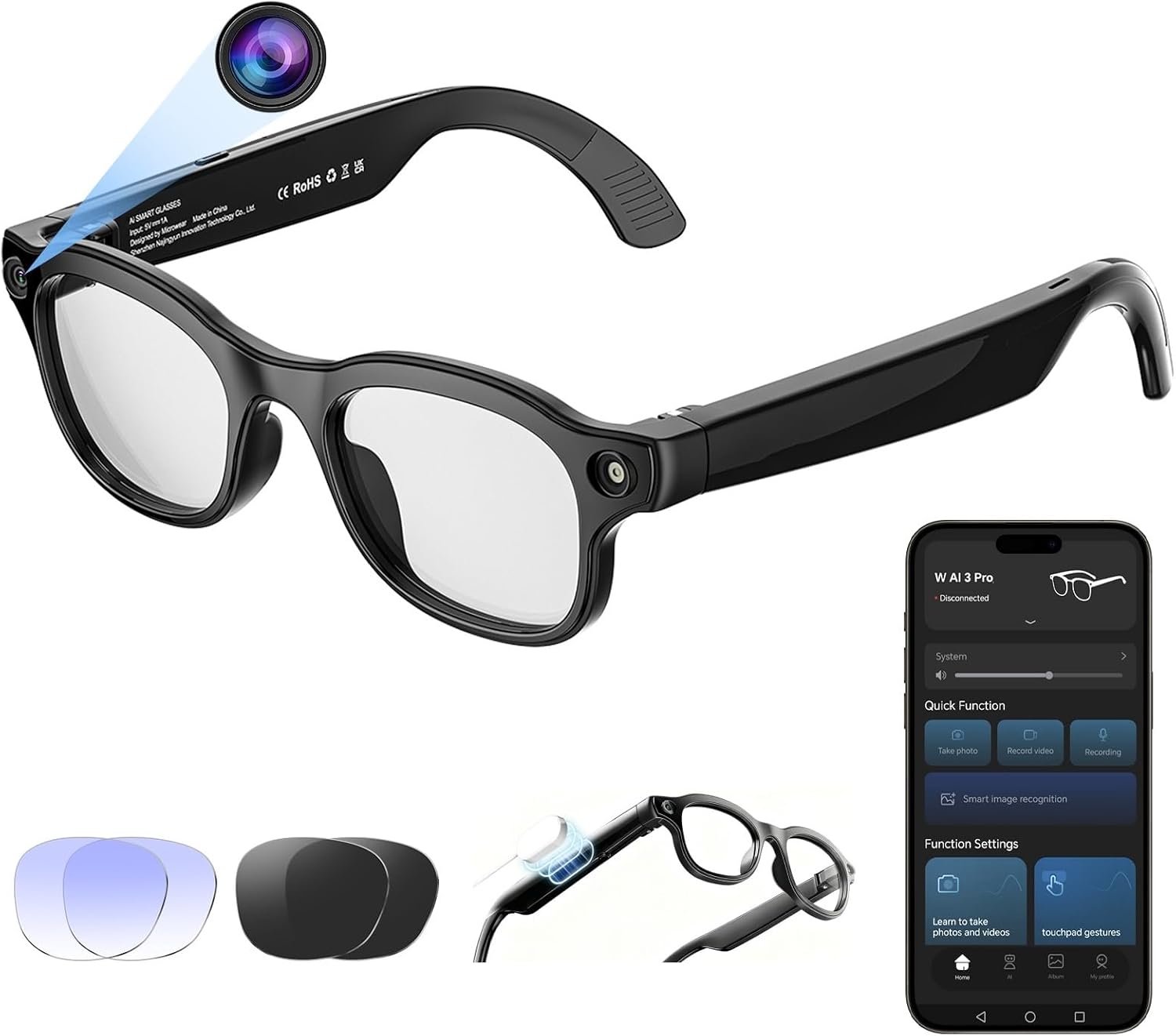
Wvryrv AI Smart Glasses with 8MP Camera and Real-Time Translation
These lightweight AI smart glasses combine a built-in 8MP camera, real-time translation, and voice assistant in an everyday-wear design. Verified buyers praise the clear video quality, comfortable fit, and magnetic wireless charging, making them a practical option for travel and daily communication without breaking the bank.
Pros
- Real-time AI translation and voice assistant features work reliably for travel and cross-language conversations
- Lightweight design at 1.44 ounces with open-ear audio keeps you aware of surroundings during commutes and outdoor activities
- Clear video and photo quality with 8MP camera, anti-shake, and multi-frame noise reduction
- Convenient magnetic wireless charging eliminates cable management
- Three interchangeable lenses adapt to different lighting conditions and use cases
Cons
- Battery lasts only 4 hours on a single charge, requiring daily recharging for full-day use
- No GPS functionality limits navigation and location-based features
- Warranty description shows conflicting information: description claims 2-year warranty but specs list 1-year limited warranty

VOICFUT CY03 AI Smart Glasses with 4K Camera
All-in-one wearable that combines 4K hands-free video capture, real-time translation in 168 languages, and open-ear audio in a lightweight 42g frame. Designed for travelers, commuters, and anyone wanting to record life without constantly holding a phone.
Pros
- 4K video with electronic image stabilization delivers smooth footage during movement and everyday activities
- 168-language translation with up to 98.5% accuracy and 0.3-second response time covers most travel and work scenarios
- Open-ear audio lets you stay aware of surroundings while taking calls or listening to navigation
- Lightweight 42g design with IP65 water resistance handles sweat, dust, and light rain comfortably
- Interchangeable lens system supports blue-light blocking, UV protection, and prescription lens options
Cons
- App sign-in issues reported by some users, requiring manual troubleshooting during setup
- Battery drains faster during extended video recording, limiting continuous capture to less than full charge duration
- Manual lens changes instead of automatic switching, adding extra step for switching between lens options

Warchody Smart Glasses with 8MP Camera and AI Assistant
These AI-powered smart glasses combine a hands-free 8MP camera with open-ear audio and real-time translation across 144 languages, making them suited for content creators, travelers, and remote workers. The built-in AI assistant and audio recording capabilities add practical utility for lectures and conferences, though the product has no verified buyer reviews to confirm real-world performance.
Pros
- Hands-free 8MP camera captures authentic first-person perspective without traditional camera bulk
- Real-time translation across 144 languages expands utility for international travel and business
- Open-ear audio design allows ambient awareness while listening to music or taking calls
- AI assistant and photo recognition add practical features for shopping, learning, and productivity
- Audio recording with AI summaries streamlines note-taking for meetings and lectures
Cons
- No verified buyer reviews available, making it difficult to assess actual reliability and user experience
- Limited detail on battery life specifications despite marketing focus on portability
- Real-time translation quality and accuracy depend on companion app performance, which is not independently evaluated

Osawalla AI Smart Glasses with 1080P Camera and Translation
These AI-powered smart glasses combine a 1080P camera with real-time translation and object recognition for travelers and students. Lightweight photochromic lenses and solid battery life make them practical for daily wear, though video quality and translation accuracy depend on real-world conditions.
Pros
- AI features like real-time translation and object recognition add practical utility for international travel and learning
- Ultra-lightweight at 40.8g with photochromic lenses reduces eye strain and adapts to lighting
- 1080P anti-shake video and selectable recording durations (15s to 12min) provide flexibility for casual capture
- 32GB storage and dual Bluetooth/Wi-Fi sync enable convenient hands-free operation
- 4.4-star rating across 199 verified reviews suggests reliable day-to-day performance
Cons
- Photochromic lenses darken slower indoors or during winter due to weaker UV exposure, limiting their effectiveness year-round
- Battery life caps at 7 hours of music playback, requiring regular charging for extended outings
- Translation and object recognition accuracy depend on internet connection and AI model performance, not specified in documentation

iONCT AI Smart Glasses with 8MP Camera & Real-Time Translation
These AI-powered smart glasses combine a hands-free 8MP camera, real-time translation across 165+ languages, and open-ear audio in a lightweight frame that looks like regular sunglasses. They're built for travelers, multilingual professionals, and anyone wanting AI features without a traditional display.
Pros
- Real-time translation in 165+ languages with multiple modes (glasses-to-phone, video call, photo translation)
- Hands-free 8MP camera with voice commands and 80 minutes of video recording per charge
- Open-ear audio design lets you stay aware of surroundings while using Bluetooth calls and music
- Dual lens options: UV-blocking sunglass lenses plus anti-blue light lenses included
- Compact and lightweight with typical sunglasses appearance, comfortable for all-day wear
Cons
- App has usability issues and uses a currency system for some AI features, requiring additional purchases
- Translation can miss content in rapid conversations, best suited for deliberate pacing
- No GPS functionality, limited battery (80 minutes video, 10 hours music) requires frequent charging
Smart Glasses with Camera Buying Guide
Smart glasses sit at the intersection of wearable fashion and portable technology, which means the buying decision involves trade-offs you would not face when shopping for a dedicated action camera or a pair of wireless earbuds.
Below are the six criteria that matter most, drawn from our research across verified buyer reports and expert analysis.
Camera Quality and Video Resolution

The camera is the centrepiece feature for most buyers, and resolution figures alone can be misleading.
Many budget models advertise “4K” output but achieve it through software upscaling rather than a true 4K sensor, which means fine detail and colour accuracy at that setting may disappoint.
Look for honest sensor resolution (8 MP is a practical benchmark at this price tier) alongside whether electronic image stabilisation (EIS) or optical image stabilisation (OIS) is present.
Footage captured during movement, such as cycling or walking, becomes unwatchable quickly without some form of stabilisation.
For still photography, ultra-wide lenses are the default in this form factor because the camera sits at eye level and needs to capture a natural field of view.
The Meta Ray-Ban family uses a 12 MP ultra-wide sensor that consistently earns praise from professional reviewers for genuine sharpness at that resolution.
Budget alternatives in the sub-$100 segment typically use smaller sensors with less reliable low-light performance, so if you plan to record indoors or at dusk, manage expectations accordingly.
Pairing your footage-sharing workflow with a good webcam for YouTube creators can complement the POV perspective that smart glasses deliver.
Video recording duration is a practical concern. Continuous 4K recording generates heat and drains batteries faster than most buyers anticipate. Check the stated recording time per charge rather than just battery capacity in mAh, because firmware efficiency varies enormously between manufacturers.
Audio System and Open-Ear Design

Nearly every smart glasses model in this guide uses open-ear audio: small speakers built into the temples that direct sound towards your ears without sealing them from the environment.
This design keeps you aware of traffic, conversations, and ambient sound, which matters for outdoor safety.
However, sound leakage is a real concern in quiet spaces such as offices or libraries, and bass response is predictably limited compared with over-ear headphones or in-ear monitors.
Microphone quality for calls and AI voice commands is equally important. Dual-microphone arrays with noise reduction perform significantly better than single-mic setups when you are outdoors or in a noisy environment.
Verified buyer reviews consistently flag call clarity as a pain point on lower-cost models.
If open-ear listening quality is a priority for you beyond just smart glasses, our roundup of open-ear headphones for running covers dedicated audio products with much stronger acoustic performance.
Bluetooth version also matters here: Bluetooth 5.0 and above delivers more stable connections and lower audio latency than older implementations. Several budget models in our list have moved to Bluetooth 5.4, which is a genuinely meaningful upgrade for call stability and music streaming.
AI Features and Real-Time Translation
“AI smart glasses” has become the dominant marketing phrase in this category, but the actual AI capabilities vary widely.
At the premium end, Meta’s integration of Meta AI into the Ray-Ban frames enables contextual awareness: you can ask the glasses what is in front of you, get navigation prompts, or initiate calls with a voice command without touching your phone.
This level of integration requires a reliable companion app ecosystem and ongoing software support, both of which Meta currently delivers more consistently than any budget competitor.
Budget brands such as Osawalla, Coucur, SURPAO, and VOICFUT advertise real-time translation, object recognition, and AI voice assistants as headline features.
The translation feature, which typically supports over 100 languages, is genuinely useful for travellers and is backed by cloud processing on your paired smartphone.
Object recognition quality, however, varies significantly based on the companion app’s AI model and your phone’s processing power. Treat these as “bonus” features rather than the primary reason to buy at the budget tier.
Privacy implications of always-on camera and AI features deserve careful thought. Look for a clear LED indicator light that signals when recording is active: this is both a courtesy to people around you and an increasingly common regulatory requirement in public spaces.
Frame Design, Comfort, and Lens Options

Smart glasses are worn for hours, so weight distribution, nose-pad design, and temple width matter as much as any tech spec.
The Meta Oakley HSTN collaboration is specifically engineered for athletic use with a wraparound fit and IP rating for sweat and splash resistance. The Wayfarer-style Ray-Ban Meta frames are optimised for all-day social wear.
Most budget models use generic frame moulds that are heavier per unit of feature because the electronics are less miniaturised.
Lens variety is another differentiator. Clear lenses are essential for indoor use and low-light environments, while polarised or gradient tinted lenses suit outdoor commuting and travel.
Photochromic lenses, which darken automatically in sunlight and clear indoors, are available on several mid-range and budget models including Osawalla and SURPAO and add meaningful versatility without requiring lens swaps.
Some models such as the Coucur ship with multiple lenses in the box, which is good value if all lens types suit your lifestyle.
Check the IP or IPX water-resistance rating before buying if you intend to use the glasses during exercise, in rain, or anywhere near water. Not all smart glasses carry an official IP rating, and those that do not should be treated as splash-resistant at best.
Battery Life and Charging

Battery life in smart glasses is a constant engineering compromise: the frames need to stay thin and light, which limits the size of the internal cells.
The second-generation Meta Ray-Ban claims roughly double the battery life of its predecessor, which is a meaningful improvement for all-day wear.
Most budget models quote usage times that blend standby, audio, and camera usage in ways that can make battery figures look more generous than real-world experience suggests.
Charging cases are an increasingly common solution to the short battery life problem, and Coucur’s inclusion of a 3,600 mAh charging case is notable in the budget segment as it can fully recharge the glasses multiple times per day.
Wireless charging support, available on some Wvryrv models, is a convenience feature worth prioritising if you dislike fiddling with magnetic pogo-pin cables. Check whether the charging case or cable is proprietary, since losing it could leave you stranded.
Companion App and Long-Term Software Support

A smart glasses product is only as good as the app that powers it.
Meta’s companion app is well-maintained, regularly updated, and integrates directly with Instagram, Facebook Messenger, WhatsApp, and Spotify, which makes the glasses feel like a natural extension of an existing smartphone ecosystem.
The Meta AI voice assistant integration has become substantially more capable since the original launch, partly through over-the-air updates at no extra cost.
Budget brands present a higher software risk. Companion apps from smaller manufacturers sometimes carry poor app-store ratings, limited language localisation, and uncertain update roadmaps.
Verified buyer reviews are the best signal here: recurring complaints about app crashes, failed firmware updates, or features that stopped working after a few months are red flags.
Check the app store review date spread rather than just the average rating; a cluster of old five-star reviews followed by recent one-star complaints tells a story.
If audio quality and wireless connectivity features matter to you in adjacent wearables, our guide to wireless earbuds and our overview of workout earbuds are worth reading alongside this one for a complete picture of hands-free audio options.
Why You Should Trust Us
REMOVU is an independent review publication. We have no commercial relationship with any manufacturer featured in this guide, and no brand paid for placement or influenced our rankings in any way.
Every product listed here was evaluated against a consistent set of criteria, and each received a REMOVU Score on our 0-to-10 scale reflecting its overall merit within this category.
Our evaluation methodology is research-based and transparent. We do not conduct our own product trials; our evaluations are grounded in research, published data, expert review consensus, and verified buyer feedback.
For smart glasses, our research sources included published technical specifications from manufacturer pages and regulatory filings, aggregated expert review consensus from specialist tech publications covering the wearables category, verified buyer feedback from major retail platforms filtered for confirmed purchases, and publicly available camera sample comparisons and audio quality assessments from independent creators.
REMOVU earns a commission when you purchase through links in our articles. This affiliate relationship does not affect our rankings, scores, or editorial recommendations in any way.
Products are ranked on merit as reflected in the REMOVU Score, not on commission rate or commercial agreement.
Our goal is to give you the most honest, useful shortlist possible so you spend less time researching and more time enjoying what you buy. For more wearable and connected-device coverage, browse our phones, tablets and wearables section.
Final Thoughts
After evaluating every model in this guide against consistent criteria, a clear hierarchy emerges.
The Meta Ray-Ban family dominates the premium tier thanks to a mature software ecosystem, genuine camera quality, and fashion-credible frames that do not shout “tech gadget.” The budget segment has genuine contenders from brands like Osawalla, VOICFUT, iONCT, and WearableTechnology, but buyers should calibrate expectations around camera fidelity and app reliability.
Here are our standout picks by use case:
- Best Overall: Ray-Ban Meta (Gen 1), Wayfarer, Matte Black earns the highest REMOVU Score in this roundup. Its combination of a 12 MP ultra-wide camera, polished open-ear audio, and seamless Meta AI integration represents the most complete smart glasses package available at a mid-range price, with an ecosystem that keeps improving through software updates.
- Best Upgrade Pick: Meta Ray-Ban (Gen 2), Wayfarer, Matte Black improves on the first generation with roughly double the battery life and a step up to 3K Ultra HD video, making it the right choice for anyone who records frequently and wants fewer interruptions for charging.
- Best for Sport and Active Use: Meta Oakley HSTN, Black combines the same Meta platform with Oakley’s athletic frame engineering and wraparound fit, offering a purpose-built option for cyclists, runners, and outdoor enthusiasts who need a more secure and sweat-resistant design.
- Best Budget Pick: VOICFUT AI Smart Glasses with Camera and iONCT AI Smart Glasses with Camera share the top REMOVU Score in the under-$100 segment. Both deliver 8 MP capture, open-ear audio, AI voice assistance, and real-time translation at an entry-level price, making them the lowest-risk way to try the smart glasses concept without a significant financial commitment.
- Best Budget Pick with Photochromic Lenses: DohellyRICH AI Smart Glasses stand out among mid-range budget options for combining photochromic lenses that adapt to light conditions with 8 MP capture and a broadly capable AI feature set, offering practical versatility for daily commuting and travel at a tầm trung price.
Whichever direction your budget takes you, the smart glasses category is now mature enough that you are unlikely to be disappointed by a well-chosen pick.
The key is matching the product to your primary use case rather than chasing the longest spec sheet.
For related wearable and audio research, our coverage of fitness trackers and smartwatches rounds out the picture of what connected wearables can do for your daily routine.
Frequently Asked Questions
Are smart glasses with cameras legal to use in public?
In most countries, recording in public spaces where there is no reasonable expectation of privacy is legal for personal use, but laws vary significantly by jurisdiction.
Recording inside private venues, changing rooms, or in any context where subjects have not consented can carry serious legal consequences.
Most reputable smart glasses, including the Meta Ray-Ban line, include a visible LED that lights up during active recording as a courtesy signal to bystanders.
Always check local legislation before recording in sensitive environments, and use common sense about consent in social situations.
How do smart glasses differ from a regular action camera or camera drone?
Smart glasses capture a first-person, eye-level perspective hands-free, which makes them ideal for documenting experiences naturally without the conspicuousness of a mounted camera or the flight regulations that govern drones.
The trade-off is that lens placement and sensor size are heavily constrained by the form factor, so raw image quality and zoom capability fall well short of dedicated imaging hardware.
Smart glasses also double as audio devices and AI assistants, making them a multi-purpose wearable rather than a pure capture tool.
Do smart glasses work without a smartphone?
Most smart glasses require a paired smartphone for initial setup, AI features, real-time translation, and cloud-based processing.
Core functions like photo and video capture to onboard storage, music playback from stored files, and basic Bluetooth calls can typically work without an active phone connection once set up.
However, AI voice assistants, live translation, and object recognition almost universally depend on a connected phone for processing power and data. If offline capability is important to you, check the product’s specific feature matrix before buying.
How long does the battery last on smart glasses with cameras?
Battery life depends heavily on which features are active. Music playback alone is the most efficient mode, typically delivering three to six hours on a charge for premium models and similar or slightly less on budget options.
Active video recording is far more demanding and may deliver under ninety minutes of continuous capture. Many models ship with magnetic or snap-on charging cases that provide additional charges throughout the day, partially offsetting the limited cell size.
Verified buyer feedback is the most reliable guide here: manufacturer claims often reflect best-case scenarios rather than mixed real-world use.
Can I get prescription lenses in smart glasses?
Meta’s Ray-Ban partnership supports prescription lens fitting through authorised opticians in several markets, which is a meaningful advantage over budget alternatives that typically ship only with fixed non-prescription lenses.
If you need vision correction, verify with your local optician whether the specific frame model is compatible with prescription lenses before purchasing.
Budget smart glasses from brands like Osawalla, Coucur, and WearableTechnology generally do not offer official prescription options, though aftermarket lens replacement services exist for some popular frame shapes.
Are smart glasses compatible with both Android and iPhone?
Most smart glasses in this guide support both Android and iOS through their companion apps, but the depth of integration can differ.
Meta’s glasses are optimised for the Meta ecosystem and work fluidly on both platforms, though some features like Spotify integration and Meta AI responses may depend on having the relevant app installed.
Budget-brand companion apps are generally cross-platform but are occasionally less polished on one OS versus the other. Check app store ratings on both Android and iOS before buying if platform compatibility is a concern.
For broader context on how smart wearables integrate with your phone ecosystem, our smartwatch guide and noise-cancelling headphones roundup offer useful perspective on cross-platform pairing behaviour.
About the author
Glen covers gaming chairs and desks for REMOVU, focusing on ergonomic comfort, build quality, and value for long sessions. He helps readers protect their posture without wrecking their budget.