The 11 Best Smart Thermostats Without C Wire
No C wire doesn't mean no upgrade. These smart thermostats skip the extra wiring hassle while still delivering app control, scheduling, and real energy savings.
 By Enrique Sullivan
Updated July 26, 2026
By Enrique Sullivan
Updated July 26, 2026

Upgrading to a smart thermostat is one of the quickest wins in home energy management, but millions of older HVAC systems were never wired with a common wire, better known as the C wire, that most modern thermostats demand for stable power.
Without it, installation can stall entirely or cause frustrating power-stealing quirks that shorten equipment life.
The good news is that a growing range of smart thermostats either ship with a C wire adapter, harvest power internally, or are explicitly engineered to run without that fifth wire, meaning you no longer have to rewire your furnace just to get app-based scheduling and energy reporting.
This guide cuts through the noise by combining published manufacturer specifications, expert review consensus across the industry, and verified buyer feedback to surface the most reliable picks at every price point and use case, from budget-friendly programmable options to full-featured premium models with room sensors and built-in air quality monitors.
Whether you rent, own a multi-zone system, or simply want the easiest possible DIY install, the shortlist below gives you a clear starting point.
Explore our smart home hub for context on how these thermostats fit into a broader connected-home setup.
| Award | Product | REMOVU Score About REMOVU ScoreThe REMOVU Score is our own rating from 0 to 10, based on performance, design and build, ease of use, and value. It reflects independent research and is never influenced by manufacturers, retailers, or affiliate commissions. Learn more › | Price | |
|---|---|---|---|---|
| Best Premium |
 ecobee Smart Thermostat Premium with Air Quality Monitor
|
9.0/10 | Buy | |
 Sensi Touch 2 Smart Thermostat ST76
|
8.3/10 | Buy | ||
| Best Overall |
 ecobee Smart Thermostat Enhanced, WiFi Programmable
|
9.1/10 | Buy | |
| Best Budget |
 Sensi ST55 Wi-Fi Smart Thermostat
|
7.6/10 | Buy | |
 Honeywell Home T5 Smart Wi-Fi Thermostat
|
7.6/10 | Buy | ||
| Best Value |
 Honeywell Home RTH9585WF1004 Wi-Fi Smart Thermostat
|
7.5/10 | Buy | |
 Honeywell T6 Pro Z-Wave Programmable Thermostat
|
7.2/10 | Buy | ||
 Vine TJ-919T Smart Thermostat 4.3" Touchscreen
|
6.9/10 | Buy | ||
 Honeywell TH5320R1002 FocusPRO Wireless Thermostat
|
6.8/10 | Buy | ||
 Meross MTS215 Matter Smart Thermostat for Baseboard Heat
|
6.5/10 | Buy | ||
 Lux PSP511LC 5-2 Day Programmable Thermostat
|
6.2/10 | Buy |
ecobee Smart Thermostat Premium with Air Quality Monitor
This premium smart thermostat combines voice control (Alexa and Siri built-in), an included room sensor, and air quality monitoring to optimize comfort and energy efficiency. It integrates with major smart home ecosystems and claims up to 26% annual savings on heating and cooling costs.
Pros
- Included SmartSensor ($50 value) provides multi-room temperature management without extra cost
- Native Alexa and Siri integration means you don't need separate Echo devices or HomeKit hub for voice control
- Wider HVAC compatibility (95% of systems) plus included PEK kit eliminates most installation barriers
- Robust app with intuitive scheduling modes, vacation holds, and time-of-use rate tracking
- Solid 4.3-star rating from 4,013 reviews with praise for reliability and customer support
Cons
- Weather data for auxiliary heat crossover relies on distant weather stations that update infrequently, causing inefficiency in rural or mountainous areas with significant temperature variations
- PEK kit terminals have poor design for twisted copper wires, requiring crimp connectors for reliable connections
- Lacks a simple one-button eco mode toggle like some competitors, requiring navigation through app menus
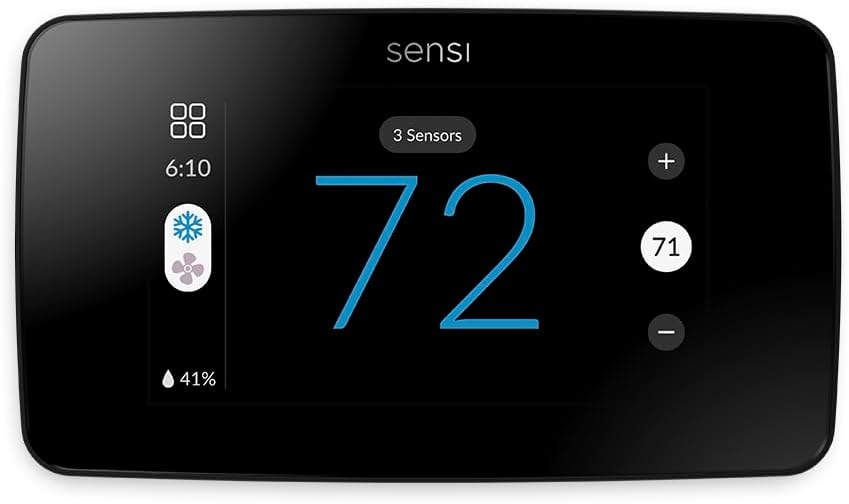
Sensi Touch 2 Smart Thermostat ST76
A privacy-focused smart thermostat with a responsive touchscreen, strong DIY installation guidance, and the ability to pair with up to 15 room sensors for zoned comfort. Its 100-year HVAC heritage and Energy Star certification deliver measurable savings, though WiFi connectivity issues and app dependency for full functionality have frustrated some users.
Pros
- Clear, responsive touchscreen display and straightforward app interface praised by users across technical skill levels
- DIY installation process genuinely accessible, with video guides and step-by-step prompts reducing setup friction
- Privacy-first approach appeals to users concerned about data monetization by thermostat manufacturers
- Room sensor compatibility addresses real comfort pain point (hot/cold spots) without running new wiring
- Automatic heat pump/auxiliary heat switching delivers noticeable gas savings in hybrid heating systems
Cons
- WiFi connection setup inconsistent for some users, requiring multiple troubleshooting attempts and rebooting
- Smartphone app dependency for product registration, customer support access, and certain advanced settings
- Limited phone support availability, leaving non-app users or connectivity-troubled customers without responsive help channels
ecobee Smart Thermostat Enhanced, WiFi Programmable
A hardwired smart thermostat with built-in radar occupancy sensing and eco+ automation that can save up to 26% annually on heating and cooling. Works with Alexa, Google Assistant, and Apple HomeKit, though installation complexity varies significantly by home HVAC setup.
Pros
- Excellent energy reporting with hourly, daily, weekly, and monthly usage breakdowns
- Seamless app setup and intuitive on-device controls once installed
- Included Power Extender Kit (PEK) handles homes without C-wire via clever voltage-repurposing
- Radar motion sensor prevents unnecessary heating/cooling of empty spaces
- Highly compatible with diverse HVAC configurations including heat pumps and dual-fuel systems
Cons
- Installation requires understanding home HVAC wiring; professional setup often recommended if C-wire absent or non-standard colors used
- No circulation-only fan mode, only minimum runtime settings per hour
- API integration limitations for advanced smart home platforms like Home Assistant unless using HomeKit workaround
Sensi ST55 Wi-Fi Smart Thermostat
Sensi's ST55 is a DIY-friendly smart thermostat backed by Emerson's HVAC expertise, offering Energy Star certification and an estimated 23% energy savings through scheduling and remote access. It prioritizes privacy and works with major smart home platforms, making it a solid choice for homeowners seeking straightforward automation without complicated setup.
Pros
- DIY installation without requiring a C-wire in most homes, with built-in level and app-guided steps
- Energy Star certified with usage reports and maintenance alerts to monitor HVAC efficiency
- Strong privacy policy - Sensi doesn't sell personal data to third parties
- Compatible with Alexa, Google Assistant, Apple HomeKit, SmartThings, and Vera
- 3-year manufacturer warranty and 24/7 HVAC expert customer support
Cons
- No touchscreen display on the ST55 model - uses LED and button controls instead
- Wi-Fi connectivity limited to 2.4 GHz band only
- No verified user reviews available yet to assess real-world reliability or long-term performance
Honeywell Home T5 Smart Wi-Fi Thermostat
The T5 is a programmable Wi-Fi thermostat with a touchscreen display, geofencing, and voice assistant compatibility. Users report straightforward installation and reliable performance, though compatibility requirements and occasional software issues warrant careful consideration before purchase.
Pros
- Easy installation and app setup, especially when replacing compatible Honeywell models without rewiring
- Clear touchscreen display readable from across the room with intuitive controls
- Broad smart home ecosystem support through major voice assistants
- Monthly energy reports and filter change reminders help track and optimize usage
Cons
- Requires C-wire power adapter, incompatible with homes lacking this connection or heating-only oil systems
- Geofencing feature reported unreliable by some users, may require disabling to maintain consistent performance
- Setup and cloud connectivity issues documented in reviews, with customer support responsiveness questioned
Honeywell Home RTH9585WF1004 Wi-Fi Smart Thermostat
A color touchscreen smart thermostat with 7-day programming, Energy Star certification, and voice control compatibility. Best for homeowners seeking flexible scheduling and energy tracking through a connected device.
Pros
- Intuitive touchscreen interface with easy operation
- Energy Star certified with built-in tracking and personalized energy-saving tips
- Seamless integration with major voice assistants and Honeywell mobile app for remote control
- Flexible programming accommodates both personal schedules and utility peak pricing
- Eligible for utility rebates and Demand Response Program rewards
Cons
- Requires C-wire installation, not compatible with electric baseboard heating or heating-only oil furnace systems without adapter
- 4.3 rating from nearly 20,000 reviews suggests mixed user experiences worth investigating before purchase
Honeywell T6 Pro Z-Wave Programmable Thermostat
A locally-controlled Z-Wave thermostat that works independently or integrated into smart home hubs like Home Assistant and SmartThings, with no cloud dependency or subscription fees. Offers 7-day scheduling, 3.5-inch touchscreen display, and compatibility with most HVAC and heat pump systems, though Z-Wave pairing can be unintuitive for some users.
Pros
- Subscription-free remote control via Resideo app with no monthly charges
- Functions as traditional programmable thermostat offline, independent of Z-Wave network or automation
- Z-Wave Plus v2 certified with extended range (up to 1,300 feet), three layers of encryption, and longer battery life
- Large 3.5-inch backlit touchscreen with clear readability and intuitive on-device controls
- Compatible with Samsung SmartThings, Apple HomeKit, IFTTT, and voice assistants (Alexa, Google Assistant, Cortana)
- Supports up to 3-stage heating and 2-stage cooling for heat pumps or 2H/2C conventional systems
- Battery or hardwired operation (3 AAA batteries or 24VAC C-wire), with built-in compressor protection
- Includes mounting hardware and cover plate for easy installation
Cons
- Z-Wave setup is poorly documented with counterintuitive menus and no straightforward factory reset option for hub migration
- Does not support Z-Wave association groups for external temperature sensors, requiring hardwired thermistor probes for multi-sensor averaging
- Not compatible with electric baseboard heating systems (120-240V)
- Humidity sensor included but secondary to primary temperature control features
Vine TJ-919T Smart Thermostat 4.3" Touchscreen
A WiFi-enabled programmable thermostat with a large 4.3-inch touchscreen and integrated nightlight, compatible with Alexa and Google Assistant. Best suited for homeowners with 24V systems looking for 7-day scheduling and remote app control without breaking budget.
Pros
- Large, user-friendly touchscreen with nightlight is rare in this category
- Broad system compatibility covers conventional, heat pump, and boiler setups
- Geofence and smart scheduling reduce energy costs when away
- Multi-control options: app, voice, and manual touchscreen
- Includes all installation accessories and guides for DIY setup
Cons
- Requires a common wire (C-wire), which may not be available in all existing homes
- No verified customer reviews yet to assess real-world reliability
- Limited comparison data with competing 4.3-inch models in the same price range
Honeywell TH5320R1002 FocusPRO Wireless Thermostat
The FocusPRO TH5320R1002 brings wireless convenience to Honeywell's popular thermostat line, allowing you to relocate without running new wires and connect to the internet via RedLink gateway. Non-programmable controls work best for those seeking simple manual operation rather than complex scheduling.
Pros
- Easy setup and installation, especially for users with existing RedLink systems
- Wireless portability solves real installation constraints without rewiring
- Works with heat pump systems and allows separate control of emergency/auxiliary heat
- Affordably priced compared to electrician installation fees, per verified buyer feedback
Cons
- Requires separate RedLink internet gateway purchase for remote access capability
- Non-programmable manual controls lack scheduling features some users expect from modern thermostats
- Connection consistency issues reported by some users; not suitable for applications requiring precise temperature stability
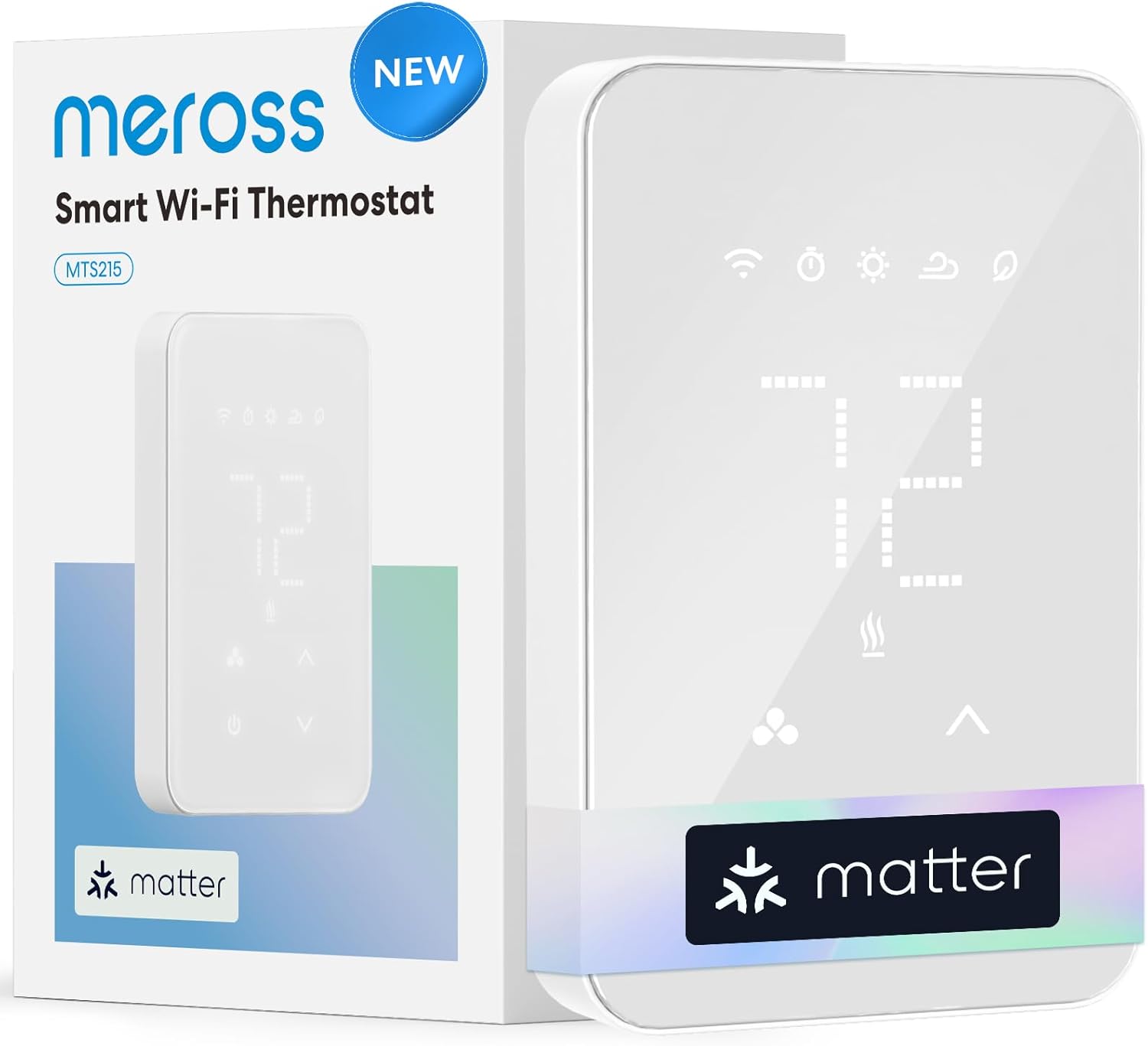
Meross MTS215 Matter Smart Thermostat for Baseboard Heat
A Matter-compatible smart thermostat purpose-built for electric baseboard heaters, offering cross-ecosystem control via Alexa, Apple Home, and Google Home. Works exclusively with 120-240V line voltage heating systems and includes real-time energy monitoring and open window detection.
Pros
- Matter support future-proofs integration across multiple smart home ecosystems without lock-in
- Energy monitoring dashboard helps identify heating patterns and reduce utility costs
- Straightforward installation process for baseboard-only systems with clear wiring guide
- App offers granular control including temperature offset calibration for accuracy
- Competitively priced compared to similar Matter-enabled baseboard thermostats like Mysa
Cons
- Incompatible with HVAC systems, heat pumps, AC, and electric underfloor heating; baseboard-only
- Requires neutral wire connection, which older homes may lack; professional electrician installation recommended
- Maximum 3840W load at 240V means dual high-wattage baseboard heaters may exceed capacity; sensor accuracy affected by nearby heat sources requiring calibration
Lux PSP511LC 5-2 Day Programmable Thermostat
A budget-friendly programmable thermostat with separate heating and cooling schedules, ideal for homeowners seeking basic energy savings without smart home integration. Simple button controls and clear instructions make setup straightforward, though it lacks modern connectivity features.
Pros
- Affordable entry-level programmable option with 4.5-star rating from 1,369 verified buyers
- Separate weekday and weekend programming with up to 4 periods per day for flexible scheduling
- Easy installation and setup using mechanical knob and push-button controls, works with existing wiring
- Battery-powered (2 AA batteries included) with adjustable temperature swing settings for comfort customization
- Keyboard lockout feature and temperature range of 45-90 degrees Fahrenheit for safety and precision
Cons
- No smart home connectivity, app control, or remote access capability
- Swing adjustment feature can be counterintuitive, allowing temperature to overshoot the set point when heating cycles off
- Limited HVAC compatibility, incompatible with multi-stage heat pumps and some furnace types
Smart Thermostats Without C Wire Buying Guide
Understanding the C Wire Requirement
The common wire, or C wire, provides a continuous 24-volt return path that keeps a smart thermostat powered without drawing electricity from the heating or cooling signal wires.
Many homes built before the late 1990s only ran four-wire or even two-wire low-voltage cable, and the fifth conductor was simply left out.
Before purchasing any smart thermostat, count the wires currently attached to your old thermostat’s terminal block and photograph the label on your furnace control board.
If you see terminals labeled R, G, Y, and W but no C, you fall into the no-C-wire camp and need a thermostat designed for that situation.
Manufacturers solve this in three main ways.
Power-stealing or power-harvesting designs trickle tiny amounts of current through the call wires even when the system is idle, which works well with most gas furnaces but can interfere with variable-speed or communicating HVAC equipment.
Adapter kits, like the Honeywell Home RedLINK receiver or the ecobee Power Extender Kit, use an existing spare wire or repurpose the G wire as a pseudo-C wire.
Finally, some budget models simply run on AA batteries and handle Wi-Fi through ultra-low-power radio chips. Understanding which approach a model uses helps you predict whether it will play nicely with your specific furnace or heat pump.
If your furnace control board has an unused wire tucked behind the wall plate that simply was not connected at the thermostat end, an HVAC technician or a confident DIYer can often activate it as a proper C wire in under ten minutes, which opens up every smart thermostat on the market.
Always check before assuming you have no options.
Compatibility with Your HVAC System
Smart thermostats are not universally compatible with every heating and cooling configuration. Conventional single-stage systems, which are the most common setup in North American homes, work with virtually every model on this list.
However, if you have a heat pump, dual-fuel system, multi-stage equipment, or electric baseboard heating, compatibility narrows considerably.
Heat pumps require O/B reversing-valve wiring that not every thermostat handles correctly, and electric baseboard heaters operate on line voltage, typically 120V or 240V, which rules out all standard low-voltage smart thermostats.
The meross Matter Smart Thermostat is one of the few picks here specifically engineered for electric baseboard applications.
Most manufacturers publish interactive compatibility checkers on their websites where you enter your current wiring configuration and receive a definitive yes or no. Running that check before checkout can save a frustrating return.
Pay special attention to whether your system is a millivolt design, common with gas fireplaces and older floor furnaces, because millivolt systems are incompatible with virtually all smart thermostats regardless of C wire status.
Scheduling Flexibility and Smart Features
The fundamental value proposition of a smart thermostat is automated temperature management that reduces energy use without sacrificing comfort.
Entry-level programmable models offer 5-2 day or 7-day scheduling, meaning you set different temperature programs for weekdays and weekends or every day of the week.
Mid-range options layer in geofencing, which detects when your phone leaves or approaches home and adjusts setpoints automatically, effectively making your schedule smarter without requiring you to micromanage it.
Premium models from ecobee go further with occupancy-sensing room sensors that shift comfort focus to whichever rooms are actually occupied, addressing the common complaint that the thermostat location never reflects where the family actually spends time.
The ecobee Smart Thermostat Premium also incorporates an air quality monitor and integrates with a wide array of smart displays and hubs, making it a genuine ecosystem device rather than just a temperature controller.
Consider how much automation you genuinely want to manage; more features mean more setup time, and some households find a well-programmed 7-day schedule perfectly sufficient.
Voice Assistant and Smart Home Integration

All of the Wi-Fi-enabled models on this list support Amazon Alexa, and most also work with Google Assistant.
The ecobee lineup adds Apple HomeKit and Siri support natively, which is a significant advantage for households heavily invested in the Apple ecosystem.
The Honeywell Home TH6320ZW2007 takes a different path by using Z-Wave rather than Wi-Fi, making it an ideal fit for homes that already run a Z-Wave hub like SmartThings or a dedicated home automation controller, while keeping the thermostat itself off your direct Wi-Fi network.
The meross model stands out for its Matter certification, which means it connects natively to Apple Home, Google Home, Amazon Alexa, and SmartThings through a single standard rather than requiring manufacturer-specific bridges.
Matter adoption is still growing, but for anyone building a future-ready smart home, it reduces the risk of devices becoming orphaned if a manufacturer discontinues a proprietary cloud service.
Think about which voice platform your household uses most before committing to an ecosystem.
Display, Interface, and Ease of Use

The thermostat wall display matters more than it might seem, because household members who do not use the app need to make adjustments directly on the device.
Budget models often use small segmented LCD screens with physical buttons, which are perfectly functional but lack the intuitive feel of a touchscreen.
Mid-range options like the Honeywell Home RTH9585WF1004 offer a color touchscreen that feels closer to a smartphone interface.
The Sensi Touch 2 pairs a clean capacitive touchscreen with a slim profile that looks noticeably more modern than the classic rectangular thermostat shape.
Consider how the thermostat will look on your wall, particularly if your current unit left a paint shadow or wall damage. Several models include cover plates that mask old mounting holes.
Installation complexity varies: most Wi-Fi models walk you through wiring via an in-app step-by-step guide with labeled photos, and typical installs run 20 to 45 minutes for a confident DIYer.
The Sensi ST55 is frequently cited in verified buyer feedback for its unusually straightforward app-guided setup, making it a popular recommendation for renters or first-time smart thermostat buyers.
Energy Savings and ENERGY STAR Certification

ENERGY STAR certification for thermostats means the U.S. Environmental Protection Agency has verified that the device meets minimum standards for energy-saving scheduling and reporting features.
Several models on this list carry that certification, including both Sensi models and the Honeywell Home RTH9585WF1004.
The EPA estimates that a certified smart thermostat can save around eight percent on heating and cooling costs annually compared to a manual thermostat, though real-world savings depend heavily on local climate, home insulation, and how consistently you use the scheduling features.
Beyond the certification badge, look for monthly energy reports in the companion app, which translate raw runtime data into actionable insights. ecobee’s Home IQ reports and Sensi’s energy tracking are among the most detailed available at their respective price points.
If energy reporting matters to you, prioritize models that push historical data to the app rather than simply displaying a current setpoint.
Pairing a smart thermostat with other efficiency upgrades in your smart locks and security ecosystem can further reduce unintended energy loss from forgotten open doors or windows.
Why You Should Trust Us
REMOVU is an independent review publication.
Every product on this list was evaluated using a consistent, multi-source research framework: we analyze published manufacturer specifications, cross-reference expert review consensus from credentialed HVAC and consumer electronics sources, and weigh verified buyer feedback from confirmed purchasers.
We do not conduct our own product trials; our evaluations are grounded in research, published data, expert review consensus, and verified buyer feedback.
Each product receives a REMOVU Score on a 0 to 10 scale that reflects overall value, reliability, feature depth, and user experience relative to competing options in the same category.
REMOVU may earn a commission if you purchase through links on this page. That affiliate relationship has no influence whatsoever on which products are included, how they are ranked, or the scores they receive.
Rankings are determined solely by our evaluation criteria, not by commercial arrangements.
Our goal is to give you the clearest, most honest picture of each product so you can make a confident decision without having to wade through dozens of conflicting sources on your own.
Final Thoughts
The smart thermostat category has matured to the point where there is a genuinely excellent option for almost every household type and budget, even without a C wire.
Whether you want a no-fuss programmable unit, a touchscreen mid-ranger, or a premium device loaded with sensors and ecosystem integrations, the picks above represent the best the market offers right now based on our research.
Here is a quick-reference summary of our top awards:
- Best Overall: ecobee Smart Thermostat Enhanced. It earns the highest REMOVU Score on this list through an exceptional combination of compatibility, smart home integration across Siri, Alexa, and Google Assistant, reliable no-C-wire installation via the included Power Extender Kit, and a proven track record of energy savings backed by ENERGY STAR certification.
- Best Premium Pick: ecobee Smart Thermostat Premium. For households that want the most feature-complete smart thermostat available, this model adds a built-in air quality monitor, SmartSensor support, and a richer home automation profile, earning it a near-perfect REMOVU Score among the premium tier.
- Best for Style and Touchscreen Experience: Sensi Touch 2 Smart Thermostat. Its slim capacitive touchscreen, straightforward app-guided setup, and ENERGY STAR credentials make it the standout choice for anyone who wants a modern-looking wall presence alongside solid smart features.
- Best Budget-Friendly Smart Thermostat: Sensi Smart Thermostat ST55. Consistently praised in verified buyer feedback for its painless DIY install and broad HVAC compatibility, this model delivers Wi-Fi scheduling and Alexa control at an accessible price point without cutting corners on reliability.
- Best for Electric Baseboard Heaters: meross Matter Smart Thermostat. A rare option explicitly designed for line-voltage electric baseboard systems, with Matter certification ensuring it works natively with Alexa, HomeKit, Google Home, and SmartThings without proprietary bridges.
If you are building out a wider connected home, also consider how your thermostat pairs with other devices. Security cameras, video doorbells, and robot vacuums increasingly share the same app ecosystems as smart thermostats, so choosing models that align on a single platform can simplify daily management considerably.
Frequently Asked Questions
How do I know if my home has a C wire?
Remove your existing thermostat faceplate and look at the wire terminals on the wall plate. If you see a wire connected to the terminal labeled C, you have a common wire and can use virtually any smart thermostat.
If the C terminal is empty or absent, check whether an unconnected wire is tucked in the wall cavity behind the plate.
That unused wire may already run to your furnace control board and can often be activated without new wiring. Many smart thermostat apps include a wiring-identification tool that walks you through this process with photographs.
Will a no-C-wire smart thermostat work with my heat pump?
Heat pump compatibility depends on the specific thermostat and how it handles power harvesting.
Some models that use power-stealing technology can interfere with the variable-speed or communicating components found in modern heat pumps, causing short cycling or erratic behavior. ecobee’s Power Extender Kit, for example, repurposes the G wire as a C wire substitute, which avoids the power-stealing issue entirely and is generally considered more reliable with heat pumps.
Always run the manufacturer’s compatibility checker using your specific wiring configuration before purchasing.
Can I install a smart thermostat myself without an electrician?
Most low-voltage smart thermostats, which cover all the Wi-Fi and Z-Wave models on this list except the meross baseboard model, operate at 24 volts and are considered safe for DIY installation in most jurisdictions.
The process typically involves turning off your furnace breaker, photographing your existing wiring, attaching wires to the matching terminals on the new base plate, and following the in-app setup wizard. The entire process takes 20 to 45 minutes for most people.
The meross baseboard thermostat runs at line voltage and should be installed by a licensed electrician unless you are fully confident working with 120V or 240V circuits.
Does a smart thermostat actually save money on energy bills?
Independent analysis by the U.S. EPA and various energy research bodies suggests that ENERGY STAR-certified smart thermostats can reduce heating and cooling costs by around eight percent annually compared to a manually operated thermostat.
Actual savings depend on your climate zone, the efficiency of your existing HVAC equipment, your current thermostat habits, and how actively you use the scheduling and geofencing features.
Households that currently leave a thermostat set to a single temperature around the clock tend to see the largest gains after switching to a properly programmed smart model.
What is the difference between Z-Wave and Wi-Fi thermostats?
Wi-Fi thermostats connect directly to your home router and are controlled through the manufacturer’s app or a linked voice assistant, requiring no additional hub hardware.
Z-Wave thermostats, like the Honeywell Home TH6320ZW2007, use a dedicated low-power mesh protocol designed for home automation and require a compatible Z-Wave hub to function.
Z-Wave setups are generally preferred by home automation enthusiasts who want local control, lower latency, and reduced dependence on manufacturer cloud services.
For most homeowners without an existing Z-Wave ecosystem, a Wi-Fi model is simpler and equally capable for everyday use.
Are smart thermostats compatible with older two-wire systems?
Two-wire or single-stage heating-only systems, common in homes with gas boilers or older furnaces, can be challenging for smart thermostats because there is no cooling wire to harvest supplemental power from.
Some models handle this well with internal batteries providing backup power; others struggle. The Sensi ST55 and LUX PSP511LC are frequently cited in buyer feedback as more tolerant of minimal wiring configurations.
If your system runs on only two wires, filter manufacturer compatibility tools specifically for that scenario and verify before purchasing rather than assuming any smart thermostat will work.
Related Guides
About the author
Enrique writes about projectors for REMOVU, weighing brightness, resolution, and throw distance for home and portable use. He helps readers get a true big-screen experience that no TV matches.