The 12 Best Smart Thermostats for Google Home
Pairing your thermostat with Google Home can cut energy bills and simplify daily comfort. Here are the top picks across every budget, from reliable DIY options to premium learning models.
 By Lawrence Hale
Updated July 26, 2026
By Lawrence Hale
Updated July 26, 2026

A smart thermostat is one of the highest-return smart home upgrades you can make.
When paired with Google Home, it becomes even more powerful: voice commands, automation routines, and remote access all work together to keep your home comfortable while trimming energy bills.
But with dozens of models on the market spanning budget-friendly options from Riseem and VINESmartHome to premium picks from ecobee and Google Nest, figuring out which one actually delivers is harder than it should be.
This guide covers the top smart thermostats that work with Google Home, based on REMOVU’s research across published specifications, expert review consensus, and verified buyer feedback.
Whether you’re building a full smart home ecosystem or simply want reliable voice control over your HVAC, the picks below give you a ranked starting point to shop with confidence.

ecobee Smart Thermostat Premium with Air Quality Monitor
This premium smart thermostat combines voice control (Alexa and Siri built-in), an included room sensor, and air quality monitoring to optimize comfort and energy efficiency. It integrates with major smart home ecosystems and claims up to 26% annual savings on heating and cooling costs.
Pros
- Included SmartSensor ($50 value) provides multi-room temperature management without extra cost
- Native Alexa and Siri integration means you don't need separate Echo devices or HomeKit hub for voice control
- Wider HVAC compatibility (95% of systems) plus included PEK kit eliminates most installation barriers
- Robust app with intuitive scheduling modes, vacation holds, and time-of-use rate tracking
- Solid 4.3-star rating from 4,013 reviews with praise for reliability and customer support
Cons
- Weather data for auxiliary heat crossover relies on distant weather stations that update infrequently, causing inefficiency in rural or mountainous areas with significant temperature variations
- PEK kit terminals have poor design for twisted copper wires, requiring crimp connectors for reliable connections
- Lacks a simple one-button eco mode toggle like some competitors, requiring navigation through app menus

Google Nest Learning Thermostat 4th Gen with Temperature Sensor
Google's latest Learning Thermostat combines smart scheduling, energy savings up to 31%, and intuitive app control with a bundled temperature sensor for managing hot and cold spots. Setup takes under 40 minutes and works with most 24V heating systems without requiring a C wire.
Pros
- Documented energy savings up to 31% on heating and cooling costs with Adaptive Eco and smart scheduling
- Inclusive temperature sensor addresses common hot and cold spots without extra purchase
- Broad device compatibility (Alexa, Google Assistant, HomeKit) and Matter-ready for flexible smart home integration
- Natural heating and cooling feature learns outdoor temperature effects to pause your system opportunistically
- DIY installation in 40 minutes with step-by-step app guidance, no professional required
Cons
- No verified buyer reviews available to confirm real-world performance and reliability
- Requires 24V system; incompatibility with low-voltage systems limits potential audience
- Additional Nest Temperature Sensors (for more rooms) sold separately, adding ongoing costs

Google Nest Learning Thermostat 4th Gen
Google's latest learning thermostat combines a larger display with energy-saving smarts, learning your temperature preferences and adapting to seasonal changes. It pairs with the included Nest Temperature Sensor and works across most heating and cooling systems without requiring a C wire in most homes.
Pros
- No C wire required for installation in most homes, simplifying setup
- Excellent multi-platform compatibility with major smart home ecosystems
- Natural heating and cooling detection pauses systems to reduce waste
- Inclusive Temperature Sensor enables precise room-by-room temperature management
- Permission-based schedule adjustments provide transparency and control over energy decisions
Cons
- No verified buyer reviews yet to validate real-world performance claims
- Savings estimates (12-15%) are averages and will vary based on climate and usage patterns
- Requires separate batteries (1 CR2) for the Temperature Sensor

Google Nest Learning Thermostat Pro with Temperature Sensor
Google's fourth-generation Nest thermostat targets homeowners who prioritize professional installation and advanced system compatibility. It pairs adaptive learning with a bundled temperature sensor for room-based control, though setup requires certified installer involvement.
Pros
- Broad system compatibility covers most residential HVAC setups including dual-fuel and geothermal
- Temperature sensor package adds granular control without separate purchase
- Professional calibration ensures proper configuration matched to your equipment
- Integrates with major voice assistants for remote control
- Solid 4.4-star rating across 71 verified reviews
Cons
- Requires professional installation, adding upfront cost and scheduling complexity
- Not suitable for DIY installers or those seeking plug-and-play setup
- Limited visibility into real-world performance data from verified buyer reviews provided

Google Nest Learning Thermostat 4th Gen with Sensor
Google's 4th-generation learning thermostat adapts to your routine and can reduce heating and cooling bills by up to 12-15%. The included temperature sensor helps manage hot and cold spots, while voice control via Alexa and Google Home adds convenience for remote management.
Pros
- Adaptive learning reduces energy consumption with documented 12-15% bill savings
- Included temperature sensor eliminates need for separate purchase to manage multiple rooms
- Compatible with most common HVAC types (gas, electric, oil, heat pump, radiant) without requiring C-wire installation
- Large bright display adjusts automatically and visible from across the room
- Genuine buyer feedback confirms remote management works well for elderly parents or multi-home scenarios
Cons
- Renewed/refurbished unit may require factory reset during initial setup, adding complexity for some users
- 90-day limited warranty is shorter than typical for smart home devices
- Requires Wi-Fi connectivity and compatible HVAC system for full feature functionality

Google Nest Learning Thermostat 3rd Gen with Wall Mount
The Nest Learning Thermostat programs itself by tracking your temperature preferences and automatically adjusts when you leave home, with independent studies showing 10-12% savings on heating and 15% on cooling bills. Control it remotely via smartphone and enjoy features like energy history tracking, Farsight display, and integration with Nest Protect for added safety.
Pros
- Learns your habits automatically and creates schedules without manual programming
- Real-time energy tracking helps you understand consumption patterns
- Works with Wi-Fi for convenient remote access from anywhere
- Farsight feature displays time, temperature, and weather when detected across the room
- Energy Star certified and proven to reduce utility bills
Cons
- No verified buyer reviews available to assess real-world performance and reliability
- Requires Wi-Fi connectivity and battery power, which may need regular monitoring
- Learning curve and setup may require 24/7 support assistance for some users

ecobee Smart Thermostat Enhanced, WiFi Programmable
A hardwired smart thermostat with built-in radar occupancy sensing and eco+ automation that can save up to 26% annually on heating and cooling. Works with Alexa, Google Assistant, and Apple HomeKit, though installation complexity varies significantly by home HVAC setup.
Pros
- Excellent energy reporting with hourly, daily, weekly, and monthly usage breakdowns
- Seamless app setup and intuitive on-device controls once installed
- Included Power Extender Kit (PEK) handles homes without C-wire via clever voltage-repurposing
- Radar motion sensor prevents unnecessary heating/cooling of empty spaces
- Highly compatible with diverse HVAC configurations including heat pumps and dual-fuel systems
Cons
- Installation requires understanding home HVAC wiring; professional setup often recommended if C-wire absent or non-standard colors used
- No circulation-only fan mode, only minimum runtime settings per hour
- API integration limitations for advanced smart home platforms like Home Assistant unless using HomeKit workaround
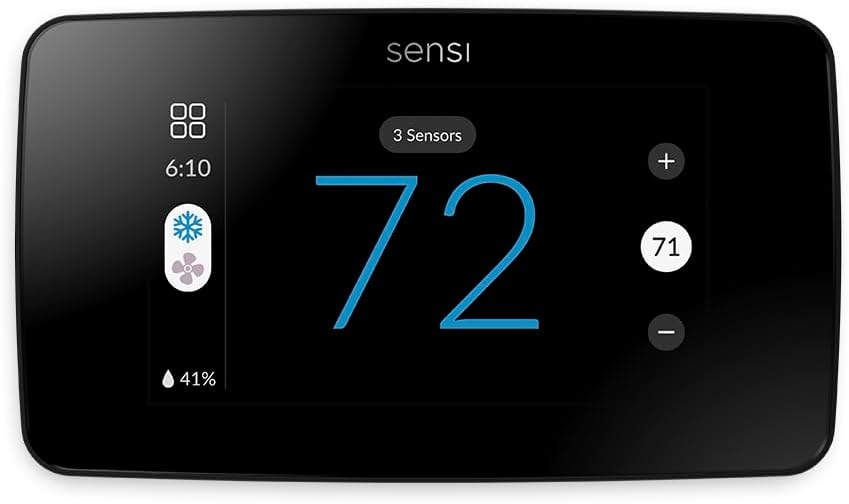
Sensi Touch 2 Smart Thermostat ST76
A privacy-focused smart thermostat with a responsive touchscreen, strong DIY installation guidance, and the ability to pair with up to 15 room sensors for zoned comfort. Its 100-year HVAC heritage and Energy Star certification deliver measurable savings, though WiFi connectivity issues and app dependency for full functionality have frustrated some users.
Pros
- Clear, responsive touchscreen display and straightforward app interface praised by users across technical skill levels
- DIY installation process genuinely accessible, with video guides and step-by-step prompts reducing setup friction
- Privacy-first approach appeals to users concerned about data monetization by thermostat manufacturers
- Room sensor compatibility addresses real comfort pain point (hot/cold spots) without running new wiring
- Automatic heat pump/auxiliary heat switching delivers noticeable gas savings in hybrid heating systems
Cons
- WiFi connection setup inconsistent for some users, requiring multiple troubleshooting attempts and rebooting
- Smartphone app dependency for product registration, customer support access, and certain advanced settings
- Limited phone support availability, leaving non-app users or connectivity-troubled customers without responsive help channels

Sensi ST55 Wi-Fi Smart Thermostat
Sensi's ST55 is a DIY-friendly smart thermostat backed by Emerson's HVAC expertise, offering Energy Star certification and an estimated 23% energy savings through scheduling and remote access. It prioritizes privacy and works with major smart home platforms, making it a solid choice for homeowners seeking straightforward automation without complicated setup.
Pros
- DIY installation without requiring a C-wire in most homes, with built-in level and app-guided steps
- Energy Star certified with usage reports and maintenance alerts to monitor HVAC efficiency
- Strong privacy policy - Sensi doesn't sell personal data to third parties
- Compatible with Alexa, Google Assistant, Apple HomeKit, SmartThings, and Vera
- 3-year manufacturer warranty and 24/7 HVAC expert customer support
Cons
- No touchscreen display on the ST55 model - uses LED and button controls instead
- Wi-Fi connectivity limited to 2.4 GHz band only
- No verified user reviews available yet to assess real-world reliability or long-term performance

Vine TJ-919T Smart Thermostat 4.3" Touchscreen
A WiFi-enabled programmable thermostat with a large 4.3-inch touchscreen and integrated nightlight, compatible with Alexa and Google Assistant. Best suited for homeowners with 24V systems looking for 7-day scheduling and remote app control without breaking budget.
Pros
- Large, user-friendly touchscreen with nightlight is rare in this category
- Broad system compatibility covers conventional, heat pump, and boiler setups
- Geofence and smart scheduling reduce energy costs when away
- Multi-control options: app, voice, and manual touchscreen
- Includes all installation accessories and guides for DIY setup
Cons
- Requires a common wire (C-wire), which may not be available in all existing homes
- No verified customer reviews yet to assess real-world reliability
- Limited comparison data with competing 4.3-inch models in the same price range

Honeywell Home RTH9585WF1004 Wi-Fi Smart Thermostat
A color touchscreen smart thermostat with 7-day programming, Energy Star certification, and voice control compatibility. Best for homeowners seeking flexible scheduling and energy tracking through a connected device.
Pros
- Intuitive touchscreen interface with easy operation
- Energy Star certified with built-in tracking and personalized energy-saving tips
- Seamless integration with major voice assistants and Honeywell mobile app for remote control
- Flexible programming accommodates both personal schedules and utility peak pricing
- Eligible for utility rebates and Demand Response Program rewards
Cons
- Requires C-wire installation, not compatible with electric baseboard heating or heating-only oil furnace systems without adapter
- 4.3 rating from nearly 20,000 reviews suggests mixed user experiences worth investigating before purchase
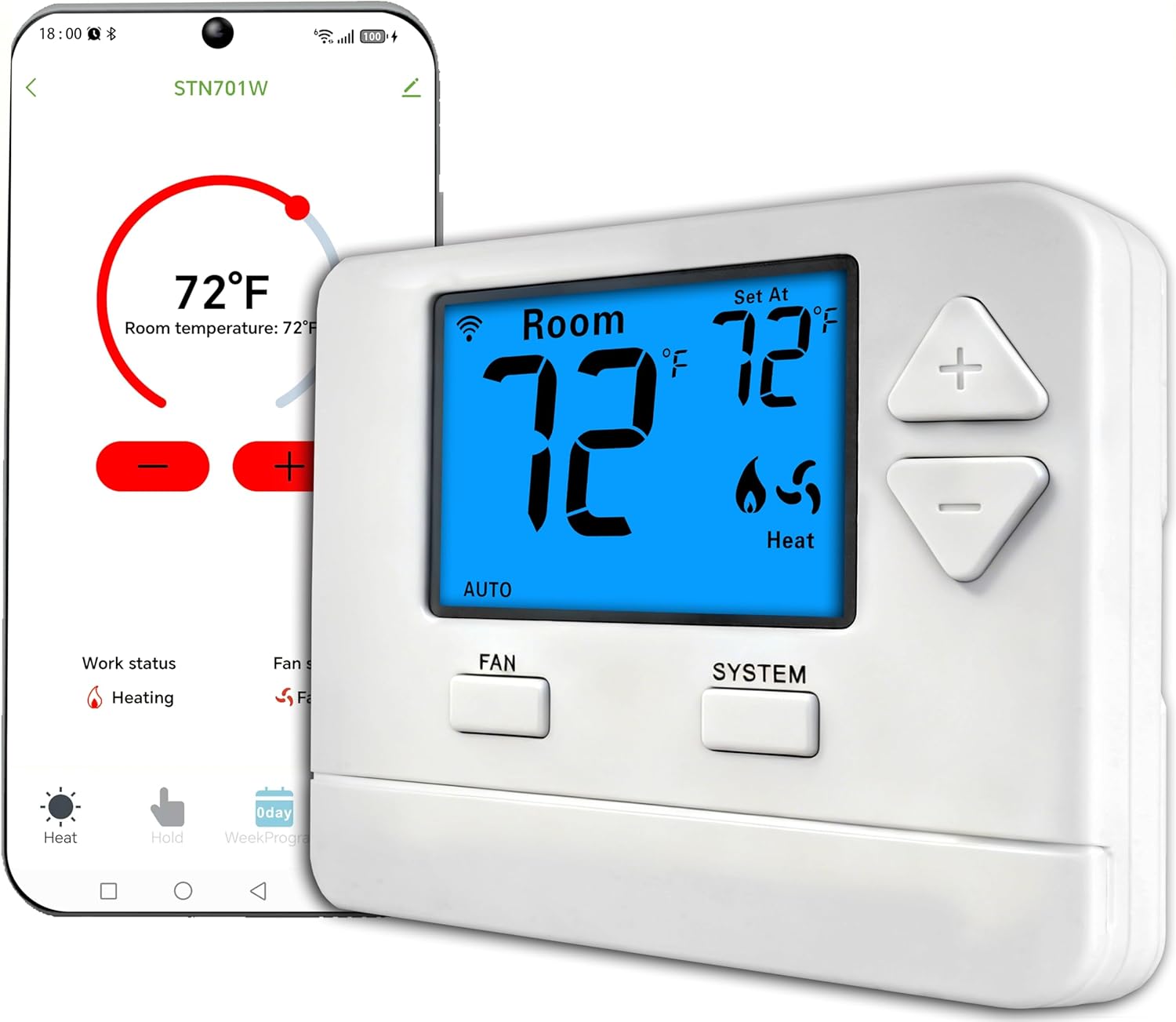
Riseem STN701W WiFi Smart Thermostat, Single-Stage
A budget-friendly WiFi thermostat for single-stage HVAC systems with app control and 7-day scheduling. Most users praise simple installation and Alexa compatibility, though it requires a C-wire and has occasional quirks with settings.
Pros
- Easy DIY installation and app setup, according to verified buyers
- Works with Alexa and smartphone app for remote temperature control
- 7-day programmable schedule for customized daily settings
- Bright blue LCD display for manual adjustments
- Good value for basic WiFi thermostat features
Cons
- Requires C-wire for power; no battery backup means potential shutdowns without proper wiring
- Limited to single-stage heating/cooling systems only, restricting compatibility
- Some users report difficulty maintaining temperature unit settings (Celsius/Fahrenheit preference)
Smart Thermostats for Google Home Buying Guide
Choosing the right smart thermostat is more nuanced than picking the one with the most features. Compatibility, wiring requirements, ecosystem depth, and long-term energy savings all affect which model is actually worth your money.
The sections below break down the criteria that matter most when shopping for a Google Home-compatible thermostat.
Google Home Compatibility and Ecosystem Depth

Not all thermostats that claim Google Home support offer the same depth of integration.
Some only respond to basic voice commands like setting a target temperature, while others expose richer controls inside the Google Home app, participate in automation routines, and support Google Assistant’s contextual queries.
Google Nest thermostats naturally deliver the tightest integration since they share the same platform.
That said, ecobee models have consistently earned strong marks from expert reviewers for their Google Assistant compatibility, and they add the benefit of cross-platform support including Siri and Alexa, making them a smart choice if you’re not fully committed to a single voice assistant ecosystem.
If you rely heavily on Google Home routines, such as syncing your thermostat with smart locks, security cameras, or smart displays and hubs, prioritize models with official Works with Google Home certification and check whether they support Google Home app controls beyond basic voice triggers.
Wiring Requirements and Installation Complexity

The most common installation barrier is whether your HVAC system provides a C-wire (common wire), which supplies continuous 24V power to keep the thermostat’s Wi-Fi radio and display running without draining batteries.
Many older homes lack a dedicated C-wire, and not all thermostats handle this gracefully.
Google Nest thermostats have historically included a proprietary power-harvesting system that works without a C-wire in many setups, though compatibility is not universal.
Budget models like the Riseem Wi-Fi thermostat explicitly require a C-wire, which is worth noting before you purchase.
Sensi’s ST55 is designed specifically for DIY installation and accommodates a wide range of wiring configurations, making it one of the easier models to get running without an electrician.
Before buying any model, use the manufacturer’s compatibility checker or cross-reference your current thermostat’s wiring diagram. Misreading wiring is the single most common reason buyers return smart thermostats.
Learning and Adaptive Scheduling
Traditional programmable thermostats require you to manually set schedules, which most people never fully optimize. Smart thermostats close that gap through learning algorithms or adaptive eco modes that adjust behavior based on occupancy patterns, local weather, and your manual adjustments over time.
The Google Nest Learning Thermostat (4th Gen) takes this the furthest, using its built-in occupancy sensor and years of algorithm refinement to build a schedule that genuinely reflects how you live in your home.
The ecobee Premium adds occupancy-sensing via its SmartSensor accessories, which detect whether specific rooms are occupied and adjust comfort accordingly rather than relying solely on the main unit’s placement.
If learning features are a priority, look specifically for models that advertise an Adaptive Eco mode or Auto-Schedule capability rather than simple 7-day programmable grids, which still require manual input to work well.
Display, Controls, and App Experience

The thermostat’s physical interface matters more than people expect. You’ll interact with it dozens of times per week, and a slow touchscreen or unintuitive dial can make even a feature-rich model frustrating to use.
Color touchscreens, as found on the Honeywell Home RTH9585WF1004 and Sensi Touch 2, make reading temperature and schedule information at a glance much more comfortable than monochrome LCD displays.
The companion app experience is equally important. ecobee’s app is widely praised for its clean layout and energy usage reporting, while Google’s Home app benefits from being the same interface users already rely on for managing the rest of their smart locks, video doorbells, and other connected devices.
Sensi’s app is considered approachable for first-time smart thermostat buyers.
Remote access via app is a standard feature at this point, but verify that the model you choose supports app control even during periods when your home Wi-Fi goes offline, as some budget models lose all functionality without a live cloud connection.
Energy Savings and ENERGY STAR Certification

One of the primary selling points of any smart thermostat is the promise of lower utility bills.
ENERGY STAR-certified models have met EPA benchmarks for energy efficiency features, and that certification appears on several picks in this list including the Sensi ST55, Honeywell Home RTH9585WF1004, ecobee Enhanced, and Sensi Touch 2.
Look for models that offer energy usage reports in their app, since data visibility encourages better usage habits.
Features like geofencing (automatically adjusting temperature when you leave home) and demand response participation (where your utility provider can offer rebates in exchange for brief adjustments during peak demand) can add meaningful savings over time.
Many utility companies offer rebates for installing ENERGY STAR-certified smart thermostats. It’s worth checking your provider’s website before purchasing, as rebates can meaningfully offset the upfront cost of higher-end models.
Budget and Long-Term Value

Smart thermostats span a wide price range, from entry-level options to premium bundles that include temperature sensors.
At the budget end, the Riseem single-stage thermostat covers the basics with app control and programmable scheduling at a fraction of the cost of flagship models.
It’s a reasonable starting point if your HVAC is straightforward and you don’t need advanced learning or multi-room sensing.
Mid-range picks like the Sensi Touch 2 and VINESmartHome Vine thermostat offer a better balance of build quality, app experience, and Google Home compatibility without the premium attached to ecobee or Google Nest.
If your budget allows, the ecobee Enhanced consistently ranks among the best-value smart thermostats across multiple expert sources, offering most of ecobee Premium’s functionality at a meaningfully lower price point.
Factor in the total cost of ownership: a thermostat that saves you a noticeable percentage on heating and cooling costs every year will pay for itself over time, which tilts the math in favor of investing in a higher-scoring model upfront rather than saving on a budget option that delivers fewer efficiency gains.
Why You Should Trust Us
REMOVU is an independent review publication. We do not manufacture, sell, or take direction from brands.
Every product in this guide was evaluated using our structured research methodology: we analyze published specifications, assess expert review consensus drawn from credible technology and home improvement sources, and weigh verified buyer feedback to identify consistent patterns in real-world performance and reliability.
Each model receives a REMOVU Score on a scale of 0 to 10, assigned according to a consistent set of criteria relevant to the product category.
For smart thermostats compatible with Google Home, those criteria include integration depth, installation accessibility, adaptive scheduling capability, app and display quality, energy efficiency features, and overall value for money.
We do not conduct our own product trials; our evaluations are grounded in research, published data, expert review consensus, and verified buyer feedback.
REMOVU may earn a commission if you purchase through links on this page. That affiliate relationship has no influence on our scores, rankings, or editorial selections. Products are ranked by research-based merit, not by commission rate or brand relationships.
Our goal is straightforward: give you the most useful, honest information so you can make a confident purchase decision.
Final Thoughts
The smart thermostat market for Google Home users is well-stocked with solid options across every price tier. Below are our editorial picks by category, each linked to the product detail so you can review specifications and current pricing directly.
- Best Overall: ecobee Smart Thermostat Enhanced earns the top REMOVU Score in this group for delivering a rare combination of broad platform compatibility, strong ENERGY STAR energy-saving credentials, and a consistently praised app experience, all at a mid-range price that makes it accessible to most buyers.
- Best Premium Pick: ecobee Smart Thermostat Premium steps up with a built-in air quality monitor, Siri and Alexa voice assistants alongside Google Home support, and live view integration with the ecobee Doorbell, making it the most feature-complete option in this roundup for buyers who want a true smart home hub at the thermostat.
- Best Google-Native Option: Google Nest Learning Thermostat (4th Gen) with Nest Temperature Sensor is the natural choice for households already invested in the Google ecosystem, offering the deepest Google Home integration, refined learning algorithms, and a bundled temperature sensor for multi-room accuracy.
- Best Mid-Range Upgrade: Sensi Touch 2 Smart Thermostat balances a color touchscreen, ENERGY STAR certification, and a well-regarded companion app at a price that sits comfortably between budget and premium tiers, making it a strong upgrade path for homeowners replacing an older programmable unit.
- Best Budget Pick: Sensi Smart Thermostat ST55 is the easiest recommendation for buyers who want reliable Wi-Fi control, ENERGY STAR certification, and a genuinely straightforward DIY installation without spending on features they will never use.
Whichever model you choose, pairing your thermostat with a broader smart home setup amplifies its value. Connecting it alongside security cameras and robot vacuums inside a single Google Home environment means more automation possibilities and less manual management across your whole home.
Frequently Asked Questions
Do all smart thermostats work with Google Home?
No. While many smart thermostats advertise Wi-Fi connectivity, Google Home compatibility requires either a native Works with Google Home certification or support for the Google Assistant integration layer.
Always check the product listing for explicit Google Home or Google Assistant support before purchasing, rather than assuming Wi-Fi alone is sufficient.
What is a C-wire and do I need one?
A C-wire (common wire) provides continuous 24-volt power from your HVAC system to your thermostat, which is necessary for keeping the Wi-Fi radio, display, and cloud features running reliably. Many smart thermostats require it.
Some models, including certain Google Nest versions, use power-harvesting techniques that work without a dedicated C-wire in many systems, but compatibility is not guaranteed.
Check your current thermostat’s wiring before you buy, and use the manufacturer’s compatibility tool if one is available.
Can I use a smart thermostat with older HVAC systems?
Most smart thermostats support conventional single-stage heating and cooling systems, which are the most common type in North American homes. Compatibility with heat pumps, multi-stage systems, or radiant heating varies by model.
The Sensi ST55 and ecobee models generally support a broader range of HVAC configurations than budget alternatives. If you have an uncommon setup, check the product’s wiring compatibility page or consult an HVAC technician before purchasing.
How much can a smart thermostat actually save on energy bills?
Real-world savings depend heavily on your current habits, local climate, and how well you use the thermostat’s features. ecobee’s published data suggests average savings of around 26% on heating and cooling costs for users who actively use scheduling and smart recovery features.
Google Nest has published similar figures based on aggregated usage data from its user base. ENERGY STAR estimates that a certified smart thermostat can save a typical household a meaningful amount annually, though individual results will vary.
The key is consistently using geofencing, eco modes, and scheduling rather than leaving the thermostat in manual mode.
Is it worth buying a renewed or refurbished smart thermostat?
Amazon Renewed models, like the Google Nest Learning Thermostat (4th Gen) Renewed listing in this guide, can offer meaningful savings compared to new retail pricing.
The trade-off is that warranty coverage and remaining software support life may differ from a new unit.
For a device that will be deeply integrated into your home’s heating and cooling infrastructure, buying new from an authorized retailer is generally the safer choice unless you’re comfortable with the renewed program’s specific return and replacement terms.
Can smart thermostats work without an internet connection?
Most smart thermostats retain basic local functionality (holding a set temperature) when your internet connection is down, but cloud-dependent features like app control, voice commands via Google Home, remote scheduling changes, and energy reporting will be unavailable until connectivity is restored.
If reliable local fallback is important to you, check the manufacturer’s documentation for offline behavior before purchasing.
Smart displays and hubs on the same local network can sometimes maintain limited device control even without active internet access, depending on the platform.
Related Guides
About the author
Lawrence covers mirrorless and DSLR cameras for REMOVU, weighing image quality, autofocus, and lens ecosystems. He helps photographers choose a body they can grow with.