The 12 Best DSLR Cameras
From first-time buyers to enthusiasts upgrading their kit, choosing the right DSLR comes down to sensor performance, AF system, and lens ecosystem. Our picks cover every budget.
 By Glen Allen
Updated July 26, 2026
By Glen Allen
Updated July 26, 2026

DSLR cameras remain one of the most rewarding tools a photographer can own.
Whether you are shooting portraits at a family gathering, chasing wildlife through a national park, or stepping into photography for the first time, a DSLR gives you optical precision, intuitive controls, and a vast ecosystem of interchangeable lenses that smartphones simply cannot replicate.
The tactile experience of holding a proper camera, adjusting a physical aperture ring, and hearing the mirror click matters to a lot of shooters, and the market has never offered more value for the money than it does right now.
This guide cuts through the noise of spec sheets and marketing claims to surface the most worthwhile picks across beginner, mid-range, and enthusiast tiers.
REMOVU researchers analyzed published specifications, synthesized expert review consensus from across the photography press, and factored in verified buyer feedback to surface cameras that consistently deliver for real-world shooters.
For a broader look at imaging gear, see our full cameras and photo category. Read on for our top picks, followed by everything you need to know before buying.

Nikon D7500 DSLR with 18-140mm Lens Bundle
A versatile DX-format DSLR pairing a 20.9MP sensor with 4K video capability and fast autofocus, designed for photographers stepping up from entry-level gear. This bundle arrives with dual batteries, memory cards, filters, and accessories, making it ready to shoot immediately. Best suited for enthusiasts wanting flagship performance without the professional-level price tag.
Pros
- 20.9MP sensor and EXPEED 5 processor deliver strong image quality comparable to the higher-end D500
- 8 fps continuous shooting and 51-point autofocus system enable reliable tracking in varied lighting
- 4K UHD video recording at 30 fps with uncompressed external output via HDMI
- Extended ISO range (51,200 native, expandable to 1,640,000) handles low-light scenes effectively
- Comprehensive bundle includes spare batteries, 128GB total storage, tripod, filters, and protective case
Cons
- 3.2-inch tilting touchscreen is functional but lower resolution (922k dots) compared to newer competitors
- DX-format sensor is smaller than full-frame, limiting telephoto reach and low-light performance versus professional alternatives
- 12-inch flexible tripod included is lightweight and suited only for casual use, not professional video work

Nikon D3300 24.2MP DSLR with 18-55mm & 55-200mm Lenses
An entry-level DSLR that delivers solid image quality with its 24.2-megapixel sensor and dual zoom lens kit, making it approachable for beginners who want to step up from smartphone photography. The compact body, intuitive Guide Mode, and 1080p video recording cover the essentials without overwhelming complexity. Best suited for hobbyists prioritizing ease of use and versatility over professional-grade features.
Pros
- 24.2MP CMOS sensor captures detailed, vibrant photos with accurate color rendering
- Dual lens kit (18-55mm VR II and 55-200mm) provides flexible focal range for various shooting scenarios
- 5 fps continuous shooting and 11-point autofocus with 3D tracking handle moving subjects reliably
- Compact, lightweight design makes it genuinely portable for everyday carry
- Guide Mode offers step-by-step assistance, lowering the barrier for beginners
- 1080p Full HD video with sound expands creative possibilities beyond stills
Cons
- DX-format sensor is smaller than full-frame alternatives, limiting low-light performance at high ISOs despite ISO 12800 capability
- No built-in wireless connectivity, requires optional WU-1a adapter to share photos directly to smartphones
- 11 AF points is modest by modern standards; tracking can struggle with erratic subject movement

Canon EOS Rebel T7 DSLR with 18-55mm Lens Kit
An entry-level DSLR designed for photographers stepping up from smartphones. The 24.1MP sensor and Full HD video capture deliver solid image quality across various lighting conditions, while built-in Wi-Fi makes sharing straightforward. Scene Intelligent Auto mode keeps operation simple for beginners without sacrificing creative control as skills develop.
Pros
- 24.1MP APS-C CMOS sensor produces sharp, detailed images with good color accuracy
- Wide ISO range (100-6400, expandable to 12800) handles low-light shooting confidently
- Built-in Wi-Fi and NFC enable quick wireless transfer and remote shooting via smartphone
- Fast, reliable 9-point autofocus system with AI Servo tracking for moving subjects
- Optical viewfinder with 95% coverage provides accurate real-time framing and works well in bright sunlight
- Extensive lens compatibility with Canon EF and EF-S library opens creative possibilities
Cons
- Fixed 18-55mm kit lens has variable aperture (f/3.5-5.6), limiting low-light and shallow depth-of-field performance
- No 4K video capability, limited to 1080p Full HD recording
- Entry-level build lacks weather sealing, making it less durable in harsh outdoor conditions

Canon EOS Rebel T7 24.1MP DSLR Bundle
This entry-level DSLR delivers a solid foundation for photography beginners with a 24.1MP sensor, dual lens kit covering wide to telephoto ranges, and practical extras like memory cards and a camera bag. The bundle approach makes it accessible for those building their first system, though the autofocus and continuous shooting speeds reflect its budget positioning.
Pros
- 24.1MP APS-C CMOS sensor with DIGIC 4+ processor produces sharp, detailed images across ISO 100-6400
- Dual lens kit (18-55mm and 75-300mm) covers everyday to telephoto shooting without additional purchases
- Full HD 1080/30p video recording with contrast-detection autofocus for live view and video work
- Built-in Wi-Fi and NFC enable wireless image sharing and remote control via smartphone
- Comprehensive bundle includes memory cards, tripod, filters, bag, and editing software for immediate use
Cons
- Slow continuous shooting at 3 fps limits action and sports photography capability
- 9-point autofocus system is basic compared to mid-range DSLRs, with only one cross-type AF point
- DIGIC 4+ processor is dated technology, potentially showing slower performance in demanding workflows

Canon EOS Rebel T7 DSLR Camera with Dual Lenses
Entry-level DSLR that bridges the gap between smartphone and professional cameras. The 24.1MP sensor and dual zoom lenses (18-55mm and 75-300mm) give beginners versatile focal range out of the box, while built-in Wi-Fi and remote shooting via smartphone make sharing content straightforward. Bundle includes practical accessories like extra battery, tripod, and memory card.
Pros
- 24.1MP CMOS sensor captures detailed images with vibrant color reproduction
- Dual zoom lens kit covers wide-angle to telephoto without additional purchases
- Built-in Wi-Fi and NFC enable wireless connectivity and remote shooting from compatible devices
- DIGIC 4+ processor handles noise reduction effectively, even in low-light conditions
- Comprehensive bundle includes backup battery, tripod, memory card, and cleaning kit
Cons
- DIGIC 4+ is older generation processor, limiting advanced computational photography features compared to newer DSLRs
- 3.0 fps continuous shooting speed is modest for action or sports photography
- Entry-level autofocus system (9-point) is less sophisticated than mid-range DSLR competitors

Canon EOS Rebel T7 24.1MP DSLR with Dual Lenses
A beginner-friendly DSLR that pairs a 24.1MP APS-C sensor with two versatile lenses, making it a complete kit for stepping up from smartphone photography. Built-in Wi-Fi, Scene Intelligent Auto mode, and optical image stabilization simplify the learning curve, while Full HD video and 9-point autofocus handle everyday shooting and action moments with solid reliability.
Pros
- Complete two-lens bundle (18-55mm and 75-300mm) covers wide to telephoto range without additional purchases
- 24.1MP APS-C sensor with DIGIC 4+ processor delivers sharp, vibrant images with reduced noise across ISO 100-12800
- Scene Intelligent Auto and Creative Auto modes lower the barrier to entry for DSLR beginners
- Built-in Wi-Fi and NFC enable quick photo transfer to smartphones and tablets via Canon Connect app
- Includes protective accessories: 32GB SD card, filter kit, camera case, and 1-year warranty
Cons
- 9-point autofocus system is basic compared to mid-range DSLRs, potentially slower for fast-moving subjects
- Continuous shooting maxes out at 3 fps, limiting performance for sports or rapid-fire sequences
- DIGIC 4+ processor is aging technology, newer entry-level models offer faster performance and more advanced features
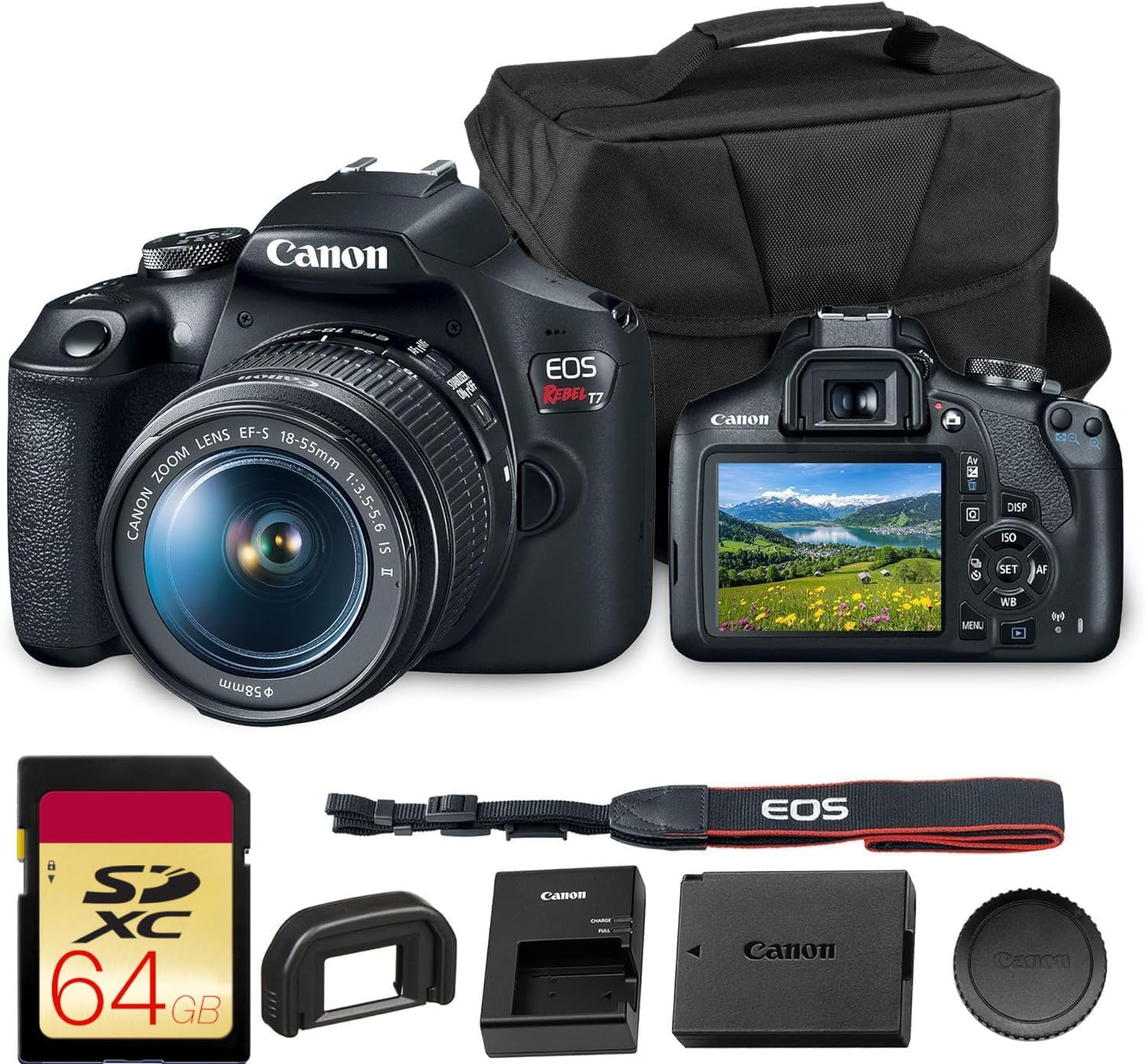
Canon EOS Rebel T7 24.1MP DSLR Camera
An entry-level DSLR built for smartphone users stepping into serious photography. The 24.1MP sensor and DIGIC 4+ processor deliver sharp, vibrant images in most lighting conditions, while built-in Wi-Fi and NFC make sharing to mobile devices straightforward. The intuitive controls and included 18-55mm lens keep the learning curve manageable for beginners.
Pros
- 24.1MP APS-C CMOS sensor captures rich detail and color with strong low-light performance
- DIGIC 4+ processor ensures fast autofocus and effective noise reduction
- Built-in Wi-Fi and NFC enable quick wireless transfer and remote shooting via smartphone
- Full compatibility with Canon's extensive EF and EF-S lens ecosystem for future upgrades
- Comprehensive kit includes camera, 18-55mm lens, 64GB card, battery, charger, and bag
Cons
- DIGIC 4+ processor is dated compared to current-generation Canon DSLRs, which may limit advanced features
- No 4K video capability, limited to 1080p recording
- Smaller battery capacity (860mAh) may require frequent charging during extended shooting sessions

Canon EOS Rebel T7 DSLR Bundle with Triple Lenses
A refurbished entry-level DSLR kit that bundles the Canon T7 with three lenses, 32GB memory, and accessories. The 24.1MP sensor and built-in Wi-Fi make it accessible for beginners, though the DIGIC 4+ processor and 9-point autofocus are dated compared to current models. Best for hobbyists starting out without breaking the bank on renewed gear.
Pros
- Comprehensive bundle includes three lenses covering wide-angle to telephoto, plus tripod, filters, and case
- 24.1MP APS-C sensor with Full HD 1080p video and built-in Wi-Fi with NFC for easy sharing
- 4.6-star rating from 427 verified buyers reflects solid reliability for a renewed product
- Amazon Renewed Guarantee provides replacement or refund protection
- One-year seller warranty included with manufacturer-supplied accessories
Cons
- DIGIC 4+ processor is older technology, limiting performance compared to newer Canon DSLRs
- 9-point autofocus system is basic; slower 3 fps max shooting speed may frustrate action photographers
- Refurbished unit means no original packaging and potential cosmetic wear, despite professional inspection

Canon EOS 2000D DSLR with 18-55mm Lens Kit
The Canon EOS 2000D (Rebel T7 internationally) is an entry-level DSLR that bundles the camera, three lenses, and accessories for beginners exploring digital photography. The 24.1MP sensor and Full HD video recording handle everyday shooting well, while the extensive kit makes it a practical choice for those building their first system.
Pros
- 24.1MP APS-C CMOS sensor with DIGIC 4+ processor delivers solid image quality for the price tier
- Comprehensive bundle includes telephoto, wide-angle, and standard lenses plus 128GB storage, case, tripod, and flash
- Built-in Wi-Fi and NFC enable easy image transfer and remote shooting
- 9-point autofocus system with AI Servo AF handles both stills and video reliably
- Extended ISO 12800 allows shooting in low-light conditions without additional equipment
Cons
- 3.0-inch 920k-dot LCD screen is modest by modern standards and lacks articulation for varied shooting angles
- 3 fps continuous shooting speed is slow compared to mid-range competitors, limiting action photography
- Renewed condition means potential cosmetic wear or limited warranty coverage depending on seller terms

Canon EOS Rebel T7 DSLR Bundle with 18-55mm Lens
An entry-level DSLR bundle designed for smartphone users stepping into interchangeable lens photography. The 24.1MP sensor and built-in Wi-Fi make it accessible for beginners, while the included auxiliary lenses and tripod provide immediate versatility. This renewed unit comes with substantial accessories, though the 3 fps continuous shooting speed limits action photography capability.
Pros
- 24.1MP APS-C CMOS sensor delivers sharp images with good low-light performance
- Comprehensive bundle includes auxiliary wide and telephoto lenses, tripod, filters, and multiple memory cards for immediate use
- Built-in Wi-Fi and NFC enable quick image sharing to mobile devices
- Full HD 1080/30p video recording with on-camera feature guide helps beginners learn
- 3.0-inch LCD screen and optical viewfinder provide clear framing options
Cons
- 3 fps continuous shooting speed is slow for sports or fast-moving subjects compared to more advanced DSLRs
- Renewed unit may show cosmetic wear, and battery condition not guaranteed despite original Canon battery included
- Auxiliary lenses included (0.43x wide, 2.2x telephoto) are low-quality glass that won't match dedicated lens optics

Canon EOS 2000D DSLR Bundle with 18-55mm Lens
A beginner-friendly DSLR that delivers solid image quality with its 24.1MP sensor and Full HD video capabilities. The bundle includes essential accessories like a tripod, LED light, and 64GB memory card, making it a complete starter package. Best suited for those new to interchangeable lens photography who want optical viewfinder experience without overwhelming complexity.
Pros
- 24.1MP APS-C sensor with good low-light performance (ISO 100-6400 expandable to 12800)
- Intuitive interface with Scene Intelligent Auto and Creative Auto modes for beginners
- Full HD 1080p video recording at 30fps with cinematic capabilities
- Built-in Wi-Fi and NFC for easy sharing and remote shooting
- Comprehensive bundle includes tripod, LED video light, filters, and cleaning kit
- Can function as USB webcam via Canon's EOS Webcam Utility software
Cons
- Renewed unit with only 1-year seller warranty, not manufacturer guarantee
- Slower autofocus with 9-point AF system compared to modern mirrorless alternatives
- Limited continuous shooting at 3 fps, slower for action photography
- 18-55mm kit lens has modest aperture (f/3.5-5.6) with limited low-light capability
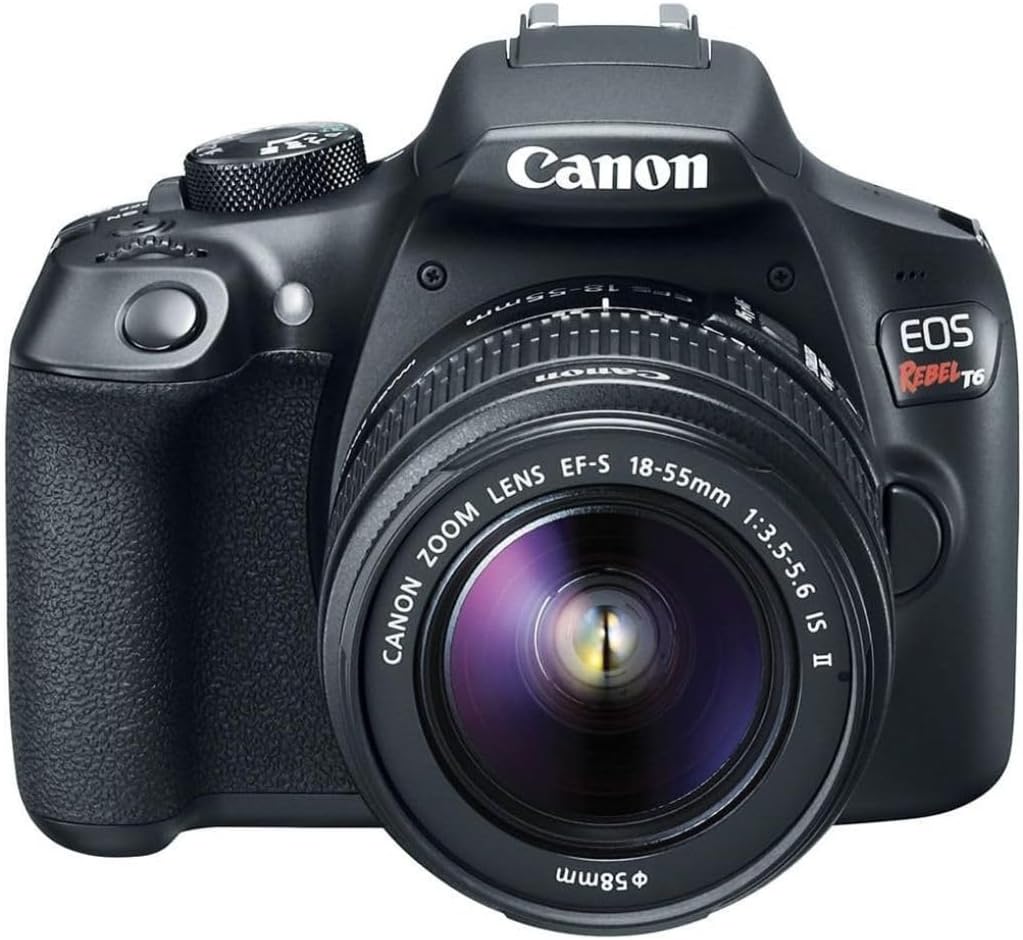
Canon EOS Rebel T6 18MP DSLR Kit with 18-55mm Lens
An entry-level DSLR designed for photographers upgrading from smartphones or compact cameras. The 18MP APS-C sensor and DIGIC 4+ processor deliver solid image quality in various lighting conditions, while built-in Wi-Fi and NFC make sharing straightforward. Scene Intelligent Auto mode keeps the learning curve gentle for beginners.
Pros
- 18MP APS-C sensor with good dynamic range for enlargements and crops
- DIGIC 4+ processor reduces noise in high ISO shots by up to 60% versus older DIGIC 4
- Full HD 1080p video recording at 30 fps for basic videography
- Built-in Wi-Fi and NFC for direct sharing to social media and mobile devices
- Scene Intelligent Auto mode automatically optimizes settings for different subjects
Cons
- 9-point autofocus system is basic compared to mid-range DSLRs, potentially slower tracking
- 3 fps continuous shooting limits action and fast-moving subject capture
- Amazon Renewed unit means no manufacturer warranty, only Amazon's return policy
DSLR Cameras Buying Guide
Buying a DSLR is not simply a matter of picking the highest megapixel count or the lowest price.
The right camera depends on what you intend to shoot, how much you plan to grow as a photographer, and what lenses and accessories you expect to add over time.
The six factors below are the ones that our research consistently shows matter most to real-world buyers.
Sensor Size and Image Quality

Almost every DSLR on the market today uses an APS-C sensor, also called a crop sensor. APS-C captures images with a 1.5x or 1.6x focal-length multiplier relative to a full-frame sensor, which matters when you start adding lenses.
For most beginners and enthusiast shooters, APS-C delivers excellent results: sharp detail, good color accuracy, and manageable file sizes. Megapixel count is relevant but not the whole story.
A 24 MP sensor with a modern image processor will outperform an older 18 MP sensor in dynamic range and high-ISO performance.
High-ISO performance is particularly important if you shoot indoors, at events, or in any low-light environment. Look for cameras that perform well at ISO 3200 and above without excessive noise.
Expert review consensus across the photography press consistently identifies this as one of the most practical real-world differentiators between generations of camera sensors.
Kit Lens Quality and Lens Ecosystem

Most DSLRs are sold as kits bundled with an 18-55mm zoom lens. This focal range covers wide-angle landscapes through short telephoto portraits and is a genuinely useful starting point.
However, kit lenses vary considerably in optical quality, and many bundle deals include a second telephoto zoom in the 75-300mm range that is more useful for sports, wildlife, or distant subjects.
Browsing the broader camera lenses category will give you a clear picture of what glass is available at each price tier.
Lens mount compatibility is a long-term investment consideration. Canon’s EF and EF-S mount and Nikon’s F mount both have enormous catalogues of first-party and third-party lenses accumulated over decades.
Choosing a body from either of these two manufacturers means you are buying into one of the deepest lens ecosystems in photography, which pays dividends as your skills and ambitions grow.
Autofocus System
Through-the-lens phase-detection autofocus is the core strength of the DSLR design. Entry-level models typically offer 9 to 11 AF points, which is sufficient for most stationary or moderately moving subjects.
Mid-range and enthusiast bodies step up to 39, 51, or more AF points and add subject-tracking capabilities that make a meaningful difference for action, wildlife, and fast-moving kids or pets.
It is worth noting that most DSLRs use contrast-detection AF in live-view mode, which is noticeably slower than the phase-detection AF active when you look through the optical viewfinder.
If you plan to shoot video or frequently use the rear screen to frame shots, evaluation whether the live-view AF speed meets your needs before committing.
Video Capabilities

Full HD 1080p at 30fps is the baseline for nearly every DSLR available today. For casual video, family recordings, or YouTube content where production values matter more than raw resolution, 1080p is entirely adequate.
Pair the camera with good lighting and you will be surprised how cinematic the results can look.
Enthusiast-tier DSLRs such as the Nikon D7500 add 4K video recording and more flexible frame-rate options, which become important if you plan to deliver footage for television, large-screen projection, or heavily cropped edits.
Manual exposure control during video recording is another differentiator: it gives you creative authority over depth of field and motion blur in a way that automatic modes do not.
Connectivity and Workflow

Built-in Wi-Fi and NFC have become standard features on contemporary DSLR models and they genuinely improve everyday workflow.
You can transfer images to a smartphone for quick social media sharing without pulling a memory card, and many manufacturer apps allow remote shutter control, which is useful for self-portraits or time-lapse setups.
NFC makes the initial pairing process considerably faster on compatible Android devices.
Memory card format matters too. Most consumer DSLRs use SD cards; enthusiast bodies may offer dual card slots for redundancy or overflow storage. If you shoot high-volume events such as weddings or sports, dual slots provide genuine peace of mind.
Pair your camera with a stable shooting platform and consider browsing tripods and gimbals for steady-shot accessories that complement still photography and video equally well.
Ergonomics and Build Quality

A camera you enjoy holding is a camera you will actually carry. Entry-level DSLRs are typically polycarbonate bodied and lighter than their enthusiast counterparts, which makes them easier to carry on long travel days or hikes.
Grip depth, button layout, and shutter feel are all subjective, but verified buyer feedback consistently highlights grip comfort and intuitive menu navigation as the factors that most influence day-to-day satisfaction among new shooters.
Enthusiast bodies like the Nikon D7500 introduce weather sealing, deeper grips, and more external controls that let you change settings without diving into menus.
If you regularly shoot in challenging outdoor conditions or simply want a camera that feels like it was built to last, the additional build quality is worth the step up in budget.
For capturing outdoor scenes beyond the reach of a standard lens, an action camera makes a compact companion for adventure situations where a DSLR would be impractical.
Why You Should Trust Us
REMOVU is an independent review publication. We do not sell cameras, we do not fulfill orders, and we have no commercial relationship with any manufacturer.
Every product in this guide was evaluated using a structured research methodology: we analyze published specifications, synthesize expert review consensus drawn from across the photography and imaging press, and incorporate verified buyer feedback from confirmed purchasers.
We do not conduct our own product trials; our evaluations are grounded in research, published data, expert review consensus, and verified buyer feedback.
Each camera is scored on the REMOVU Score, a 0 to 10 scale that applies consistent criteria across image quality, autofocus performance, build, features, value, and user experience.
The score reflects the weight of evidence across all sources rather than any single reviewer’s opinion. We reassess scores as new firmware, competing products, or significant changes in market pricing shift the relative value of any given model.
Transparency on affiliate relationships: REMOVU may earn a commission if you purchase through a link in this article. This affiliate arrangement has no influence on our scores, rankings, or which products we recommend.
Every pick in this guide was selected on merit. If a product does not deserve a recommendation, it does not appear here regardless of commercial considerations.
Final Thoughts
The DSLR market in 2026 offers something genuinely useful at almost every budget level, from capable entry-level kits to versatile enthusiast bodies with professional-grade AF systems.
After synthesizing specifications, expert review consensus, and verified buyer feedback across every model in this guide, a few standout picks emerge clearly.
- Best Overall: Nikon D7500 DSLR Camera Bundle with 18-140mm Lens earns the top REMOVU Score in this group thanks to its superior autofocus system, 4K video recording, weather-sealed body, and a bundled accessory package that delivers genuine value for intermediate and advanced shooters.
- Best Camera for Beginners: Canon EOS Rebel T7 with Shoulder Bag and 64GB Card earns its high REMOVU Score by combining a 24.1 MP APS-C sensor, intuitive guided menu system, built-in Wi-Fi, and a practical bundle into one of the most accessible entry points in the category.
- Best Mid-Range Value: Nikon D3300 Kit with 18-55mm VR II and 55-200mm Lenses remains a compelling choice for buyers who want dual-lens versatility and Nikon’s renowned color science at a mid-range price point, reflected in its strong REMOVU Score among kit packages.
- Best Renewed Pick: Canon EOS 2000D / Rebel T7 Three-Lens Renewed Kit is the standout certified-renewed option, pairing a wide-angle lens, telephoto lens, and ample storage into a package that earns a notably high REMOVU Score among renewed listings in this roundup.
- Best Budget-Conscious Entry: Canon EOS 2000D / Rebel T7 Essential Bundle (Renewed) delivers an impressive accessory complement including a video light, carrying case, and flexible tripod at an accessible price tier, making it the smartest spend for cost-conscious first-time DSLR buyers.
Whichever camera you choose, pairing it with a well-chosen lens and a stable support system will do more for your photography than the body alone.
If you are building out a full creative setup, a capable photo-editing laptop and a reliable storage workflow are the natural next investments after you have your camera in hand.
Frequently Asked Questions
Are DSLR cameras still worth buying in 2026?
Yes, absolutely. DSLRs offer unmatched optical viewfinder clarity, outstanding battery life compared to mirrorless alternatives, and access to enormous lens catalogues built up over decades.
For many photographers, especially beginners and hobbyists, the price-to-performance ratio on current DSLR models is genuinely hard to beat.
The sensor technology inside today’s entry-level DSLRs is capable of producing images that would have required professional-grade gear just a few years ago.
Mirrorless cameras are the future direction of the industry, but the DSLR ecosystem remains fully supported by Canon and Nikon with lenses, firmware updates, and accessories.
If budget is a priority and you want a large, proven lens ecosystem, a DSLR is a smart, practical choice right now.
What is the difference between a DSLR and a mirrorless camera?
A DSLR uses a mirror inside the body to reflect light up through an optical viewfinder. When you press the shutter, the mirror flips up, light hits the sensor, and the image is captured.
A mirrorless camera removes the mirror entirely: light hits the sensor continuously, and the viewfinder (if present) is an electronic display rather than an optical one.
In practical terms, DSLRs typically offer longer battery life, faster phase-detection AF through the viewfinder, and lower prices for equivalent image quality. Mirrorless bodies tend to be more compact, offer better live-view AF, and represent the direction of future lens development from the major manufacturers.
How many megapixels do I actually need in a DSLR?
For the vast majority of use cases, including large prints up to A2 size, social media content, and even commercial portrait work, 24 megapixels is more than sufficient.
Going higher than 24 MP increases file sizes and demands for both storage and computing power without delivering visible improvements in most output contexts.
Where higher resolution genuinely pays off is in heavily cropped wildlife or sports images, or in commercial and fine-art contexts where very large prints are required. For beginners and hobbyists, prioritize sensor quality and low-light performance over raw megapixel count.
Should I buy a DSLR bundle or just the body and lens separately?
Bundle deals can represent strong value, particularly for first-time buyers who need to build a complete kit from scratch.
A bundle that includes a telephoto zoom, extra batteries, a memory card, a carrying case, and a tripod saves the effort of sourcing each accessory individually and is often priced more competitively than buying each item separately.
The trade-off is that bundle accessories are often generic rather than best-in-class. A more experienced photographer may prefer to invest in a higher-quality prime lens and specific accessories rather than a broad bundle of average-quality extras.
Beginners almost always benefit more from bundles: having all the tools available from day one encourages experimentation and learning. You can always upgrade individual components later as your needs become clearer.
When you are ready to expand your creative toolkit beyond the camera itself, accessories like camera drones open up entirely new photographic perspectives worth exploring.
What should I look for in a renewed or refurbished DSLR?
Certified-renewed DSLRs sold through Amazon Renewed are inspected, cleaned, and guaranteed to function like new, and they come with a minimum 90-day satisfaction guarantee. They represent genuine value, particularly for buyers who want a larger accessory bundle at a more accessible price point.
When evaluating any renewed camera, check the shutter count if it is disclosed, confirm the warranty terms, and verify that included lenses are also refurbished to a consistent standard.
Verified buyer feedback on renewed listings tends to be reliable for flagging any quality-control patterns across a large batch of units.
Several of the renewed picks in this guide, including the Canon EOS Rebel T7 bundles, score well precisely because buyers consistently report receiving units in excellent cosmetic and functional condition.
About the author
Glen writes about capture cards for REMOVU, comparing resolution, latency, and reliability for streaming and recording console gameplay. He helps creators find a card that fits their setup and software.