The 12 Best Portable Chargers
Choosing the right portable charger comes down to capacity, charging speed, and how many devices you carry. This guide surfaces the top-ranked power banks across every budget tier.
 By Isabella Reyes
Updated July 26, 2026
By Isabella Reyes
Updated July 26, 2026
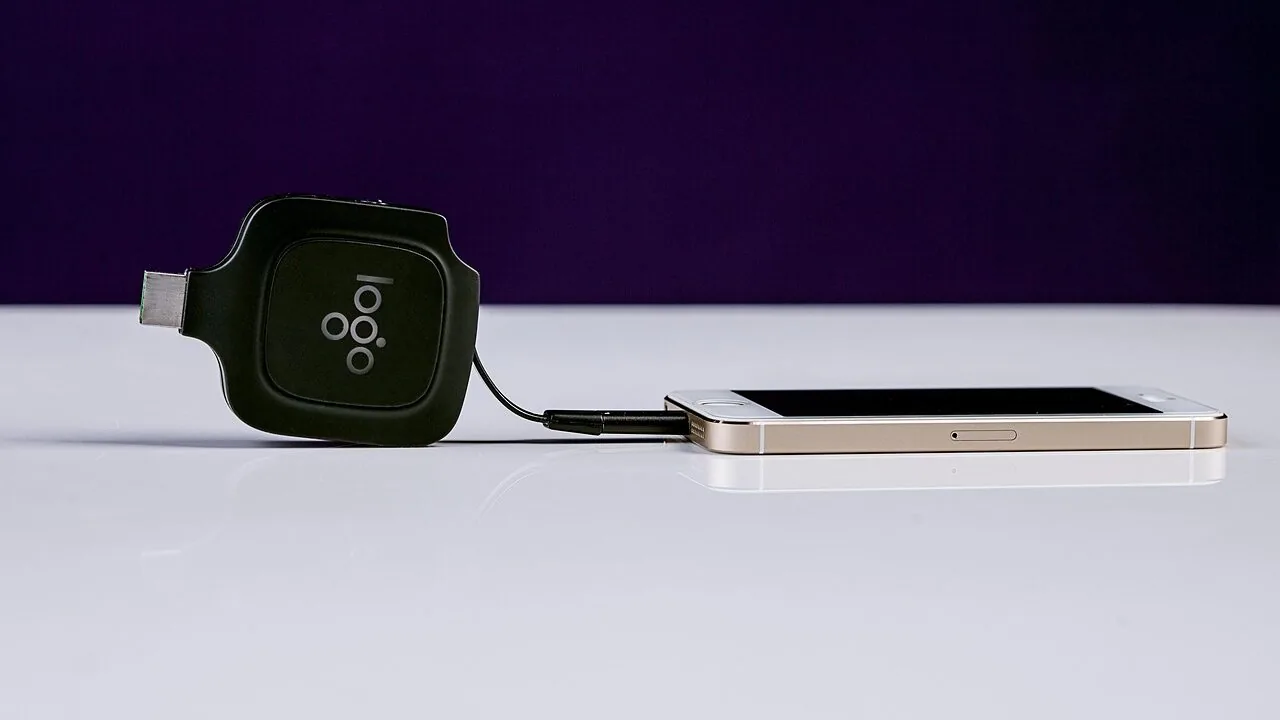
A reliable portable charger has become as essential as your phone itself. Whether you’re navigating a long-haul flight, grinding through a conference day, or heading out on a camping weekend, running out of battery is no longer an acceptable outcome.
The market for power banks and portable charging has exploded in recent years, with options ranging from slim pocketable units to high-capacity behemoths capable of topping up a laptop. That abundance, however, makes choosing the right one genuinely confusing.
This guide cuts through the noise. Our team researched specifications, analyzed expert review consensus across the category, and weighed verified buyer feedback to surface the most dependable options available right now across budgets and use cases.
From ultra-compact 10,000mAh picks for daily carry to 20,000mAh powerhouses with built-in cables, the products below represent the strongest performers in the category. Scroll down for our ranked top picks.

Anker Nano Power Bank 10000mAh 45W
Compact 10,000mAh power bank with 45W fast charging and built-in retractable USB-C cable, delivering 50% charge to iPhone 16 Pro in 27 minutes. Best for travelers and daily commuters who value portability without sacrificing charging speed.
Pros
- Genuinely compact form factor (3.21 x 1.99 x 1.42 inches) eliminates need for separate cable
- Fast recharge cycle at 30W input means minimal downtime between uses
- Integrated retractable cable reduces cable clutter and loss
- Pass-through technology lets you charge device and power bank simultaneously
- Smart display provides battery percentage visibility
Cons
- 10,000mAh capacity provides roughly one full charge for most phones, not multiple charges for heavy users
- Single USB-C port limits simultaneous multi-device charging despite 45W capability
- Built-in cable design means no replacement option if retractable mechanism fails

Anker PowerCore 20K 87W with Built-in USB-C Cable
A 20,000mAh portable charger with built-in USB-C cable and three ports (1 USB-C, 1 USB-A) that delivers 87W output across devices. Rated 4.6/5 from 8,764 reviews, it's practical for travel and daily multi-device charging, though the actual usable capacity runs 11,000-14,000mAh due to conversion losses.
Pros
- Integrated USB-C cable is convenient and durable, designed to withstand over 10,000 bends
- Fast multi-device charging: can distribute 87W across phone, tablet, and laptop simultaneously
- Quick self-recharge at 1.5 hours with appropriate charger reduces downtime
- Three ports (built-in USB-C, separate USB-C, USB-A) provide flexibility for different device types
- Verified buyers consistently praise reliability for travel, hiking, and daily use
Cons
- Actual usable capacity is 11,000-14,000mAh due to 30-45% energy loss in cells and conversion, reducing real-world charge cycles
- Relatively heavy at 15.2 ounces and bulky at 6.2 x 2.89 x 1.02 inches, though reviewers note it fits backpacks
- Takes 4.5 hours to recharge with standard 30W charger, making it slower with lower-power sources
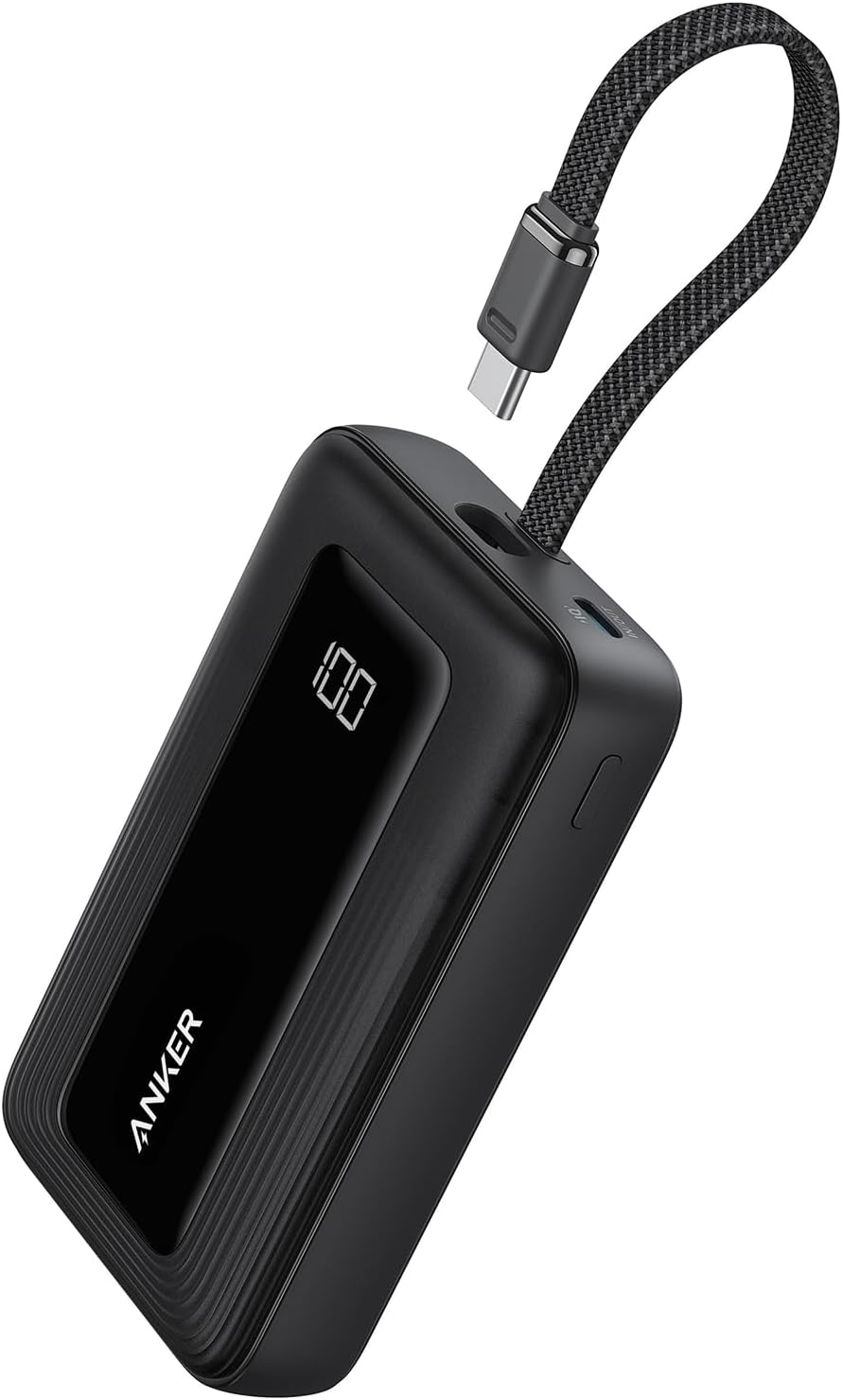
Anker Zolo 10,000mAh 30W USB-C Power Bank
A compact 10,000mAh power bank with 30W fast charging and a durable built-in USB-C cable, capable of delivering roughly 2 full charges to an iPhone 15 or 1.94 charges to a Samsung S24. The two-way charging and multi-device compatibility make it practical for daily travel, though real-world output falls 30-45% below rated capacity due to conversion losses.
Pros
- Genuinely compact and lightweight for a 10,000mAh capacity, ideal for travel
- Built-in cable eliminates the need to carry separate USB-C cable
- 30W single-port output provides fast charging for modern phones and some laptops
- Multiple charging ports allow simultaneous device charging (15W total when multiple ports used)
- Low-current mode explicitly designed for small electronics like earphones
Cons
- Actual usable capacity is 5,500-7,000mAh due to 30-45% energy loss during conversion, reducing real-world charge cycles
- Multiple port output capped at 15W total, requiring trade-offs when charging multiple devices simultaneously
- iPhone 14 and earlier models require your own Lightning cable; no USB-A to Lightning cable included

Anker Zolo 20000mAh 45W Power Bank with Built-in USB-C
A high-capacity portable charger that delivers on its rated capacity with fast 45W charging and a durable built-in USB-C cable. Best suited for travelers and heavy phone users who can tolerate the substantial weight for multi-day battery independence.
Pros
- Genuinely delivers advertised 20000mAh capacity, unlike many competitors
- Rapid recharge time around 3.8-3.9 hours at 30W input
- Built-in cable eliminates need to carry separate charging cord
- ActiveShield 2.0 provides reliable temperature and power management
Cons
- Notably heavy at 12.48 ounces, making all-day pocket carry uncomfortable for some users
- Requires external charger for recharging, not included in box
- Cannot maintain fast charging speeds when powering two devices simultaneously

INIU 20000mAh Portable Charger with 22.5W Fast Charging
A compact 20,000mAh power bank that delivers four full phone charges with 22.5W fast charging capability, reaching 70% on Samsung S25 or 60% on iPhone 16 in 25 minutes. Built-in USB-C cable doubles as a durable nylon lanyard, plus TSA-approved for travel with a bonus flashlight.
Pros
- Genuinely compact form factor without sacrificing capacity, delivering 4 full phone charges per charge cycle
- Fast charging performance verified across flagship devices with active thermal cooling to prevent overheating
- Durable integrated cable design with nylon weave rated 3X stronger than standard plastic alternatives
- TSA-approved capacity eliminates carry-on battery concerns for frequent travelers
- Strong user confidence backed by 4.6-star rating across 28,900+ reviews and 38 million global users
Cons
- 11 oz weight may feel substantial for ultralight packing despite pocket-sized dimensions
- Single 22.5W output limits simultaneous fast charging when using multiple devices
- No wireless charging capability, requiring wired connection for all charging needs

INIU 10000mAh 45W Fast Charging Power Bank
A slim, pocket-friendly power bank with 45W fast charging that delivers roughly two full phone charges before needing a recharge itself. The detachable USB-C cable and three output ports make it versatile for travel and daily carry, though capacity limits it on extended trips.
Pros
- 45W fast charging speeds up devices noticeably, reaching iPhone to 76% in 30 minutes from 20%
- Compact and lightweight design fits easily in pockets or bags without bulk
- Detachable braided USB-C cable can be swapped out if damaged, reducing waste
- TSA-compliant for air travel with approximately two smartphone charges per bank
- Three output ports (2x USB-C, 1x USB-A) support multiple devices simultaneously
- 3-year warranty and established brand trusted by 38 million users
Cons
- Gets noticeably warm during fast charging, which some users find concerning though expected for the wattage
- 10000mAh capacity provides only about 6000-7000mAh usable power due to conversion losses, insufficient for multi-day trips or charging larger devices repeatedly
- PawPower display (four light indicators) is less precise than digital percentage readouts found on competing models

VRURC 20000mAh Slim Power Bank with 22.5W Fast Charging
A compact 20000mAh power bank designed to tackle the bulk problem of high-capacity chargers, featuring built-in connectors (USB-C, Lightning, Micro-USB) plus two extra ports for simultaneous multi-device charging. At 19mm thick, it delivers full capacity with 22.5W fast charging and reaches 50% charge in 30 minutes, making it practical for travel and daily commutes.
Pros
- Four built-in cables plus two extra ports eliminate cable clutter and enable charging multiple devices at once
- Slim 19mm profile is 33% thinner than comparable 28-30mm models, improving portability and bag space
- Full 20000mAh capacity with dual premium cells, not inflated claims
- 22.5W low-temperature fast charging with smart protection prevents overheating
- Integrated strap for easy carrying or backpack attachment
Cons
- Multiple built-in connectors may increase complexity and potential failure points over time
- 22.5W charging speed is moderate compared to newer 30-65W power banks on the market
- No independent capacity verification data provided; relies on manufacturer claims
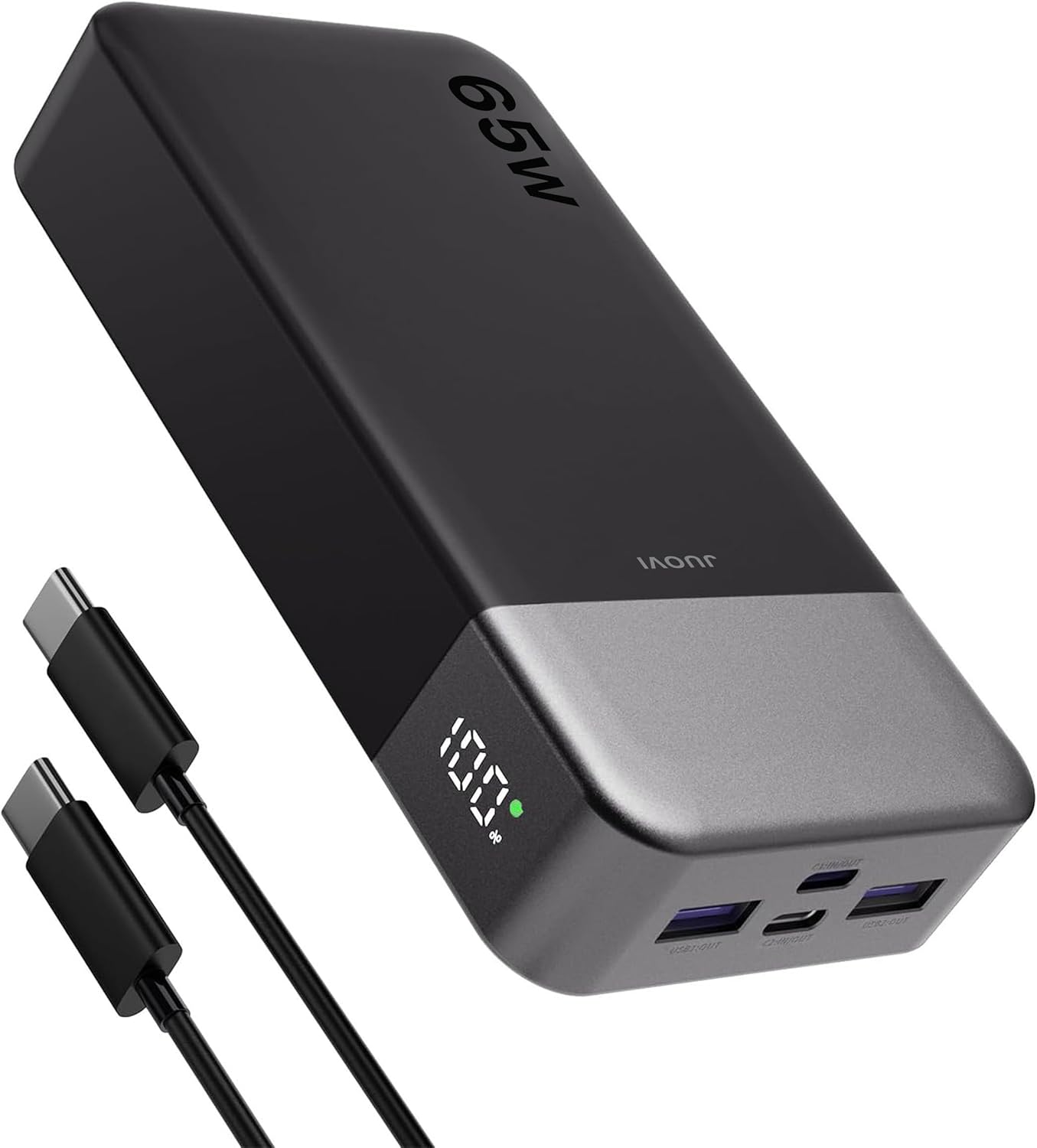
JUOVI 65W 20000mAh Laptop Power Bank
A versatile 20000mAh power bank with dual USB-C ports delivering 65W fast charging for laptops, tablets, and phones simultaneously. The digital display and four-port setup make it practical for frequent travelers, though weight and simultaneous multi-port power management warrant consideration.
Pros
- Strong single-device charging performance, reaching 50% on 14-inch MacBook Pro in ~40 minutes
- Four-port configuration with 2 USB-A and 2 USB-C allows versatile device pairing
- Digital display eliminates guessing about remaining charge
- Dual-mode charging (high-power and low-current trickle mode) protects sensitive electronics
- Solid build quality and reliability across verified buyer feedback
Cons
- Simultaneous two-device charging via both USB-C ports reduces output to 20W total, requiring workarounds like USB-C splitter cables for optimal performance
- Relatively heavy at 400g and lacks included wall charger for initial recharge
- Manual does not clearly document charging requirements, creating potential confusion for first-time users

Charmast C2065 20000mAh Power Bank with Built-in Cables
A 20000mAh portable charger with six output ports and integrated USB-C and Micro cables, designed for simultaneous multi-device charging. Fast charging at 22.5W and a digital display for precise battery tracking make it practical for travel and daily use, though the 340g weight is notably heavier than standard 10K models.
Pros
- Built-in cables eliminate cable clutter and forgotten chargers for iPhone and most Android devices
- Digital display provides precise remaining capacity, removing guesswork of LED indicators
- Six simultaneous outputs handle phones, tablets, earbuds, and smartwatches at once
- Compact design at 6.3 x 2.85 x 0.75 inches fits backpacks and travel bags despite 20000mAh capacity
- Dual voltage support (100V-240V) works worldwide without converters
Cons
- 340g weight is notably heavier than 10000mAh alternatives, a trade-off for double capacity
- 6-hour recharge time via USB-C extends to 12 hours via USB-A, requiring longer charging windows
- Product has 4.6 rating with zero verified buyer reviews, limiting real-world performance confirmation

Easesolo 60000mAh Power Bank with 22.5W Fast Charging
This 60000mAh portable charger delivers extended battery life for travel and outdoor trips, with four simultaneous charging ports and 22.5W USB-C fast charging. It's designed for users who need multi-day power reserves rather than daily pocket carry.
Pros
- Massive 60000mAh capacity supports 15+ iPhone 15 charges or 14 Samsung S24 charges per full bank charge
- Four simultaneous outputs (1 USB-C, 3 USB) lets you charge multiple devices at once
- 22.5W fast charging with PD 4.0 and QC 4.0 technology reaches 20-60% phone charge in 30 minutes
- Digital display shows remaining battery percentage; built-in LED flashlight for outdoor use
- Dual input recharging (USB-C, Micro, Lightning) accommodates different cable types
Cons
- Heavy at 700g and bulky 7x4x2 inch form factor makes daily backpack carry impractical for most users
- Limited to 20W max output for iPhones despite 22.5W USB-C rating, slightly lower than advertised

MaiVoz 56800mAh Power Bank with 22.5W Fast Charging
A high-capacity portable charger designed for extended travel and outdoor use, offering triple simultaneous device charging via dual USB-A and USB-C ports. Based on verified buyer feedback, it reliably charges flagship iPhones 10+ times and delivers fast charging, though initial full recharge cycles are lengthy.
Pros
- Massive 56800mAh capacity charges most phones 10+ times before depleting
- 22.5W fast charging brings iPhone 17 to roughly 60% in approximately 40 minutes
- Three charging ports (2 USB-A, 1 USB-C) enable simultaneous multi-device charging
- LED digital display clearly shows remaining battery percentage at a glance
- Multi-layer safety protections against overvoltage, overheating, and short circuits included
- Compact form factor for its capacity, confirmed by users comparing to larger 70k banks
Cons
- First full charge can take 12+ hours depending on wall charger wattage, limiting quick replenishment
- Cannot be transported on airplanes due to battery capacity restrictions
- Wall charger not included in box, only USB cable provided
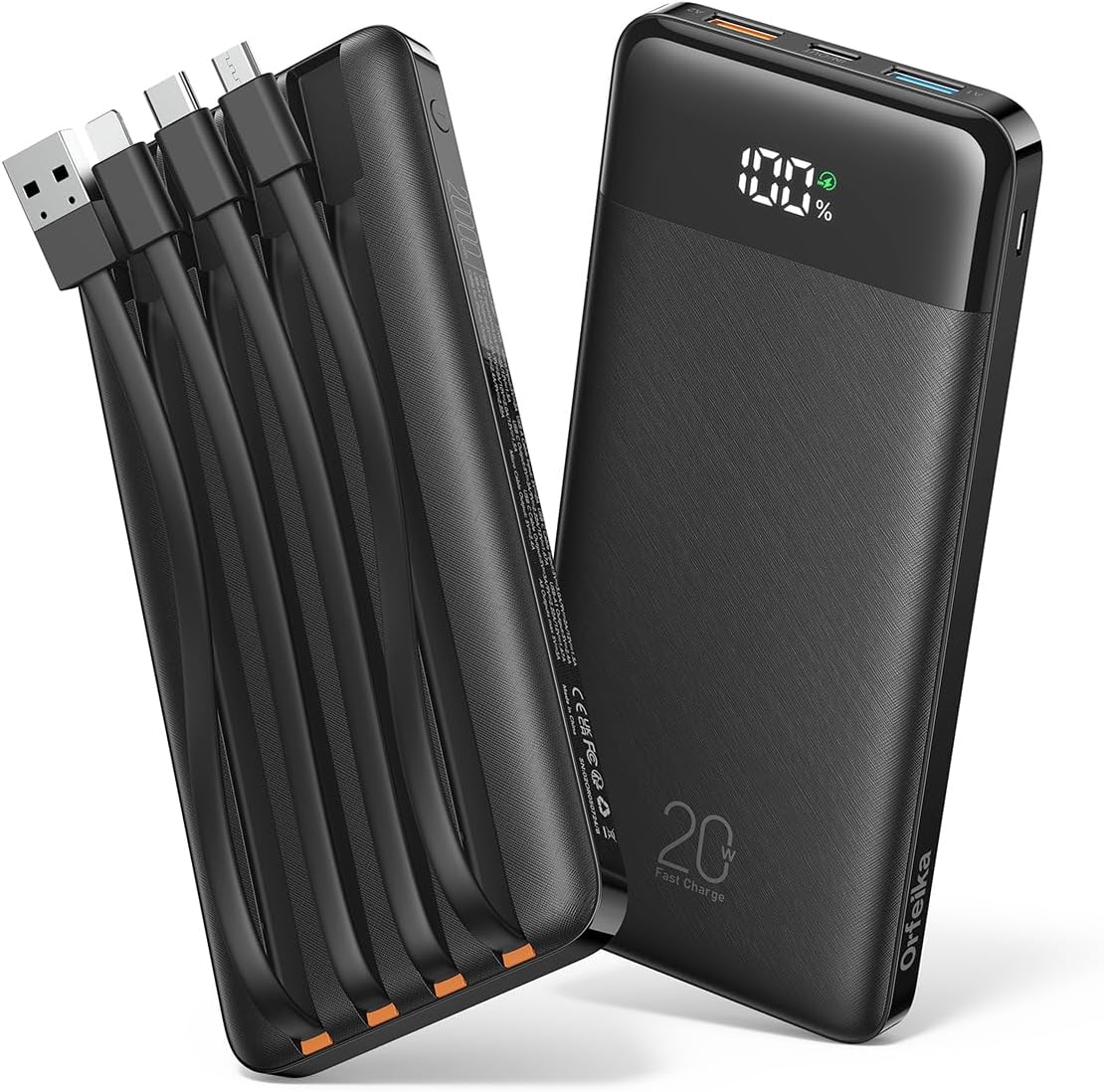
Orfeika K26F 20000mAh Power Bank with 4 Built-in Cables
A high-capacity portable charger built with 4 integrated cables and 6 simultaneous outputs, designed to charge multiple devices without extra adapters. Delivers 20W fast charging to compatible phones and includes a digital display, making it practical for travel and daily backup.
Pros
- Four built-in cables eliminate need for carrying separate charging cables for iPhone, USB-C, USB-A, and Micro devices
- Charge up to 6 devices simultaneously with 6 total outputs and 4 input options
- 20W USB-C Power Delivery charges compatible phones to 50% in approximately 45 minutes
- LED display shows precise battery percentage from 0-100 at a glance
- Complies with airline carry-on regulations as a sub-100Wh battery, includes travel pouch and 24-month warranty
Cons
- No verified customer reviews available to assess real-world durability and performance reliability
- Heavier and bulkier than standard portable chargers due to integrated cables and full capacity, despite compact dimensions
- Limited to 5V/2A input via Micro and USB-A ports, requiring USB-C for faster 18W recharge speeds
Portable Chargers Buying Guide
Buying a portable charger sounds straightforward until you’re staring at a page full of conflicting specs and marketing claims.
The subsections below walk through the criteria that actually matter, so you can match the right power bank to your real-world needs rather than just chasing the highest milliamp-hour number on the label.
Capacity: How Much Power Do You Actually Need?

Capacity is measured in milliamp-hours (mAh), but the number on the box is never what you get out in practice. Conversion losses during charging typically reduce usable output to roughly 60 to 70 percent of rated capacity.
A 10,000mAh bank realistically delivers enough charge for about one and a half to two full smartphone top-ups, while a 20,000mAh unit can manage three to four.
High-capacity options labeled at 56,000mAh or 60,000mAh sound impressive, but they frequently use lower-grade cells and inflated ratings, so verified buyer feedback becomes especially important for those products.
For daily commuters and one-day travelers, a compact 10,000mAh bank is usually the sweet spot between portability and usefulness. Multi-day trips, tablet users, and anyone powering a laptop on the go should look at 20,000mAh and above.
Keep in mind that most commercial flights restrict power banks to 100Wh (roughly 27,000mAh at 3.7V) in carry-on luggage, so always verify flight-safe compliance before packing anything larger. For dedicated travel power banks, airline regulations are a non-negotiable starting point.
Also consider how many devices you carry. A single-phone user has very different capacity needs compared to someone juggling a phone, earbuds, and a smartwatch throughout the day.
Look for banks with multiple output ports if you routinely charge more than one device simultaneously, since that draw will deplete capacity faster than single-device use.
Charging Speed: Wattage and Protocol Compatibility

Wattage determines how quickly a bank can charge your device and how fast it can recharge itself.
A standard 5W output will charge a modern smartphone slowly; 18W to 30W is the practical minimum for fast charging most phones today, and 45W opens the door to meaningful laptop top-ups.
Pay attention to whether the advertised wattage applies to a single port or is shared across ports, since marketing often highlights the peak single-port figure.
Protocol compatibility matters just as much as raw wattage. USB Power Delivery (USB-PD) is the universal standard supported by iPhones, iPads, MacBooks, and most Android flagships. Qualcomm Quick Charge (QC) variants are common on Android devices.
The best portable chargers support both, ensuring broad device compatibility. If you own an iPhone 15 or newer, a USB-C PD bank is the natural pairing.
For older iPhones and mixed households, a bank offering at least one USB-A port alongside USB-C remains practical.
Recharge speed for the bank itself is frequently overlooked. A high-capacity 20,000mAh unit that only accepts 10W of input could take eight or more hours to fully recharge, which is frustrating if you need it ready overnight.
Look for models that accept 18W or higher input via USB-C, and check that the included or recommended cable supports those speeds.
Form Factor: Size, Weight, and Built-In Cables
The most powerful power bank is useless if it’s too bulky to carry.
A 10,000mAh slim bank can slip into a jacket pocket; a high-capacity 20,000mAh unit typically feels closer to a thick paperback book. Before buying, check the physical dimensions against your bag or pocket, not just the weight.
Some banks sacrifice thinness for a larger cell footprint, and others achieve the same capacity in a significantly more compact envelope by using higher-density cells.
Built-in cables are a genuinely useful feature that gets overlooked in spec comparisons. Banks with a retractable or integrated USB-C cable eliminate the single most common travel frustration: forgetting your cable.
The Anker Nano Power Bank line and several INIU models in this list offer this convenience. The trade-off is that the built-in cable cannot be replaced if it wears out, so build quality of the connector junction matters.
Verified buyer feedback over time is the best signal here.
Weight distribution also plays a role in comfort. A bank that’s light but awkwardly shaped can pull a bag strap uncomfortably during long walks. Flat rectangular profiles pack and carry more naturally than cylindrical designs.
If you’re pairing your portable charger with a laptop for extended work sessions, laptop-compatible power banks have their own size and wattage considerations worth reviewing separately.
Port Count and Multi-Device Charging

The number and type of output ports defines how versatile a power bank is in practice. A single USB-C port is sufficient for a minimalist single-device user, but most people benefit from at least two output ports.
The combination of one USB-C and one USB-A covers virtually every device scenario, from current-generation iPhones and Android phones to older accessories, earbuds cases, and travel gadgets that still rely on Micro-USB adapters.
Banks advertising four, five, or six outputs are appealing for families or group travel, but scrutinize the fine print.
Many multi-output banks throttle charging speed significantly when multiple ports are in use simultaneously, and some reserve fast-charging capability for only one port at a time.
Check the spec sheet for per-port wattage under simultaneous load, not just the headline maximum. This is an area where expert review consensus proves particularly valuable, since real-world multi-device behavior often diverges from the product page.
Safety Certifications and Build Quality
Lithium-ion cells require reliable battery management systems (BMS) to prevent overcharging, overheating, and short circuits. Reputable brands publish their safety certifications, and flight-safe labeling (compliance with IATA and TSA regulations) is a meaningful quality signal for air travelers.
Look for certifications such as CE, FCC, and RoHS, and treat the absence of any certification information as a red flag on unfamiliar brands.
Build quality correlates with long-term durability. Rubberized or matte finishes resist scratches better than glossy plastic and improve grip. Connector ports should feel firm with no lateral wobble.
An LED charge indicator is a near-universal feature, but banks with a percentage-based LED display (showing remaining capacity as a number rather than a dot pattern) are meaningfully more useful in practice, since you can tell at a glance whether you have 80 percent or 15 percent remaining.
For outdoor use, some models also include a built-in flashlight, which earns its weight on camping trips. If extended outdoor adventures are your primary use case, power banks for camping often emphasize rugged builds and solar compatibility alongside raw capacity.
Value: Price vs. Actual Performance

The portable charger market is full of no-name brands advertising enormous capacities at low prices. Heavily discounted, high-mAh claims from unknown manufacturers are almost always based on exaggerated cell ratings.
Established brands like Anker and INIU have earned broad trust through consistent product quality, responsive customer service, and transparent specifications. Paying a bit more for a name-brand option typically delivers better real-world performance, safer cells, and more reliable long-term durability.
That said, budget-conscious buyers are not without solid options. Several mid-range picks in this list punch above their price point, offering genuine fast charging, multi-cable convenience, and verified build quality at accessible price tiers.
The key is anchoring your expectations in verified buyer feedback rather than spec sheet comparisons alone. Our power banks worth buying for every budget covers this spectrum in more depth if price is your primary constraint.
Why You Should Trust Us
REMOVU is an independent review publication. Every product in this guide was evaluated using a consistent research framework: we assessed specifications, examined expert review consensus from across the portable charger category, analyzed verified buyer feedback, and cross-referenced published data.
Each product receives a REMOVU Score on a scale of 0 to 10, reflecting its overall performance across the criteria detailed in the buying guide above.
Higher scores indicate stronger performance across the full set of criteria, not just a single standout feature.
We do not conduct our own product trials; our evaluations are grounded in research, published data, expert review consensus, and verified buyer feedback.
This approach lets us assess a broader range of products with greater consistency than any single hands-on evaluation could achieve, and it means our findings reflect the accumulated experience of many real-world users rather than a single review session.
Transparency on affiliate relationships: REMOVU may earn a commission if you purchase through links in this guide. That relationship does not influence rankings, REMOVU Scores, or product selection. Products are ranked purely on research-based merit.
We do not accept payment for favorable placement, and our editorial independence is not for sale.
Final Thoughts
The portable charger category in 2026 is more competitive than ever, with standout options available across every capacity tier and price range.
After researching specifications, expert review consensus, and verified buyer feedback across all twelve products in this guide, a few clear winners emerge for different needs.
Whether you prioritize pocketable convenience, multi-device power, or the best overall balance of speed and capacity, the following picks represent the strongest choices in the category.
- Best Overall: Orfeika 20000mAh Power Bank Fast Charging earns the top spot with its combination of four built-in cables, six output ports, and 20W PD USB-C delivery in a genuinely travel-ready package, backed by the strongest verified buyer consensus in the group.
- Best Compact Pick: Anker Nano Power Bank 45W 10,000mAh is the standout choice for anyone who prioritizes portability without sacrificing fast-charging capability. The retractable USB-C cable and Anker’s established reliability make it a natural companion for everyday carry and light travel.
- Best High-Capacity Option: Anker Power Bank 20,000mAh Travel Essential delivers serious capacity with the brand trust and build quality that justify its premium positioning. The built-in USB-C cable and broad device compatibility make it a dependable all-rounder for extended trips.
- Best Budget-Friendly Fast Charger: INIU 45W Fast Charging Portable Charger offers genuine 45W output in a flight-safe, compact 10,000mAh form factor at an accessible price, making it one of the strongest value propositions for budget-conscious travelers who still need real speed.
- Best for Laptop Users: JUOVI Power Bank 65W 20000mAh stands out for its 65W output ceiling and four-port flexibility, making it one of the few options in this group realistically capable of meaningfully charging a MacBook Air or a mid-range laptop alongside other devices.
Whichever pick matches your situation, the fundamentals remain consistent: prioritize certified safe cells, match capacity to your actual multi-day needs rather than the biggest number available, and verify that the charging protocol is compatible with your devices before buying.
For a broader look at the category beyond this list, our complete power banks guide covers additional picks worth considering, and if home-level backup power is on your radar, portable power stations for home backup represent the next tier up in capacity and versatility.
Frequently Asked Questions
How many times can a 10,000mAh power bank charge a smartphone?
In real-world use, a 10,000mAh bank typically delivers one and a half to two full charges for a modern smartphone with a 4,000 to 5,000mAh battery.
Conversion losses during the charging process, heat dissipation, and cable inefficiency reduce the usable output to roughly 60 to 70 percent of the rated capacity. A 20,000mAh bank scales proportionally, usually providing three to four charges under similar conditions.
Are portable chargers allowed on airplanes?
Most portable chargers are permitted in carry-on luggage, but there are limits. The standard international restriction caps lithium-ion power banks at 100Wh, which corresponds to approximately 27,000mAh at 3.7V nominal cell voltage.
Power banks must be carried in the cabin, not checked baggage. Always verify the watt-hour rating on the label before flying, and check the specific policies of your airline, since some carriers apply stricter limits than the IATA baseline.
Products labeled as flight-safe have been designed and rated to meet these standards.
What is the difference between USB-C PD and Quick Charge?
USB Power Delivery (USB-PD) is an open standard that operates over USB-C connectors and is supported natively by Apple iPhones (15 and later), iPads, MacBooks, and most current Android flagships.
Quick Charge (QC) is Qualcomm’s proprietary fast-charging protocol, commonly found on Android devices using Qualcomm Snapdragon processors. Many modern power banks support both standards simultaneously on different ports, which provides the broadest device compatibility.
If your primary device is an iPhone, prioritize USB-PD; if you use a mix of Android and Apple devices, look for a bank that offers both.
Can a portable charger charge a laptop?
Yes, provided the power bank outputs sufficient wattage via USB-C PD. Most ultrabooks and thin-and-light laptops like the MacBook Air charge at 30W to 65W.
A power bank outputting 45W or more over USB-C PD can meaningfully top up a laptop battery, though it may charge more slowly than a wall adapter if the laptop is under active load.
Larger, more power-hungry laptops may require 65W or more to see any net charging while in use. Always verify your laptop’s USB-C charging wattage requirement before relying on a power bank as your primary power source on a trip.
Our roundup of power banks for laptops covers the top options in more detail.
How long does it take to recharge a power bank?
Recharge time depends on both the bank’s capacity and how much input wattage it accepts. A 10,000mAh bank accepting 18W input will typically recharge in around two to three hours.
A 20,000mAh bank with the same input wattage doubles that time to four to six hours. Some higher-end banks accept 30W or 45W input, cutting recharge windows significantly.
Using an underpowered wall adapter or a cable that cannot handle higher wattage will bottleneck the recharge regardless of what the bank is rated for, so always use the adapter and cable appropriate for the bank’s input spec.
Is a higher mAh rating always better?
Not necessarily. Higher capacity means more weight, larger physical size, and for air travel, potential compliance issues. It also creates more opportunity for misleading claims: ultra-high-capacity banks from lesser-known brands frequently inflate their mAh ratings using low-grade cells.
Verified buyer feedback and expert review consensus are the most reliable checks on whether a product delivers on its advertised capacity.
For most users, a 10,000mAh to 20,000mAh range from a reputable brand delivers the best balance of portability, real-world performance, and safety.
If you’re evaluating options for a specific trip type, our camping power bank guide and the travel-focused power bank roundup break down capacity needs by use case in more detail.
About the author
Isabella writes about smart rings for REMOVU, weighing sensor accuracy, comfort, and subscription costs for sleep and recovery tracking. She helps readers decide whether a ring beats a wrist wearable.