The 11 Best Automatic Litter Boxes
Automatic litter boxes have matured into genuinely useful appliances for cat owners. We researched top-rated models across capacity, safety sensors, odor control, and app reliability to find the picks worth buying.
 By Paul Syverson
Updated July 26, 2026
By Paul Syverson
Updated July 26, 2026

Keeping your home fresh when you share it with a cat has never been easier, thanks to a new generation of automatic litter boxes that sift, rake, and seal waste on a schedule you control.
Whether you live in a studio apartment with one curious kitten or a multi-cat household juggling daily scooping duty, a self-cleaning litter box can meaningfully cut odors, reduce hands-on maintenance, and give you real-time visibility into your pets’ bathroom habits through a companion app.
The category has expanded quickly, with options ranging from open-top raking units at a budget-friendly price to fully enclosed globe-style robots with dual safety sensors and large-capacity waste bins.
Picking the right one requires matching capacity, cleaning mechanism, noise level, and smart-home integration to your specific setup.
To help you cut through the noise, REMOVU researched and evaluated every model below using published specifications, expert review consensus across the category, and verified buyer feedback from confirmed purchasers.
We assessed odor control, ease of setup, safety features, app reliability, and long-term durability, then scored each unit on our 0-to-10 REMOVU Score. The picks below represent the most defensible choices across price tiers and household types.
Read on for our top-ranked automatic litter boxes right now.

PETKIT PuraMax 2 Automatic Self-Cleaning Litter Box
An app-controlled automatic litter box with 11 safety sensors and dual odor control that handles up to 15 days without scooping. Best for multi-cat households seeking hands-free maintenance, though WiFi connectivity is essential for full functionality.
Pros
- Significantly reduces daily litter maintenance burden with reliable auto-cleaning cycles
- App provides valuable health monitoring through weight tracking and usage patterns for each cat
- Spacious 76L interior and low-entry design suit multi-cat homes and older cats
- Quiet operation and dual odor control create fresher home environment
- 11 safety sensors with anti-pinch structure ensure cat safety during use
Cons
- Requires consistent 2.4GHz WiFi connection; offline mode severely limits functionality and requires manual button pressing
- Some clumps stick to grate edges and mat requiring manual assistance despite auto-cleaning claims
- WiFi-dependent app control means litter box is difficult to operate without internet connection

Furrykiddy 65L Automatic Self-Cleaning Litter Box with App Control
This globe-shaped automatic litter box separates waste into a sealed 12L bin and offers app-based monitoring of bathroom frequency and cat weight, making it practical for multi-cat households. Setup requires patience with the leakproof tape application, and litter tracking remains an issue depending on entrance height.
Pros
- Dual safety sensors reliably pause rotation when cats enter, verified by owners including those with large Maine Coons
- 65L capacity accommodates cats up to 18 lbs comfortably and fits multiple litter types including clumping, crystal, and tofu
- App control tracks bathroom habits, weight trends, and sends full-bin alerts; waste liner lasts 10-15 days per refill
- Operates under 35dB with quiet silicone roller system, suitable for bedrooms and home offices
- Reduces manual scooping significantly and controls odor through sealed waste compartment
Cons
- Assembly is time-intensive and frustrating, particularly applying curved leakproof tape to the spherical design; instruction clarity varies across formats
- Low entrance design causes noticeable litter tracking and spillage during cat use, even when litter amount is reduced
- May be too small for oversized breeds like Maine Coons despite advertised 18-lb capacity; some 14-lb cats are described as borderline

Cumrige M2 95L Automatic Self-Cleaning Litter Box
The Cumrige M2 is a large-capacity automatic litter box with app control via 2.4G WiFi and safety sensors that pause cleaning when cats are detected. It offers a 15-day waste capacity and quiet operation, though setup requires careful installation and WiFi connectivity.
Pros
- Large 15L waste bin capacity extends intervals between emptying, convenient for multi-cat households
- Safety priority system with sensors prevents accidental cleaning when cats are inside
- App connectivity allows monitoring litter changes and one-touch waste disposal remotely
- Quiet performance keeps household noise minimal during nighttime operation
Cons
- Requires careful manual installation of litter bags and bottom porta-potty alignment to function correctly
- WiFi connectivity limited to 2.4G networks only, incompatible with 5G or mesh systems
- No verified customer reviews available to assess real-world reliability and long-term durability

Ovesong M5 Open-Top Self-Cleaning Litter Box
An open-top automatic litter box designed for multiple cats, featuring app control, dual safety sensors, and a 15L sealed waste bin. Reviewers praise its intuitive setup, effective odor control, and spacious design that cats take to quickly.
Pros
- Open-top design (16.5" x 16.5") provides comfortable entry without claustrophobic feeling, especially appealing to nervous or multi-cat households
- Dual safety system with 7 sensors (4 weight-activated + 3 infrared) prevents accidental operation when cat is nearby
- App control enables remote activation, scheduling, usage tracking, and full-bin alerts via 2.4G WiFi
- Large 15L sealed waste compartment with odor-lock design reduces maintenance frequency and household odors
- Quiet operation and quick setup noted by multiple verified buyers; leak-proof with washable liner included
Cons
- May not accommodate very large cats comfortably (one 14lb cat in reviews used it reluctantly despite fitting)
- Setup instructions contain confusing elements like unclear left/right markers and cotton removal guidance, requiring video reference despite included laminated manual
- Requires 2.4G WiFi connectivity only (not 5G compatible) for app features

FRCFRC CAST-500D Automatic Self-Cleaning Litter Box
An app-connected self-cleaning litter box designed for cats 3.3-20 lbs that automates waste removal and tracks bathroom activity via smartphone. Delivers genuine convenience with whisper-quiet operation, though assembly demands serious time investment and occasional manual intervention may be needed for larger cats.
Pros
- Genuinely quiet during operation, not disruptive to household
- Smart app allows remote cycle activation and full bathroom monitoring from phone
- Effective odor control with waste containment system
- Most cats adapt quickly to automatic operation
- Reliable cleaning performance across multiple litter types
Cons
- Assembly takes 45 minutes to 2 hours with numerous small fiddly components
- May not capture 100% of waste on first cycle, especially with larger cats, requiring manual intervention 10-15% of the time
- Heavy unit at 21.6 lbs with weight capacity limit of 15 lbs for safe operation

Hazrela Mini-E Automatic Self-Cleaning Litter Box
This open-top automatic litter box handles multiple cats with a 10.5L waste bin, app-based health tracking, and dual safety sensors to prevent trapping. Setup is tool-free and quiet operation, though some larger cats may find the entrance snug.
Pros
- Reliable automatic cleaning keeps litter fresh after each use with strong odor control via sealed waste bin
- Easy transition for multi-cat households; most cats adapted to open design within hours to days
- Smart app provides useful health insights like weight tracking and bathroom duration without requiring manual monitoring
- Straightforward assembly and maintenance with quick waste drawer replacement
- Quiet operation doesn't startle cats or disrupt household noise levels
Cons
- Entrance height and box dimensions may be tight for larger cats over 17-18 lbs, occasional sync issues reported by owners of heavier cats
- Requires WiFi setup (2.4GHz only) and app connection; occasional minor app glitches noted alongside flawless hardware performance
- Bulky footprint occupies significant floor space; may require litter mat or ramp for easier cat access and to protect floors

Fumoi M4 Automatic Cat Litter Box with App Control
A large-capacity self-cleaning litter box designed for multiple cats, featuring app control, infrared safety sensors, and a washable liner system. Owners report significant time savings and odor reduction, though the device requires regular interior maintenance and careful liner installation to avoid operational issues.
Pros
- Effectively eliminates daily scooping and reduces litter box odor significantly
- App tracks cat weight and usage patterns, providing useful household insights
- Safety sensors reliably prevent cleaning cycles when cats are inside the box
- Large size accommodates multiple cats with less frequent waste bin emptying
- Quiet operation and easy assembly out of the box
Cons
- Interior walls require wiping down every 2-3 days to prevent debris buildup on cat fur
- Washable liner installation is finicky; excess film at edges can jam the tray closure or tear during insertion
- May be tight fit for larger cat breeds, and lacks included step stool for older or mobility-limited cats

Loveepee BP01 Automatic Self-Cleaning Litter Box
This fully open automatic litter box features app control, triple sensor protection, and a 10L waste bin designed for multi-cat households. Most owners report significant time savings and odor control, though app usability and cleaning thoroughness have mixed feedback.
Pros
- Eliminates daily scooping, saves significant time and effort
- Strong odor control with interior odor-control packet compartment
- Quick cat adaptation with large, open design
- Quiet operation doesn't disturb pets
- Multi-sensor protection provides safety assurance during cleaning cycles
Cons
- App interface reported as difficult to navigate by some users
- Occasional incomplete cleaning of liquid waste noted in reviews
- Incompatible with long-grain, tofu-based, or granules over 8mm; unclear power button location frustrated one user

FEELNEEDY S20-A Automatic Litter Box with App Control
This self-cleaning litter box uses a rotating mechanism to separate waste into an 11L trash bin, eliminating daily scooping for households with multiple cats. It combines odor control via airtight storage and waterproof design with safety sensors that pause cleaning if a cat enters, though some users report the waste bin seal doesn't fully contain smell.
Pros
- Quick setup with no tools required; pre-assembled design reduces initial friction
- Spacious 22.5 x 22.5 x 20.25 inch interior accommodates larger cats comfortably
- Triple-layer odor defense with ABS material, waterproof mat, and airtight waste storage with silicone gasket
- Safety sensors pause cleaning if cat enters the box or probes the trash bin port during cycle
- App-based health tracking monitors bathroom habits and provides notifications when trash needs emptying
- Quiet operation during self-cleaning cycle minimizes stress on cats
Cons
- One verified buyer reported significant odor issues despite advertised odor control system, suggesting seal performance may vary
- Waste bin lacks a top cover, which may compromise odor containment claims in some conditions
- Requires manual tilting of the litter box to empty used litter into trash bin, adding a step beyond standard refilling
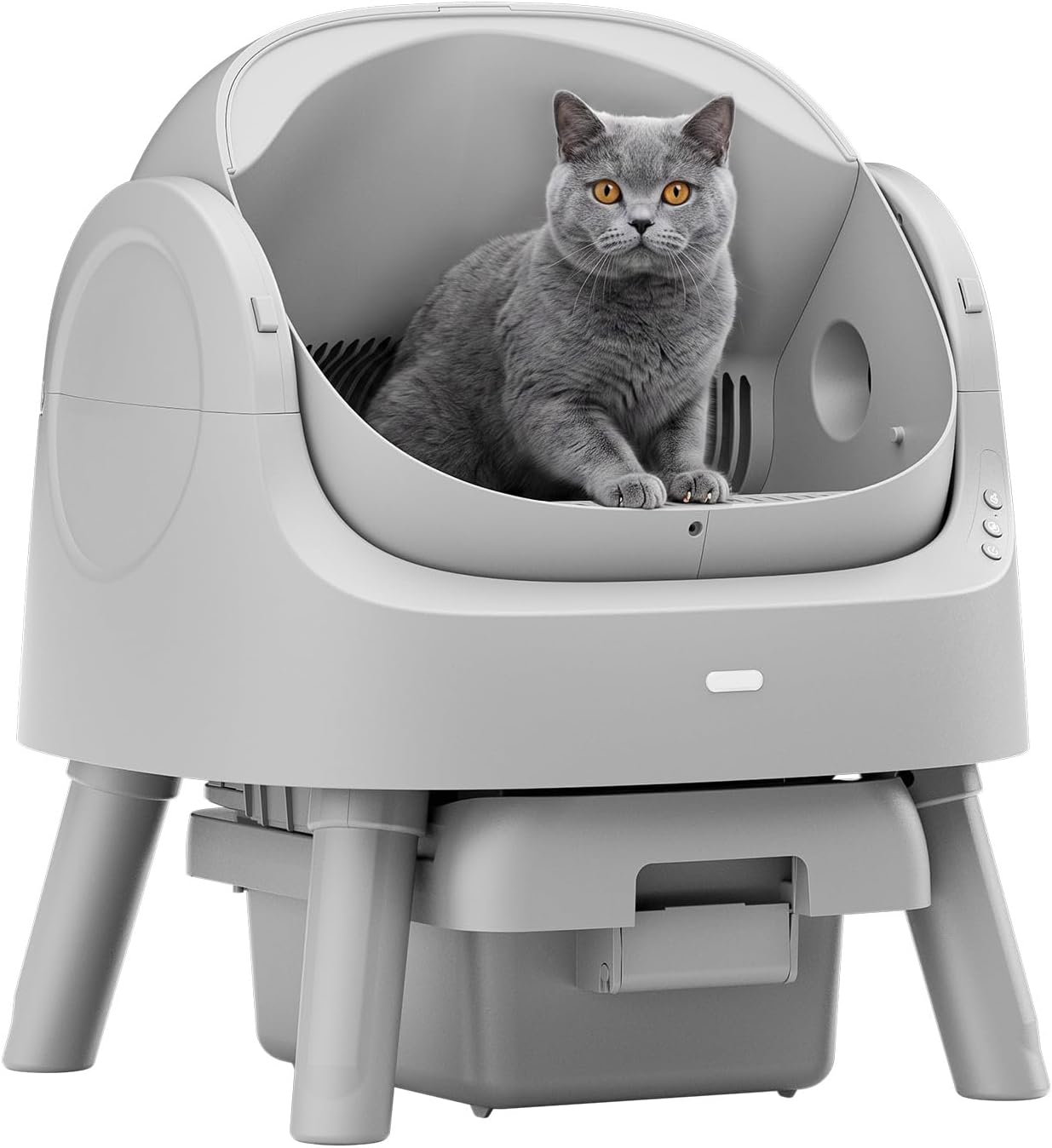
Mimfam AS11 Automatic Self-Cleaning Litter Box
This open-top automatic litter box uses infrared sensors and a 3-step cleaning cycle to handle waste from multi-cat homes, holding up to 10 days of litter without manual scooping. At 32dB and priced competitively, it appeals to owners tired of daily maintenance, though control button placement and sensor maintenance require attention.
Pros
- Effective odor containment with sealed waste compartment, reviewers report no smell in common areas
- Quick assembly (5 minutes) and simple operation without app dependency
- Reliable sensor detection prevents accidental activation and ensures pet safety
- Comes with supplies (liners and mat) plus responsive customer service replacement policy
Cons
- Control buttons positioned on front where cats step during entry/exit, causing accidental activation according to verified buyers
- Sensors accumulate dust film over time, requiring cleaning to maintain function
- No full-capacity indicator, so users must monitor manually to prevent overflow
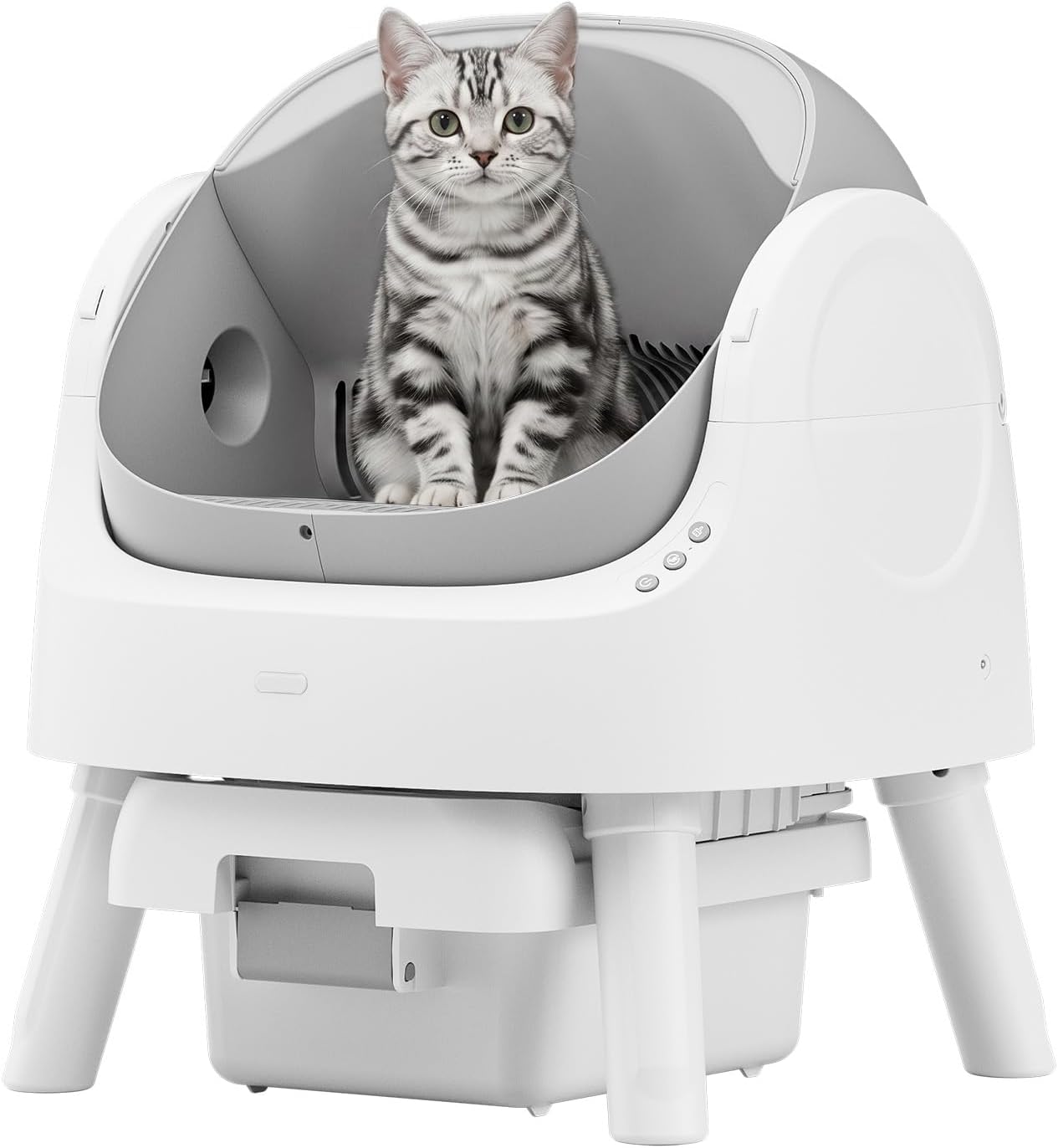
Teweoa AS11 Automatic Self-Cleaning Litter Box
An open-top automatic litter box designed for multiple cats with infrared safety sensors and quiet 32dB operation. Best suited for households wanting hands-free cleaning without the premium price tag, though size and dust accumulation in crevices are trade-offs.
Pros
- Effectively eliminates daily scooping and reduces odor through prompt waste removal
- Safety sensors work reliably to pause cleaning when cats are inside
- Quiet operation that doesn't startle most cats or disrupt sleep
- Cost-effective compared to premium brands while handling multiple cats
- Cats adapted quickly due to familiar open-top design similar to traditional boxes
Cons
- Small footprint can be uncomfortable for larger cats or those preferring more space, leading to accidents outside the box
- Waste bin fills quickly with 3+ cats, requiring bag changes every 1-2 days rather than fewer days as expected
- Dirt and litter accumulate in crevices and gaps throughout the unit, requiring weekly deep cleaning despite automatic dumping
Automatic Litter Boxes Buying Guide
Automatic litter boxes are not one-size-fits-all appliances.
The factors that matter most depend on the number of cats you have, the size of your living space, how tech-forward you want your pet-care routine to be, and how tolerant your cats are of noise and enclosed spaces.
The subsections below break down every meaningful decision point so you can match a model to your actual situation rather than simply buying the highest-rated unit on a list.
Cleaning Mechanism and Cycle Timing
The two dominant cleaning approaches in this category are rotating globe mechanisms and flat-bed raking or conveyor systems.
Globe-style units like the Furrykiddy 65L spin the entire chamber so clumps fall through a sifting screen into a sealed waste drawer below, producing minimal litter scatter and very consistent clump removal.
Flat-bed and open-top raking designs, favored by brands like Cumrige and Hazrela, use a motorized rake or belt to sweep clumps toward a collection bin; they tend to be easier for cats to enter and exit but may leave finer residue if the timing is off.
Cycle timing matters enormously for odor control. Most app-connected models let you set automatic post-use delays, typically three to ten minutes after a cat exits, so the mechanism does not startle a cat mid-visit.
Look for units that allow both scheduled cycles and manual overrides from the app. If you own multiple cats, a shorter delay and more frequent cycles reduce ammonia buildup significantly.
Some models in this roundup, including the PETKIT PuraMax 2, also log individual visit data so you can spot irregularities in bathroom frequency that might signal a health concern.
If you already rely on connected devices around the home, pairing an app-controlled litter box with your broader smart home setup is straightforward on most 2.4 GHz Wi-Fi networks. Most units in this roundup connect via 2.4 GHz Wi-Fi, which has broader router compatibility than 5 GHz bands.
Capacity and Multi-Cat Suitability

Litter box capacity is measured two ways: the interior volume cats can comfortably use and the waste bin volume that determines how long you can go between emptying.
Globe units marketed as 65L refer to the globe’s total interior, not the usable litter area, so compare usable interior dimensions rather than advertised volume alone.
For a single adult cat, a unit with a 10L to 15L waste bin typically needs emptying every one to two weeks.
For two or more cats, a larger bin, such as the 10L waste drawer on the Loveepee model, becomes a practical necessity rather than a luxury.
Open-top designs like the Hazrela and ovesong models are better suited to large or senior cats that find enclosed hoods claustrophobic, since there is no lid to duck under.
Enclosed globe designs provide superior odor containment but require cats to enter through a portal opening, which some cats resist initially.
If you are introducing an automatic box to a cat previously using a traditional open pan, a flat open-top model is almost always an easier transition.
Give any new unit two to three weeks before concluding your cat will not adapt.
Safety Sensors and Anti-Pinch Protection
Because an automatic litter box is a motorized appliance that activates on its own, safety engineering is non-negotiable, particularly in multi-cat or kitten households. The most reliable units combine infrared (IR) presence sensors, weight sensors, and anti-pinch motor cutoffs.
IR sensors detect a cat inside the unit and prevent the cycle from starting; weight sensors catch cases where a small cat might sit still enough to fool an IR beam.
Anti-pinch protection stops the motor if unexpected resistance is detected during rotation or raking, preventing injury if a paw or tail is caught.
Units like the Mimfam include four pairs of IR sensors, which is notably more coverage than the single-sensor designs common in budget models.
When evaluating safety specs, pay attention to how the manufacturer describes sensor layering, not just the claim that sensors exist.
Verified buyer feedback across this category consistently flags that budget units with only one sensor type have a higher incidence of cycle-starting prematurely, which startles cats and discourages future use.
If you have kittens or elderly cats that move slowly, prioritize triple-sensor or dual-sensor designs over single-sensor alternatives regardless of price tier.
For broader connected pet monitoring, robot vacuums with pet-detection modes can complement an automatic litter box in a fully automated pet-care setup.
Odor Control and Waste Sealing

Odor management is the primary reason most people upgrade from a traditional box, so it deserves careful scrutiny beyond marketing language.
Effective odor control depends on three things working together: how quickly the cleaning cycle runs after use, how well the waste compartment seals, and whether the unit uses any active deodorizing mechanism such as a carbon filter or ion generator.
Globe designs with sealed waste drawers that accept liner bags, like the Furrykiddy and FEELNEEDY models, perform better in small or poorly ventilated spaces because waste is contained immediately after sifting.
Open-top raking designs rely more heavily on litter quality and cycle frequency for odor suppression, since the waste bin is typically not hermetically sealed. In these configurations, clumping litter with activated charcoal performs meaningfully better than standard clay.
Most brands in this roundup include one or two rolls of proprietary liner bags in the box; factor in the ongoing cost and availability of compatible liners when calculating total cost of ownership, since some brands use proprietary sizes that are more expensive to restock than standard 13-gallon kitchen bags.
App Control and Smart Features

App connectivity has moved from novelty to expected feature in this category. The most useful implementations let you adjust cleaning delays, view visit logs with timestamps, receive low-litter or full-bin alerts, and trigger a manual cycle remotely.
The PETKIT app, used with the PuraMax 2, is among the more mature platforms in the category, offering health trend tracking alongside the standard remote-control features.
Brands like FRCFRC, Cumrige, and ovesong offer more basic app experiences that cover remote start and scheduling without deep analytics.
Before purchasing, check that the companion app is available for your smartphone operating system and that it has recent updates in the app store, which signals ongoing developer support.
An app that has not been updated in over a year on a connected appliance is a real durability risk.
All Wi-Fi-connected units in this roundup use 2.4 GHz networks; if your router broadcasts only 5 GHz, you will need a dual-band router or a dedicated 2.4 GHz SSID to complete setup.
For households already invested in connected devices, you might also explore smart displays and hubs that can surface litter box alerts alongside other home notifications.
Noise Level and Placement Considerations

Noise is an underrated factor in automatic litter box satisfaction. A unit that cycles loudly at 2 a.m. in a studio apartment will frustrate owners as much as their cats.
Most brands in this roundup advertise operating noise below 35 dB, roughly equivalent to a quiet library, though real-world noise depends heavily on litter type, fill level, and whether the unit is on a hard floor or a mat.
Globe-style motors tend to produce a low hum during rotation, while raking mechanisms can produce more variable sounds depending on litter clump consistency.
Placement also affects perceived noise and cat acceptance.
Units placed on a hard tile or hardwood floor transmit vibration more readily than those on a rubber-backed mat; most brands include a basic mat, but an aftermarket, thicker anti-vibration mat is worth considering if noise is a concern.
Place the unit in a low-traffic location your cat already uses for its traditional box, not a new spot it has not visited, to accelerate adoption.
Avoid placing it directly next to food and water bowls, as cats instinctively prefer separation between feeding and elimination areas.
Why You Should Trust Us
REMOVU is an independent review publication. We do not manufacture, sell, or distribute any of the products we cover, and we have no commercial relationship with any brand featured in this roundup.
Every product on this page was evaluated against a consistent set of criteria, including cleaning mechanism effectiveness, safety sensor design, app feature depth, odor control engineering, noise specifications, and long-term owner satisfaction, then assigned a REMOVU Score on a 0-to-10 scale that reflects our overall confidence in that product relative to its competition and price tier.
We do not conduct our own product trials; our evaluations are grounded in research, published data, expert review consensus, and verified buyer feedback.
We cross-reference manufacturer-published specifications with independent reviewer analysis and aggregated owner feedback from confirmed purchasers to identify patterns that single-source reviews can miss.
Where expert consensus and owner feedback diverge, we weight both and note the discrepancy in our scoring rationale.
REMOVU may earn a commission if you purchase through a link on this page. That affiliate relationship has zero bearing on our rankings, REMOVU Scores, or product selection.
Products are ranked by score, not by commission rate, and no brand can pay to appear on or be removed from our lists. If a product drops in quality or a better alternative emerges, we update our evaluations accordingly.
Final Thoughts
After evaluating every model in this roundup against our research criteria, a few clear winners emerge for different household needs. Here are our editorial awards, each tied to the product’s REMOVU Score and its strongest real-world attributes:
- Best Overall: PETKIT PuraMax 2 Automatic Self-Cleaning Cat Litter Box earns the top spot with the highest REMOVU Score in this roundup. Its combination of a mature companion app, anti-leakage design, safety sensor array, and strong odor containment puts it ahead of every other unit we evaluated, making it the most defensible all-around purchase for most cat owners.
- Best Globe-Style Pick: Furrykiddy Automatic Self Cleaning Litter Box delivers the 65L enclosed globe format with dual safety sensors and sub-35 dB operation, earning a strong REMOVU Score as the best-performing fully enclosed design outside the top tier.
- Best Large-Capacity Runner-Up: Cumrige Self Cleaning Litter Box stands out for its large interior, app control, and included garbage bag rolls, scoring well for households that want a high-capacity unit at a mid-range investment.
- Best Open-Top Design: ovesong Automatic Cat Litter Box offers a clean open-top layout with app control and quiet operation at a competitive price point, earning a solid REMOVU Score as the most practical option for cats that resist enclosed hoods.
- Best Budget-Conscious Pick: teweoa Self Cleaning Cat Litter Box provides the core automatic-raking experience with integrated safety protection and an open-top design at the most accessible price in this group, making it a reasonable entry point for first-time buyers.
Whatever your budget or household size, the automatic litter box category has genuinely matured to the point where even mid-range units offer meaningful quality-of-life improvements over daily manual scooping.
The PETKIT PuraMax 2 is the safest all-around recommendation for most buyers, but every pick above earned its place through consistent research across multiple evaluation dimensions.
Frequently Asked Questions
How Often Does an Automatic Litter Box Need to Be Emptied?
Most units with a 10L or larger waste bin need emptying every one to two weeks for a single cat household.
Multi-cat homes should plan on emptying every four to seven days depending on how many cats are using the box and how frequently the cleaning cycle runs.
The companion app on Wi-Fi-connected models typically sends a full-bin alert so you do not have to guess.
Checking the waste drawer every few days when you first set up the unit helps you calibrate a realistic emptying schedule for your specific household.
Will My Cat Actually Use an Automatic Litter Box?
Most cats adapt within one to three weeks, particularly if the automatic unit is placed in the same location as the previous box.
The most common reason cats reject an automatic litter box is noise or vibration startling them during or just after a visit.
To ease the transition, turn off auto-cycling for the first few days so the cat treats it as a normal box, then gradually enable the automatic function once the cat is comfortable entering and exiting.
Open-top designs typically see faster adoption than enclosed globes for cats that have always used a standard open pan.
What Type of Litter Works Best in These Units?
Medium-grain clumping clay litter is the safest choice for the vast majority of automatic litter boxes, including every unit in this roundup. Fine-grain litters produce more dust, which can clog sensors and sifting screens over time.
Crystal silica litters work well in some designs but are incompatible with certain raking mechanisms because they do not clump.
Biodegradable litters such as wood pellet or tofu litter are generally not recommended unless the manufacturer explicitly states compatibility, because they may not sift cleanly through the mechanism’s screen.
Check your specific model’s user manual before experimenting with non-standard litter types.
Are Automatic Litter Boxes Safe for Kittens?
Most manufacturers recommend waiting until kittens are at least five months old and above a minimum weight threshold, typically around 1.5 kg, before allowing unsupervised use of an automatic unit.
Below that weight, some sensor systems may not reliably detect the cat’s presence, which creates a risk of the cycle starting while the kitten is still inside.
Units with multi-layer sensor systems, including both IR and weight detection, offer more protection for small cats than single-sensor designs. Until a kitten reaches the recommended weight, supervise interactions with the unit or disable auto-cycling during unsupervised periods.
For monitoring young pets more broadly, dedicated baby monitors repurposed as pet cameras can provide an additional visual check on litter box activity.
How Do I Clean and Maintain an Automatic Litter Box?
Beyond emptying the waste bin on the schedule described above, most units benefit from a deeper cleaning every four to six weeks.
Remove the waste drawer and litter chamber, wash them with unscented soap and warm water, rinse thoroughly, and allow them to dry completely before refilling with fresh litter.
Avoid bleach or scented cleaners, which can leave residue that deters cats or degrades plastic components. Wipe sensor windows with a dry microfiber cloth during each bin-empty to prevent dust accumulation from triggering false readings.
Some models have washable liners, which simplifies this step considerably. Following the manufacturer’s maintenance schedule will extend motor life and keep the cleaning mechanism operating at full consistency.
Do Automatic Litter Boxes Work Without Wi-Fi?
Yes, every unit in this roundup includes manual controls on the device itself, so basic automatic cycling works without an active Wi-Fi connection.
Wi-Fi connectivity enables remote monitoring, push notifications, scheduling from the app, and visit logging, but losing Wi-Fi does not disable the core cleaning function.
If you experience connectivity issues, the unit will continue to operate on whatever cleaning schedule was last set.
That said, buyers in households with unreliable internet should verify that the manual control panel on their chosen model is intuitive, since app-based setup flows vary widely in how much they depend on a stable connection for initial configuration.
Smart connectivity is increasingly common across home devices; smart locks and security cameras face similar offline-fallback considerations worth thinking through as a household.
Related Guides
About the author

Paul Syverson writes reviews and buying guides for REMOVU.