The 9 Best Robot Vacuum and Mop
From pet hair to sticky kitchen floors, the right robot vacuum and mop combo can handle daily cleanup with minimal effort. Here are the top-rated picks across every budget.
 By Alexis Hawkins
Updated July 26, 2026
By Alexis Hawkins
Updated July 26, 2026

Robot vacuums with built-in mopping have matured into genuinely capable home-cleaning tools.
Where early combo units offered little more than a damp pad dragged across the floor, today’s flagship models feature pressurized roller mops, sonic scrubbing, auto mop-lifting over carpets, self-washing mop pads, and hot-air drying, all managed through polished smartphone apps.
Whether you’re dealing with pet hair, sticky kitchen floors, or the daily grind of a busy household, a well-chosen robot vacuum and mop can meaningfully reduce the time you spend pushing a broom or wringing out a mop.
The market now spans a wide range of price points, from budget-friendly entry models to premium all-in-one stations that essentially run the cleaning cycle from start to finish without you ever touching a dustbin.
REMOVU assessed each model in this roundup using a structured research process: we analyzed published specifications, cross-referenced expert review consensus from multiple credible sources, and weighed verified buyer feedback to arrive at a REMOVU Score for every pick.
The result is a curated, ranked list of the best robot vacuum and mop combos you can buy right now, covering top-tier performers from eufy, roborock, and iRobot across a range of budgets.
Read on for our top picks, then dive into the buying guide below to find the right model for your home.
| Award | Product | REMOVU Score About REMOVU ScoreThe REMOVU Score is our own rating from 0 to 10, based on performance, design and build, ease of use, and value. It reflects independent research and is never influenced by manufacturers, retailers, or affiliate commissions. Learn more › | Price | |
|---|---|---|---|---|
| Best Premium |
 eufy E25 Robot Vacuum and Mop Combo, 20,000 Pa
|
8.6/10 | Buy | |
 iRobot Roomba 505X Combo with AutoWash Dock
|
8.1/10 | Buy | ||
 Roborock Q7 M5+ Robot Vacuum with LiDAR and Auto-Empty Dock
|
7.9/10 | Buy | ||
 roborock Qrevo S5V Robot Vacuum and Mop with 12,000Pa Suction
|
8.2/10 | Buy | ||
| Best Overall |
 iRobot Roomba 415X Vacuum and Mop Combo
|
8.7/10 | Buy | |
| Best Value |
 eufy C28 Robot Vacuum and Mop Combo, 15,000 Pa
|
8.4/10 | Buy | |
| Best Budget |
 Roborock Q7 M5+ Robot Vacuum and Mop, 10000Pa
|
7.8/10 | Buy | |
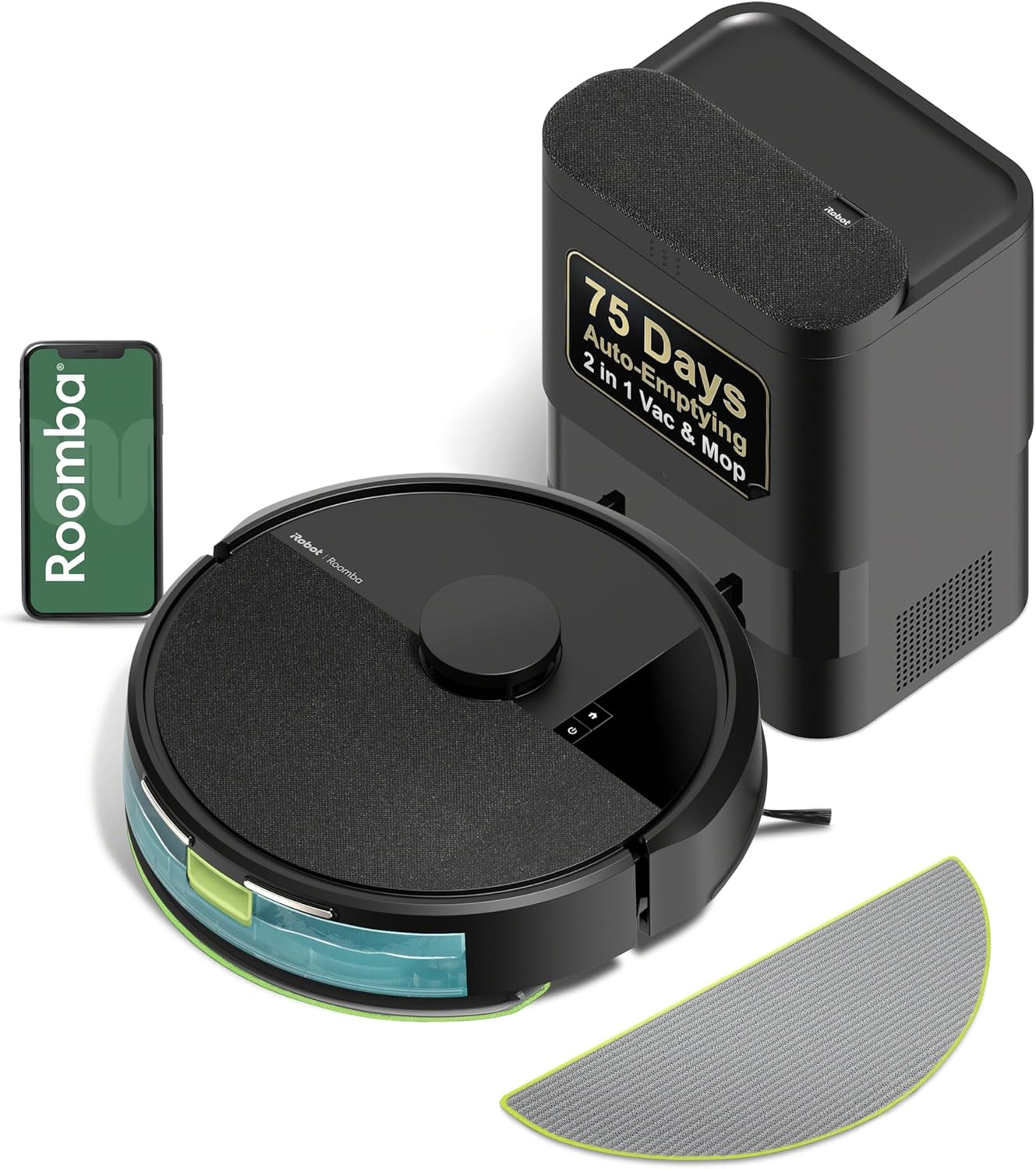 iRobot Roomba 105 Combo + AutoEmpty Dock
|
6.5/10 | Buy | ||
 ROPVACNIC S1 Robot Vacuum and Mop with 5200Pa Suction
|
6.2/10 | Buy |
eufy E25 Robot Vacuum and Mop Combo, 20,000 Pa
A versatile 2-in-1 robot that vacuums and mops with real-time cleaning via HydroJet system, self-empties, and avoids obstacles across multiple floor types. Strong suction and quiet operation make it solid for households with pets, though app controls and random cleaning patterns need refinement.
Pros
- Exceptional suction and deep cleaning power, especially for pet hair and dust in carpets and grout
- Hands-free convenience with auto-emptying, mop washing, and water refilling through all-in-one station
- Operates quietly enough for work-from-home use and won't disturb most pets
- Handles transitions and obstacles well with reliable AI navigation and avoidance
- Low maintenance on brushes compared to filter upkeep
Cons
- Mobile app lacks intuitive mapping interface and floor plan management after extended use
- Cleaning pattern is randomized, sometimes missing spots or favoring certain rooms over others
- Dust emissions during emptying cycle are loud and can scatter fine particles around garbage area; filters require frequent cleaning every 40 days
iRobot Roomba 505X Combo with AutoWash Dock
A hybrid vacuum-mop robot designed for busy households and pet owners, combining 70x stronger suction with dual spinning mop pads and a fully automated dock that self-empties for 75 days and heat-dries pads. Best suited for multi-surface homes willing to invest in hands-free cleaning automation.
Pros
- Comprehensive automation through the AutoWash Dock eliminates weekly mop pad maintenance and ensures up to 4 weeks of hands-free mopping
- Intelligent obstacle avoidance and object recognition reduce the need to pre-clean floors or manage cords manually
- Flexible cleaning modes (vacuum only, mop only, combo, or vacuum-then-mop) adapt to different room types and messes
- Extended mop pad coverage reaches 18% more floor area along walls and corners compared to standard pads
- Dirt Detection Technology identifies larger wet and dry messes and automatically makes extra cleaning passes
Cons
- Requires regular maintenance including bin wiping, dock water tank rinsing, and filter changes every 3-6 months, plus self-cleaning cycles for the dock
- No verified user reviews available at launch, so real-world reliability and durability remain unproven
- AutoWash Dock increases footprint and requires dedicated hard-surface floor space at least 4 feet from stairs
Roborock Q7 M5+ Robot Vacuum with LiDAR and Auto-Empty Dock
A budget-friendly robot vacuum and mop combo with strong 10,000Pa suction, LiDAR navigation, and hands-free self-emptying for up to 7-9 weeks. Best suited for vacuuming on hard floors and carpets; mopping functionality is basic and requires manual setup.
Pros
- Powerful suction at this price point consistently picks up pet hair and fine dust
- Self-emptying base genuinely reduces maintenance burden and feels effortless
- Roborock app offers more customization than competitors, with detailed mapping and scheduling
- LiDAR navigation is fast and accurate, enabling grid cleaning patterns and room-to-room coverage
- Quiet operation at 65dB and voice feedback adds convenience
Cons
- Mopping requires manual setup before and after each session with waterproof mat placement; lacks automatic dock-based water tank systems found in premium models
- Smaller onboard dustbin and shorter main brush compared to higher-tier Roborock models means less coverage per cycle
- No obstacle avoidance camera, so smaller soft obstacles like socks must be cleared manually; bumper-based navigation less sophisticated than premium variants
roborock Qrevo S5V Robot Vacuum and Mop with 12,000Pa Suction
A premium 2-in-1 robot that combines strong 12,000Pa suction with smart mopping via an extendable FlexiArm design, all managed through an all-in-one dock that auto-empties, washes mops, and refills water tanks. Best suited for pet owners and multi-floor homes seeking minimal maintenance.
Pros
- Comprehensive dock automation removes most maintenance burden, ideal for large homes up to 3,552 sqft
- Zero-Tangle brush system reduces hair wrapping, particularly valuable in pet households
- Flexible edge mopping with extendable arm and carpet avoidance addresses typical navigation gaps
- Multi-floor mapping and room-specific cleaning modes suit complex home layouts
- Structured light obstacle detection prevents getting stuck in cluttered spaces
Cons
- No verified user reviews available to assess real-world reliability and durability claims
- Premium feature set and all-in-one dock system suggest high price point with significant maintenance investment
- 180-minute battery life may require multiple charging cycles for larger homes despite auto-refill capability
iRobot Roomba 415X Vacuum and Mop Combo
A 2-in-1 robot that vacuums and mops simultaneously with 20,000Pa suction, automatic mop washing via its AutoWash dock, and pet-friendly tangle-free brushes. Best suited for multi-surface homes with pets that want hands-off cleaning for up to 90 days between dock empties.
Pros
- Combo vacuum and mop in one unit handles multiple floor types without switching machines
- Self-emptying dock extends cleaning intervals to 90 days with minimal user maintenance
- SmartScrub and DualClean mop pads reduce need for manual scrubbing on hard floors
- Pet-friendly design with tangle-free brushes prevents constant brush cleaning
- Slim profile fits under more furniture; edge brushes reach corners effectively
Cons
- No verified buyer reviews available to confirm real-world performance claims
- Requires regular water refills and dock maintenance despite self-emptying feature
- 6-hour battery life may require docking mid-session for larger homes
eufy C28 Robot Vacuum and Mop Combo, 15,000 Pa
The C28 combines strong suction with a self-cleaning HydroJet mop roller that actually scrubs floors rather than just dragging a damp pad. Its all-in-one station handles 75 days of maintenance, making it ideal for pet owners and those seeking truly hands-off cleaning.
Pros
- HydroJet roller mop spins at 270 RPM with 24 water ports for continuous self-cleaning during mopping, eliminating marks from pet accidents and spills
- Handles up to 30 cm long hair without tangling, with zero hair wrapping on the roller after multiple cleaning cycles per verified evaluation
- 15,000 Pa suction power effectively removes pet hair, dander, and fine dust from both hard floors and carpets with automatic boost on carpet
- All-in-one station auto-empties dust for 75 days, auto-washes mop with 50°C hot air drying, auto-refills clean water, and collects wastewater
- LiDAR navigation avoids obstacles without cameras, protecting privacy, with auto-mop lift on short carpets and 140-minute battery life
Cons
- Requires approximately 6 feet of clear space in front of charging station for proper auto-return and alignment, limiting placement flexibility
- All maintenance tasks must be handled manually except for the station functions, including emptying dirty water tanks and refilling clean water reservoirs
- Station-dependent design means the all-in-one benefits are lost if placed in multi-floor homes or if charging station access is limited
Roborock Q7 M5+ Robot Vacuum and Mop, 10000Pa
A dual vacuum-and-mop robot with 7-9 weeks of hands-free cleaning thanks to its self-emptying dock and 2.7L dust bag. Built for pet owners with a dual anti-tangle system and PreciSense LiDAR navigation for efficient room mapping.
Pros
- Extended self-emptying capability means less frequent maintenance for busy households
- Dual anti-tangle design and zero-tangling side brush specifically address pet hair challenges
- Electronic mopping with three adjustable water flow settings adds versatility beyond vacuuming alone
- PreciSense LiDAR mapping enables efficient multi-room navigation and optimized cleaning paths
- Full app control with scheduling, temporary cleaning modes, and smart no-go zone creation
Cons
- App requires 2.4GHz Wi-Fi connectivity only, limiting compatibility with some smart home networks
- No obstacle avoidance system included, unlike some competing models in the Roborock lineup
- Relatively short 150-minute runtime may require multiple charge cycles for larger homes
iRobot Roomba 105 Combo + AutoEmpty Dock
A 2-in-1 robot vacuum and mop with a self-emptying dock that holds up to 75 days of debris, offering strong suction (70X vs. 600 series), LiDAR mapping, and the ability to avoid carpets while mopping. Best for households wanting both wet and dry cleaning automation without frequent manual emptying.
Pros
- 75-day self-emptying capacity reduces maintenance frequency significantly
- Effective combo cleaning with separate vac-only, mop-only, or simultaneous modes
- ClearView LiDAR navigation maps homes and avoids obstacles reliably
- Automatically detects and avoids carpets while mopping to prevent water damage
- Voice control and app integration work smoothly with Alexa, Google, and Siri
Cons
- Random cleaning pattern misses some areas in open-concept homes; closed rooms perform better
- 100-minute battery life may not cover large houses on one charge; frequent recharging needed
- Mopping performance is modest and does not replace manual deep cleaning or regular mopping
- Hair tangling in brushes and wheels requires weekly maintenance, especially in multi-pet or long-hair households
ROPVACNIC S1 Robot Vacuum and Mop with 5200Pa Suction
This 2-in-1 vacuum and mop combo delivers strong suction power and adjustable mopping for hardwood and low-pile carpets, with app and voice control. It's particularly well-suited for pet owners and those seeking a budget-friendly automated cleaning solution.
Pros
- Strong suction performance praised across verified reviews for picking up dust, pet hair, and debris
- Mopping functionality works well for routine surface cleaning on hard floors
- Intuitive app control and reliable auto-docking to charging base
- Long battery life covers extended cleaning sessions without recharge
- Low profile reaches hard-to-access areas under furniture
Cons
- Obstacle detection occasionally misses objects and bumps into walls before correcting course
- Mopping pad handles routine dust but not heavy-duty for dried stains or sticky spills
- Random navigation patterns noted when not using scheduled mode, lacks LiDAR for precision mapping
Robot Vacuum and Mop Buying Guide
Choosing between dozens of competing models is easier once you know which specifications actually matter for your floors, your home layout, and your tolerance for maintenance.
The sections below break down every key decision point, from suction power and mopping systems to navigation quality and base-station convenience.
Suction Power and Floor Coverage

Suction is measured in Pascals (Pa), and the spread across current models is enormous. Entry-level machines sit around 5,000 Pa, while premium picks push beyond 15,000 Pa and even 20,000 Pa.
Raw Pa figures are a useful starting point but not the whole story: airflow path design, brush geometry, and filtration quality all affect how much debris actually reaches the dustbin.
For homes with a mix of hard floors and low-pile carpet, mid-range suction is usually sufficient. Thick rugs or high pet-hair volume benefit from the higher-suction flagship models.
Side brush design matters too. Traditional spinning side brushes are effective on open floors but prone to tangling with long hair.
Several models in this roundup use a dual anti-tangle or zero-tangle system that wraps hair-prone rollers with a protective mechanism, significantly reducing maintenance.
If you have shedding pets or long-haired residents, prioritize models that address tangle prevention in their design rather than relying purely on Pa ratings.
Edge and corner coverage is another consideration often overlooked until you own a robot vacuum. Extendable side brushes, as found on the eufy E25, are engineered to reach closer to wall edges and push debris into the suction path.
If your home has lots of baseboard trim or cluttered corners, this feature can make a visible difference in real-world cleanliness.
Mopping System Quality

There is a significant performance gap between a passive-pad mopping system and an active roller-mop system. Passive pads simply drag a damp cloth across the floor and work reasonably well for light dust and minor smudges.
Active roller mops, such as the HydroJet roller system used in eufy’s lineup, apply consistent pressure, spin or vibrate to scrub, and distribute water more evenly.
For kitchens with grease residue or dining areas with dried food spots, active mopping makes a meaningful difference.
Mop-lifting capability is critical in mixed-flooring homes. Without lift, the robot will drag wet pads across your rugs.
Current top models offer 10 mm or more of automatic mop elevation when carpet is detected, which prevents moisture damage and avoids re-depositing dirt. Verify the claimed lift height against your specific rug pile height before buying.
Thin area rugs and low-pile carpet are usually fine with 7 to 10 mm of lift; thicker rugs may still pose a problem regardless of brand claims.
Water management is a detail that separates the good from the great.
Look for models that actively regulate water flow rather than relying on passive drip, especially if your floors include hardwood or engineered wood that is sensitive to excess moisture.
Several units in this guide pair electronic water control with zone-specific mopping settings via app, so you can restrict mopping to tile and sealed hardwood while keeping water away from laminate or parquet areas entirely.
Navigation and Mapping Technology
LiDAR (laser-based) navigation is the current standard for reliable whole-home mapping. It creates accurate floor plans that persist between sessions, enabling room-specific scheduling, virtual no-go zones, and efficient coverage paths that avoid redundant passes.
Older gyroscope- or camera-only navigation systems tend to miss spots and struggle in low-light environments.
Every model in this roundup uses LiDAR or a comparable structured-light system, which is why we excluded budget bots that still rely purely on random-bounce patterns.
Obstacle avoidance quality varies even among LiDAR-equipped robots. Entry-level LiDAR models map rooms well but may still bump into low-profile objects like charging cables, socks, or pet toys.
Higher-tier models add 3D structured-light or AI-vision sensors that recognize and route around common household clutter without manual no-go zones.
This matters most in lived-in spaces where it’s unrealistic to pre-clear the floor before every run. iRobot’s ClearView LiDAR and roborock’s PreciSense system are worth comparing against eufy’s AI-based obstacle recognition for your specific use case.
Multi-floor mapping support is worth confirming if you have a multi-story home. Most premium models can store several saved maps simultaneously. Verify the number of stored maps in the app specifications rather than the marketing copy, as the two sometimes differ.
Base Station and Maintenance Features
The auto-empty base station has shifted from a premium add-on to a near-standard feature across mid-range and high-end robot vacuums.
Capacity claims range from 45 days to 90 days between bag changes, but actual intervals depend heavily on floor area, debris load, and pile height.
For practical purposes, a larger dustbin bag means fewer interruptions, and sealed bag designs reduce allergen exposure during disposal, an important consideration for allergy sufferers.
Auto mop washing and drying is the feature that most dramatically reduces hands-on maintenance for mopping robots. Without it, mop pads need to be hand-rinsed after every session or they spread dirty water on subsequent runs.
Models with hot-air drying, like the iRobot Roomba 505X and 415X, go a step further by preventing mildew growth on pads between sessions.
This feature is particularly valuable in humid climates where a damp pad sitting in a base station overnight can develop unpleasant odors.
Auto-refill water tanks, found on select models, close the loop so you rarely need to interact with the cleaning station at all.
Docking station footprint is a practical concern in smaller apartments. Multifunction docks that handle emptying, mop washing, drying, and water refilling are larger than simple charging docks.
Measure your intended placement area before ordering, and check whether the dock requires a nearby water line connection or operates entirely from a self-contained tank.
App, Smart Home Integration, and Controls

A polished companion app is no longer optional for a robot vacuum and mop.
The best apps offer room-by-room scheduling, adjustable suction and water-flow levels per zone, real-time map editing, consumable life tracking, and cleaning history logs. roborock’s app is widely cited in expert reviews as one of the most feature-complete in the category, while iRobot’s updated app ecosystem has improved substantially in recent generations. eufy’s EufyHome app sits comfortably in between, with solid mapping tools and straightforward scheduling.
Voice assistant compatibility with Amazon Alexa and Google Home is standard across most models at this price level. Apple HomeKit support is less common and worth checking specifically if you run an Apple-centric smart home ecosystem.
Matter protocol support is an emerging factor to watch for future-proofing, though at present most users will find standard Wi-Fi app control sufficient. Smart locks, smart thermostats, and robot vacuums increasingly work together in home automation routines, so checking broader ecosystem compatibility before committing to a platform is worthwhile.
Budget and Value Considerations

The robot vacuum and mop market spans a notably wide price range.
Entry-level options like the ROPVACNIC model in this roundup provide solid basic coverage at a budget-friendly price point, making them a reasonable starting point for small apartments or users who want to try the category without a large upfront commitment.
These models typically lack mop-washing base stations and advanced obstacle avoidance, but for light-use scenarios on mostly hard floors they represent respectable value.
Mid-range picks, including several roborock and iRobot options in this guide, strike the best balance for most households: capable LiDAR navigation, reliable mopping with some degree of auto-maintenance, and long self-empty intervals.
Premium models add auto mop washing, hot-air drying, and higher suction figures, and are worth the additional investment for large homes, households with pets, or anyone who wants to minimize day-to-day interaction with the device entirely.
Factor ongoing consumable costs into your value calculation. Replacement mop pads, HEPA filters, side brushes, and auto-empty bags all carry recurring costs. Some manufacturers offer subscription bundles; others price accessories high enough to offset an initially competitive hardware price.
Checking consumable availability and pricing before buying is a step many shoppers skip and later regret.
For households running multiple connected devices, also consider how a robot vacuum fits alongside other pet tech tools and security cameras that may share your home network and app ecosystem.
Why You Should Trust Us
REMOVU is an independent review publication with no brand relationships, sponsorships, or paid placements.
Every product in this roundup was evaluated using the same consistent methodology: we analyze manufacturer-published specifications, aggregate expert review consensus from multiple credible sources, and factor in verified buyer feedback from confirmed purchasers.
Each model receives a REMOVU Score on a scale of 0 to 10, reflecting its overall performance across the criteria most relevant to this category, including suction and mopping effectiveness, navigation reliability, base-station convenience, app quality, and long-term ownership value.
We do not conduct our own product trials; our evaluations are grounded in research, published data, expert review consensus, and verified buyer feedback.
This approach lets us cover a broader range of products and price points than single-lab evaluations allow, and it ensures our conclusions reflect real-world ownership patterns across many users rather than a single controlled session.
Our rankings are updated as new models launch and as verified owner feedback accumulates over time.
Transparency on affiliate relationships: REMOVU may earn a commission if you purchase through a link in this article. That relationship has no bearing on which products are included, how they are scored, or how they are ranked.
Scores and rankings are determined entirely by our research criteria, not by commission rates or brand incentives.
Final Thoughts
After thorough research across this category, a few standout performers deserve special recognition based on their REMOVU Scores and what they deliver for specific buyer profiles. Here are our editorial picks for 2026:
- Best Overall: eufy E25 Robot Vacuum and Mop Combo. The highest REMOVU Score in this roundup reflects a compelling combination of 20,000 Pa suction, HydroJet roller mopping, an extendable side brush for edge cleaning, AI obstacle avoidance, and a fully integrated all-in-one station. It earns the top spot for buyers who want the most capable all-around performer.
- Best for Smart Home Power Users: iRobot Roomba 505X Robot Vacuum and Mop Combo. With the highest suction tier in iRobot’s current lineup, a multifunction dock that handles emptying, mop cleaning, and hot-air drying, and polished AI obstacle avoidance, the Roomba 505X earns its place as the top iRobot pick and a strong overall contender for households deeply invested in app-driven cleaning routines.
- Best Everyday Performance: roborock Robot Vacuum Mop with LiDAR. This roborock model pairs reliable LiDAR mapping, a dual anti-tangle system ideal for pet hair, and a generously sized auto-empty dock with a well-regarded companion app. It represents roborock’s sweet spot between capability and value, making it a consistently recommended choice for mixed-flooring homes.
- Best Budget Pick: ROPVACNIC Robot Vacuum Cleaner. For buyers who need reliable daily vacuuming and basic mopping without a premium investment, the ROPVACNIC delivers self-charging convenience, solid obstacle avoidance for its class, and personalized cleaning adjustments at an accessible price. It is the right entry point for small apartments or first-time robot vacuum owners.
- Best for Allergy-Sensitive Homes: roborock Qrevo S5V Robot Vacuum and Mop. The Qrevo S5V’s combination of 12,000 Pa suction with a dual zero-tangle system, 10 mm mop lifting, and auto mop washing and drying makes it an especially strong choice for households where dust, dander, and allergen control are priorities alongside clean floors.
Whatever your budget or floor type, the robot vacuum and mop category has matured to the point where nearly every pick in this guide will deliver a meaningful upgrade over manual cleaning routines.
Use the buying guide above to match specifications to your specific needs, and lean on the REMOVU Scores to calibrate relative quality within your price range.
Frequently Asked Questions
Do robot vacuums with mops actually clean floors well, or is the mopping just a gimmick?
Modern mopping systems have improved dramatically. Active roller-mop designs with pressurized water delivery and scrubbing action genuinely remove dried-on stains and everyday grime from hard floors, something passive-pad systems could not do reliably.
That said, no robot mop replaces a deep manual scrub for heavily soiled grout or ingrained staining. Think of a robot mop as an excellent maintenance tool between deep cleans rather than a full replacement.
For households in the smart home category looking to automate daily floor care, the results from a quality combo unit are genuinely impressive.
Will a robot vacuum and mop damage my hardwood floors?
Risk to hardwood comes primarily from excess moisture and abrasive pads. Quality models with electronic water flow control and soft roller-mop materials are generally safe on sealed hardwood.
The key is ensuring the mop pad stays damp rather than wet, and that the robot does not park on wood floors with mop pads in contact for extended periods.
Most premium models address this with automatic pad retraction or mop lifting when docked. Always check the flooring compatibility notes in your model’s documentation, and start with the lowest water-flow setting to assess how your specific floor responds.
How often do I need to maintain a robot vacuum and mop combo?
With a full-featured base station that auto-empties, auto-washes mop pads, and hot-air dries, day-to-day maintenance can be minimal.
Realistically, you’ll need to refill the clean water tank every week or two depending on usage, replace dustbin bags every one to three months, check roller brushes for hair wrap monthly even with tangle-resistant designs, and replace mop pads and HEPA filters on the manufacturer’s recommended schedule, typically every two to three months.
Budget for consumable costs when comparing models, as these ongoing expenses vary significantly between brands. Keeping your smart home devices and robot vacuum on a regular maintenance routine ensures consistently good performance over years of use.
Can a robot vacuum and mop handle pet hair on carpet?
Yes, and several models in this roundup were specifically designed with pet households in mind.
The dual anti-tangle and zero-tangle brush systems found on roborock and eufy models are particularly effective at picking up long pet hair without jamming the roller. Higher suction ratings help extract embedded hair from carpet pile.
If pet hair is your primary concern, prioritize tangle-resistant brush design and strong suction over mopping features, then treat the mop capability as a bonus for your hard floors.
Many pet owners also find it useful to pair their robot vacuum with dedicated pet tech tools for a more complete care routine.
Is it worth spending more on a premium model versus a budget option?
For most households, yes, if you have a mix of floor types or significant pet hair.
The jump from a budget model to a mid-range LiDAR model brings better mapping accuracy, more reliable obstacle avoidance, and genuine mopping capability rather than a passive pad.
The jump from mid-range to premium adds auto mop washing, hot-air drying, and higher suction, which meaningfully reduces your hands-on maintenance burden. For a small apartment with mostly hard floors and light debris, a budget pick can perform well.
For larger homes, pet households, or anyone who wants near-hands-free operation, the mid-to-premium tier delivers the automation you’re actually paying for.
Consider how a robot vacuum fits alongside other connected devices like smart displays and hubs that can further automate your home routines.
How does LiDAR navigation compare to camera-based navigation?
LiDAR uses laser pulses to create precise distance measurements, producing accurate and repeatable floor maps regardless of lighting conditions. Camera-based visual navigation works well in normal light but can struggle in darkness, direct sunlight glare, or low-contrast environments.
For most homes, LiDAR is the more reliable choice. Some higher-end models combine LiDAR with AI camera systems for enhanced obstacle recognition, getting the best of both approaches.
All nine models in this roundup use LiDAR or an equivalent structured mapping system, which is one reason they outperform older random-navigation robots in both cleaning efficiency and obstacle handling.
Related Guides
About the author
Alexis covers Blu-ray and 4K disc players for REMOVU, comparing picture quality, format support, and streaming extras. She helps collectors and cinephiles get the best possible image from a physical library.