The 12 Best Robot Vacuums with Self Emptying
Self-emptying robot vacuums have matured fast. We researched twelve models across every price tier to help you find the right mix of suction, mapping, and dock capability for your home.
 By Marlene Barnes
Updated July 26, 2026
By Marlene Barnes
Updated July 26, 2026

A robot vacuum with a self-emptying base has become one of the most genuinely useful smart home upgrades you can make.
Instead of bending down to empty a dustbin every run, the robot docks itself and the base evacuates debris automatically, sometimes going weeks between manual empties.
That shift matters most for households with pets, allergy sufferers, or anyone who wants truly hands-off floor care.
The catch is that the category spans a wide price range and the technology varies enormously, from budget LiDAR mappers with basic suction all the way to full-system docks that wash, dry, and refill the mop pad on their own.
This guide covers twelve models across the full spectrum, drawing on published specifications, expert review consensus, and verified buyer feedback to help you match the right robot to your home.
Whether you share your floor with a shedding dog, live in a multi-room apartment, or just want one less chore to think about, the picks below represent the strongest options available right now across the category.
Scroll down for our ranked list of top picks, then read the buying guide before spending a cent.

Dreame L60 Ultra PE Robot Vacuum and Mop, 30,000Pa
A hybrid vacuum-mop robot with strong 30,000Pa suction and hot-water self-cleaning mop dock. Works well for pet hair and mixed floors, though occasional carpet spots require second passes and app notifications can be excessive.
Pros
- Strong suction power noticeably effective on carpets with pet hair and deep fibers
- Self-cleaning dock significantly reduces maintenance burden
- Hot-water mop washing keeps pads sanitary with minimal in-depth care
- Quiet operation even at maximum suction, suitable for nighttime cleaning
- Dual Flex Arm with extending side brush and swinging mop reaches tight spaces
Cons
- Occasionally misses small pieces on carpets, sometimes requiring second run
- Excessive app notifications for each cycle phase can become intrusive
- App interface may frustrate non-tech-savvy users despite initial setup ease

iRobot Roomba 505X Combo with AutoWash Dock
A hybrid vacuum-mop robot designed for busy households and pet owners, combining 70x stronger suction with dual spinning mop pads and a fully automated dock that self-empties for 75 days and heat-dries pads. Best suited for multi-surface homes willing to invest in hands-free cleaning automation.
Pros
- Comprehensive automation through the AutoWash Dock eliminates weekly mop pad maintenance and ensures up to 4 weeks of hands-free mopping
- Intelligent obstacle avoidance and object recognition reduce the need to pre-clean floors or manage cords manually
- Flexible cleaning modes (vacuum only, mop only, combo, or vacuum-then-mop) adapt to different room types and messes
- Extended mop pad coverage reaches 18% more floor area along walls and corners compared to standard pads
- Dirt Detection Technology identifies larger wet and dry messes and automatically makes extra cleaning passes
Cons
- Requires regular maintenance including bin wiping, dock water tank rinsing, and filter changes every 3-6 months, plus self-cleaning cycles for the dock
- No verified user reviews available at launch, so real-world reliability and durability remain unproven
- AutoWash Dock increases footprint and requires dedicated hard-surface floor space at least 4 feet from stairs

ECOVACS DEEBOT X9 PRO OMNI Robot Vacuum, 16,600Pa
The X9 PRO OMNI combines dual vacuuming and mopping with a 10-in-1 station that handles washing, drying, and emptying over 150 days hands-free. Its BLAST airflow and OZMO Roller mop system excel at pet hair and carpet cleaning, though suction power trails some flagship competitors.
Pros
- Excellent for pet hair and carpet cleaning with BLAST airflow and ZeroTangle 3.0 design
- True dual functionality with real-time mop self-cleaning prevents odor and streaks
- Comprehensive 10-in-1 station minimizes in-depth maintenance for extended periods
- Triple Lift prevents water on carpets and automates surface transitions
- Supports multiple control methods including voice assistants (Alexa, Google, Siri)
Cons
- 16,600Pa suction ranks lower than comparable DEEBOT models (X11 PRO at 19,500Pa, T80 at 24,800Pa)
- No bagless station option or PowerBoost GaN charging like higher-tier models
- No verified buyer reviews available to assess real-world reliability and long-term performance
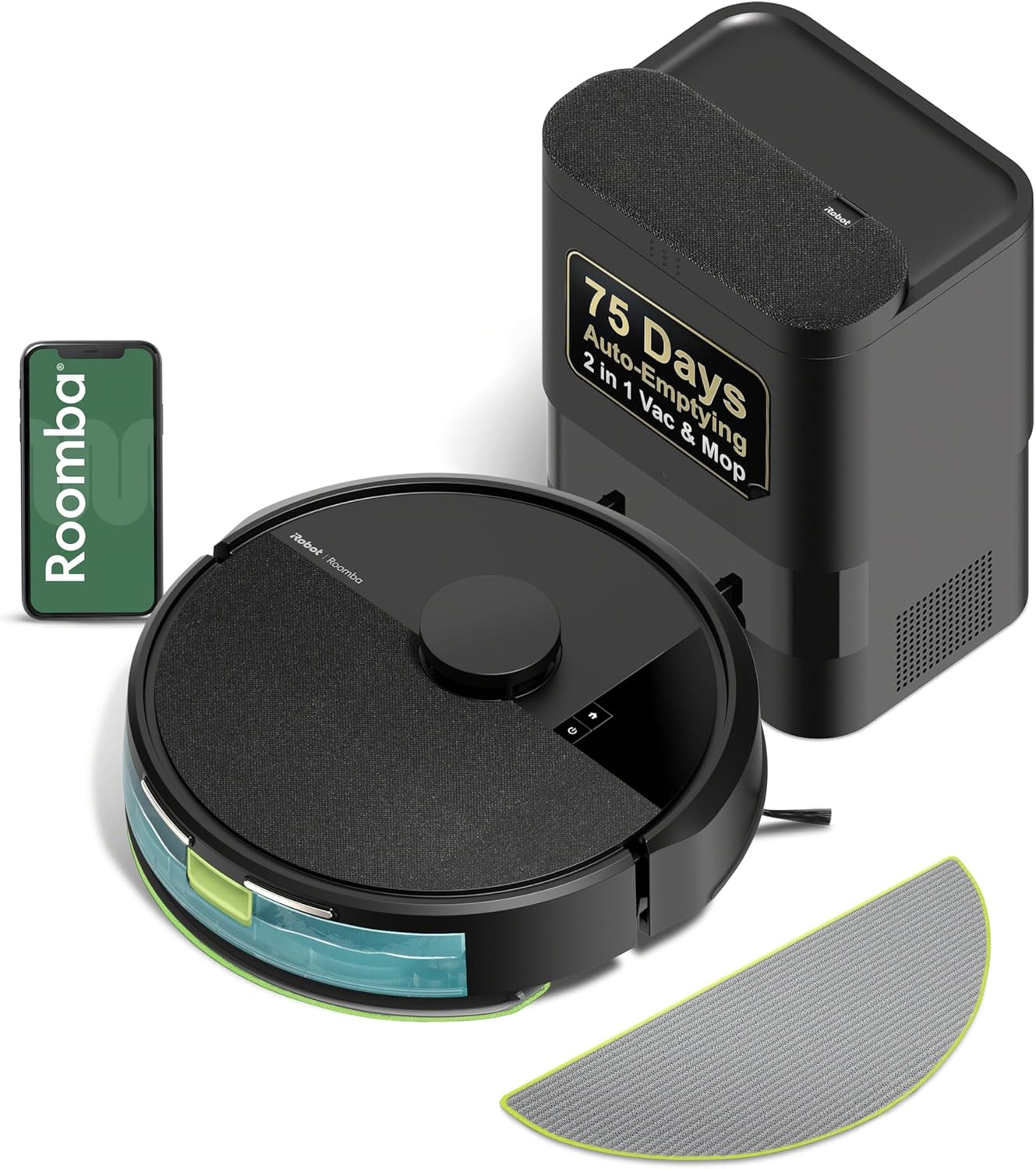
iRobot Roomba 105 Combo + AutoEmpty Dock
A 2-in-1 robot vacuum and mop with a self-emptying dock that holds up to 75 days of debris, offering strong suction (70X vs. 600 series), LiDAR mapping, and the ability to avoid carpets while mopping. Best for households wanting both wet and dry cleaning automation without frequent manual emptying.
Pros
- 75-day self-emptying capacity reduces maintenance frequency significantly
- Effective combo cleaning with separate vac-only, mop-only, or simultaneous modes
- ClearView LiDAR navigation maps homes and avoids obstacles reliably
- Automatically detects and avoids carpets while mopping to prevent water damage
- Voice control and app integration work smoothly with Alexa, Google, and Siri
Cons
- Random cleaning pattern misses some areas in open-concept homes; closed rooms perform better
- 100-minute battery life may not cover large houses on one charge; frequent recharging needed
- Mopping performance is modest and does not replace manual deep cleaning or regular mopping
- Hair tangling in brushes and wheels requires weekly maintenance, especially in multi-pet or long-hair households

eufy C28 Robot Vacuum and Mop Combo, 15,000 Pa
The C28 combines strong suction with a self-cleaning HydroJet mop roller that actually scrubs floors rather than just dragging a damp pad. Its all-in-one station handles 75 days of maintenance, making it ideal for pet owners and those seeking truly hands-off cleaning.
Pros
- HydroJet roller mop spins at 270 RPM with 24 water ports for continuous self-cleaning during mopping, eliminating marks from pet accidents and spills
- Handles up to 30 cm long hair without tangling, with zero hair wrapping on the roller after multiple cleaning cycles per verified evaluation
- 15,000 Pa suction power effectively removes pet hair, dander, and fine dust from both hard floors and carpets with automatic boost on carpet
- All-in-one station auto-empties dust for 75 days, auto-washes mop with 50°C hot air drying, auto-refills clean water, and collects wastewater
- LiDAR navigation avoids obstacles without cameras, protecting privacy, with auto-mop lift on short carpets and 140-minute battery life
Cons
- Requires approximately 6 feet of clear space in front of charging station for proper auto-return and alignment, limiting placement flexibility
- All maintenance tasks must be handled manually except for the station functions, including emptying dirty water tanks and refilling clean water reservoirs
- Station-dependent design means the all-in-one benefits are lost if placed in multi-floor homes or if charging station access is limited

Tikom L8000 Plus Robot Vacuum with Self-Emptying Base
This 2-in-1 vacuum and mop combines 6000Pa suction with a 90-day self-emptying base and LiDAR navigation for hands-off cleaning. Strong on pet hair and hard floors, though mopping capability is limited compared to dedicated wet cleaners.
Pros
- 90-day self-emptying dustbag capacity eliminates frequent manual emptying
- 6000Pa suction power effectively handles pet hair, dust, and debris on multiple floor types
- 360-degree LiDAR navigation and multi-floor mapping prevent missed spots and repeated passes
- Quiet operation at 60dB, even at higher suction levels
- 150-minute runtime with auto-recharge and resume functionality
- App control allows scheduling, no-go zones, and room-specific cleaning customization
- Competitively priced for a 2-in-1 vacuum and mop combo
Cons
- Mopping is basic, essentially a damp microfiber cloth pass rather than true wet cleaning
- Dark flooring and sharp color contrasts can trigger false cliff detection, causing interruptions
- Edge and perimeter cleaning performance is limited near furniture and room edges
- Replacement dustbags are brand-specific and require ongoing purchase
- Room mapping occasionally loses directional accuracy, reducing reliability of no-go zones

iRobot Roomba 415X Vacuum and Mop Combo
A 2-in-1 robot that vacuums and mops simultaneously with 20,000Pa suction, automatic mop washing via its AutoWash dock, and pet-friendly tangle-free brushes. Best suited for multi-surface homes with pets that want hands-off cleaning for up to 90 days between dock empties.
Pros
- Combo vacuum and mop in one unit handles multiple floor types without switching machines
- Self-emptying dock extends cleaning intervals to 90 days with minimal user maintenance
- SmartScrub and DualClean mop pads reduce need for manual scrubbing on hard floors
- Pet-friendly design with tangle-free brushes prevents constant brush cleaning
- Slim profile fits under more furniture; edge brushes reach corners effectively
Cons
- No verified buyer reviews available to confirm real-world performance claims
- Requires regular water refills and dock maintenance despite self-emptying feature
- 6-hour battery life may require docking mid-session for larger homes

WSUANE D15S Max Robot Vacuum, 10000Pa Suction, 90-Day Self-Emptying
A self-emptying combo vacuum designed for pet owners and busy households, featuring 10,000Pa suction, dToF LiDAR navigation, and an anti-tangle blade brush. The 90-day dustbin capacity and 160-minute runtime reduce maintenance, though real-world pet hair performance and mopping effectiveness remain unverified.
Pros
- Exceptional dustbin capacity eliminates frequent emptying for extended periods
- Multiple suction modes (800Pa to 10,000Pa) adapt to different surfaces and noise preferences
- dToF LiDAR plus 9 sensors (drop, collision, ground detection) enable precise navigation and mapping
- Hair-cutting blade specifically designed to prevent tangling in pet-heavy households
- Extended battery life offers up to 160 minutes per charge on quiet mode
Cons
- Zero verified user reviews limit real-world performance assessment for pet hair and mopping effectiveness
- Mopping capability mentioned in title but not detailed in specifications or features
- Noise level of 70dB in quiet mode may still be audible during operation

Roborock Q7 M5+ Robot Vacuum and Mop, 10000Pa
A dual vacuum-and-mop robot with 7-9 weeks of hands-free cleaning thanks to its self-emptying dock and 2.7L dust bag. Built for pet owners with a dual anti-tangle system and PreciSense LiDAR navigation for efficient room mapping.
Pros
- Extended self-emptying capability means less frequent maintenance for busy households
- Dual anti-tangle design and zero-tangling side brush specifically address pet hair challenges
- Electronic mopping with three adjustable water flow settings adds versatility beyond vacuuming alone
- PreciSense LiDAR mapping enables efficient multi-room navigation and optimized cleaning paths
- Full app control with scheduling, temporary cleaning modes, and smart no-go zone creation
Cons
- App requires 2.4GHz Wi-Fi connectivity only, limiting compatibility with some smart home networks
- No obstacle avoidance system included, unlike some competing models in the Roborock lineup
- Relatively short 150-minute runtime may require multiple charge cycles for larger homes

Shark AV2501AE AI Robot Vacuum with 60-Day Self-Empty Base
This LiDAR-equipped robot vacuum uses Matrix Clean Navigation to methodically cover floors in a grid pattern, with a 60-day bagless self-emptying base that captures 99.97% of dust and allergens. It handles pet hair well and runs up to 120 minutes per charge, though it requires regular maintenance and struggles with multi-floor mapping.
Pros
- Effective grid-based cleaning with LiDAR navigation that avoids obstacles and adapts to room changes
- 60-day self-empty base reduces frequent bin emptying and traps allergens with HEPA filtration
- Strong suction for pet hair, litter, and debris across carpets and hard floors
- 120-minute runtime with Recharge and Resume allows whole-home cleaning on larger floors
- App and voice control via Alexa and Google Assistant for scheduling and on-demand cleaning
Cons
- Requires monthly maintenance (brush hair removal, filter cleaning) to maintain performance and prevent battery drain
- Multi-floor mapping is cumbersome, requiring remapping each time the unit moves between floors
- Hair frequently tangles around the brush spindle and can cause wheel binding, necessitating manual cleaning with small tools

iMartine D16S MAX Robot Vacuum and Mop Combo
A 2-in-1 vacuum and mop with 18000Pa suction, bagless self-emptying station, and LiDAR navigation that handles multiple floor types and pet hair effectively. Smart app and Alexa control make it convenient for hands-off home maintenance.
Pros
- Strong suction handles carpets, tiles, laminate, and pet hair without tangling
- Extended runtime and auto-resume after recharge suit large multi-floor homes
- Precise LiDAR mapping and obstacle avoidance with customizable cleaning zones
- Quiet operation doesn't disrupt daily routines while maintaining cleaning power
- Easy setup and intuitive app control even for non-tech-savvy users
Cons
- Limited to 150ml water tank capacity, which may require refills for extensive mopping sessions
- No negative feedback in available reviews limits insight into potential durability or edge-case performance issues
- Dust cup size (220ml onboard) means frequent emptying in heavy-use scenarios despite large station capacity
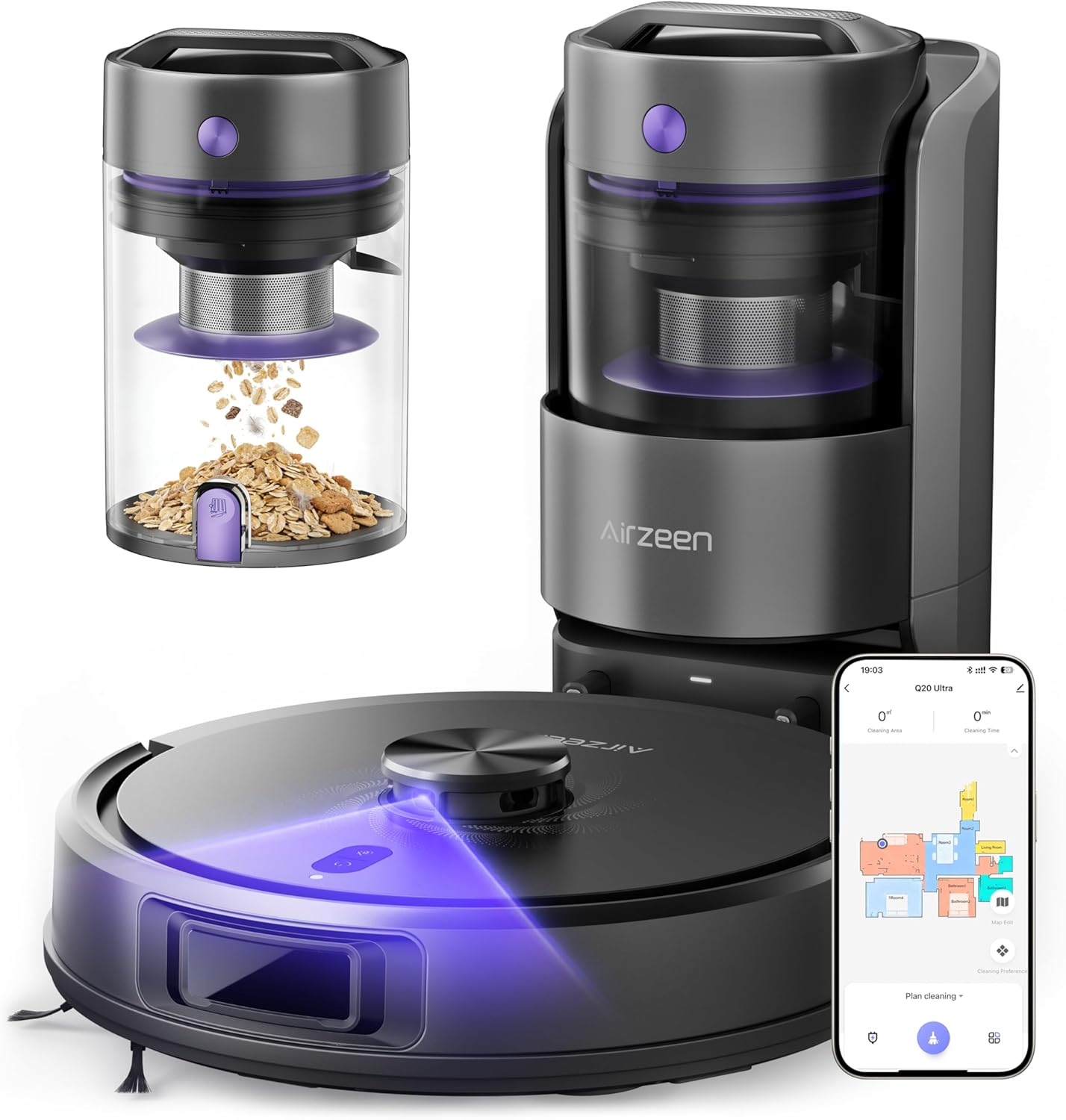
Airzeen Q20 Ultra Robot Vacuum and Mop with Self-Emptying
A 3-in-1 vacuum, sweep, and mop combo with LiDAR navigation and 45-day bagless self-emptying. Delivers 6000Pa suction for pet hair and debris on hard floors and low-pile carpets, controlled via app with Alexa support. Best for multi-level homes wanting hands-free cleaning without bag replacement costs.
Pros
- Excellent navigation and room recognition with LiDAR, reducing missed spots compared to random-path models
- Strong suction handles pet hair, crumbs, and dust effectively across hard floors and low-pile carpet
- Reusable dust cup design eliminates ongoing bag costs and reduces waste
- User-friendly app allows granular control including room selection, schedules, and water flow adjustment
- Includes extra filters, brushes, and mop cloths from purchase, extending product lifespan
Cons
- Only supports 2.4GHz Wi-Fi, not 5GHz, limiting connectivity in some modern networks
- Mopping performance is entry-level; does not include automated water heating or spinning mop like premium models
- One verified buyer reported battery lasting only 30 minutes instead of advertised runtime, suggesting potential QC variance
Robot Vacuums With Self Emptying Buying Guide
Buying a self-emptying robot vacuum is genuinely different from buying a regular one. The base station adds cost, footprint, and complexity, so you need to evaluate both the robot itself and the dock together.
Below are the six criteria that matter most, drawn from the patterns we observed across specifications and buyer feedback for every model in this roundup.
Suction Power and Cleaning Performance

Suction figures in this category range from roughly 6,000 Pa on budget models all the way to 30,000 Pa on flagship robots. Raw Pa numbers are a useful starting point but not the whole story.
The shape of the brush roll, the airflow path, and the sealing of the dustbin all affect real-world pickup. For hard floors and low-pile carpet, mid-range suction is more than adequate.
For thick carpet or homes with heavy pet-hair shedding, you want a robot with stronger suction combined with a brush roll designed to resist tangling.
Several models in this roundup use dual anti-tangle or zero-tangle brush systems specifically to prevent hair from wrapping around the roller, which is one of the most common failure points verified buyers complain about.
If you have a dog or long-haired cat, treat tangle resistance as a must-have rather than a nice-to-have. Pairing a capable robot with a well-designed pet tech ecosystem in your home can make the whole experience feel far more seamless.
Mopping performance is increasingly bundled into self-emptying robots.
Look carefully at how the mop operates: a dragged pad covers far less effectively than a spinning or vibrating roller mop, and only the more advanced systems automatically lift the mop pad when crossing carpet, preventing wet streaks on rugs.
Self-Empty Capacity and Dock Design

Manufacturers advertise capacity in days, typically ranging from 60 to 90 days between empties. Treat these figures as estimates for average-sized homes with moderate debris loads. In a pet-heavy or high-traffic household, your real-world interval will be shorter.
The more meaningful distinction is whether the dock uses a bag or a bagless bin. Bagged systems seal allergens more completely when you do empty them, which is a significant advantage for allergy sufferers.
Bagless designs save on ongoing consumable costs but can release a puff of fine dust at the moment of disposal.
Higher-end docks go further, adding water tanks, mop-washing capability, and hot-air drying for the mop pads. These all-in-one stations meaningfully reduce maintenance but add to the footprint and price.
Before buying, measure the space near your power outlet: a full station with water tanks can be surprisingly bulky. Also consider whether the dock needs to be placed on hard floor only or if it can sit on low carpet.
Navigation Technology and Mapping
Every robot in this roundup uses some form of LiDAR navigation, which represents a meaningful baseline quality level compared with older bump-and-spin robots.
LiDAR lets the robot build a persistent floor map, enabling zone cleaning, no-go boundaries set in the app, and more efficient coverage paths.
The differences between LiDAR implementations are subtle but real: some systems use a single rotating sensor while others combine LiDAR with additional depth-sensing cameras for improved obstacle detection.
Obstacle avoidance is the area where the most significant performance gaps exist between budget and premium robots. Entry-level models can navigate around large objects but may struggle with charging cables, shoes, or pet waste.
Premium robots with 3D structured light or dual cameras handle a wider range of obstacles and are considerably less likely to drag debris around the floor or get stuck.
If your floor is cluttered at the end of a typical day, budget extra for better obstacle avoidance rather than raw suction.
If you enjoy integrating gadgets, pairing this kind of smart system with smart displays and hubs lets you trigger cleaning schedules by voice or routine without picking up a phone.
Mopping System Quality

The mopping capabilities bundled into combo robots in this category vary more than any other feature.
At the lower end, mopping means a damp pad is dragged behind the robot, which adds a light clean to hard floors but won’t shift dried-on grime.
Mid-tier models introduce a spinning or vibrating roller mop that scrubs with far more pressure.
The best systems pair a pressurized roller with automatic mop washing at the dock and hot-air drying, which prevents mildew and keeps the mop pad hygienic between uses.
Auto carpet detection and mop lift are critical if your home mixes hard floors with rugs or carpeted rooms. Without mop lift, the robot will either skip those areas entirely or trail a damp pad across your carpet.
The better implementations raise the mop pad by at least 10 mm when crossing onto a rug, keeping carpet dry while still mopping the rest of the floor in a single run.
App, Connectivity, and Smart Home Integration

Every model here connects to Wi-Fi and is controllable via a companion app. The quality of those apps varies considerably.
The most polished apps let you view and edit a multi-floor map, set room-specific schedules and suction levels, create permanent no-go zones, and track cleaning history with area-coverage data.
Weaker implementations may offer only basic start/stop and a rudimentary map view.
Buyer reviews frequently call out app stability and the reliability of the initial mapping process as pain points, so it is worth checking recent reviews for the specific model you are considering.
Alexa and Google Home compatibility is widespread in this roundup. Matter protocol support is beginning to appear on flagship models and will eventually simplify multi-device automation.
Voice control is convenient for triggering spot cleans or sending the robot home, and if you already have a robust smart home setup, a robot with strong integration removes one more app from your daily routine.
Value, Warranty, and Brand Support

Self-emptying robots represent a meaningful investment. Price alone is not a reliable proxy for quality in this category; some lesser-known brands deliver strong specifications and competitive REMOVU Scores at substantially lower price points than legacy brands.
That said, brand support matters more here than with simpler appliances.
A robot that needs a firmware fix, a replacement brush roll, or a new filter in two years is only useful if parts remain available and the app is still maintained.
Established brands like iRobot, Dreame, Roborock, and ECOVACS have multi-year track records of software updates and accessible spare parts. Newer or lesser-known brands can offer compelling hardware at lower prices but carry more uncertainty about long-term support.
If longevity matters to you, it is reasonable to pay a moderate premium for a brand with a demonstrable service record.
Finally, check whether the self-empty dock is sold as part of a bundle or must be purchased separately, as this affects the true all-in cost.
Why You Should Trust Us
REMOVU is an independent review publication with no brand affiliations and no manufacturer-sponsored placements.
Every product in this roundup is assigned a REMOVU Score on a 0 to 10 scale using a consistent evaluation framework that weighs cleaning performance, navigation quality, self-empty system design, mopping capability, software reliability, and overall value relative to price.
Scores are derived from published technical specifications, expert review consensus drawn from the broader review community, and verified buyer feedback aggregated across major retail platforms.
We do not conduct our own product trials; our evaluations are grounded in research, published data, expert review consensus, and verified buyer feedback.
This approach lets us cover a broader range of products more quickly and without the conflict of interest that sometimes comes when a publication accepts manufacturer samples. Rankings reflect scoring outcomes, not commercial relationships.
REMOVU may earn an affiliate commission if you purchase through a link on this page. That relationship does not influence which products appear in our roundups, how they are ranked, or what scores they receive.
Our editorial positions are determined independently of any affiliate revenue. We cover everything from security cameras to smart locks using the same framework, so you can apply consistent expectations across every category we publish.
Final Thoughts
After evaluating twelve models across this category, a few clear standouts emerge at each price tier. Here are our editorial picks by use case, each reflecting the product’s REMOVU Score relative to the full field.
- Best Overall: Dreame L60 Ultra PE Robot Vacuum and Mop earns the highest REMOVU Score in the roundup. Its combination of class-leading suction, corner-to-edge cleaning geometry, a detangling brush, full obstacle avoidance, and a comprehensive self-cleaning dock sets the benchmark for the category in 2026.
- Best Mid-Range Pick: iRobot Roomba 505X Robot Vacuum and Mop Combo delivers strong scores across navigation, mopping, and self-emptying at a more accessible price than the top-tier flagships. Its multifunction dock with hot-air mop drying and AI obstacle avoidance make it a well-rounded choice for most homes.
- Best for Pet Owners on a Budget: Tikom L8000 Plus Robot Vacuum and Mop punches above its price with a 90-day self-empty capacity, LiDAR navigation, and solid pet-hair performance at a budget-friendly entry point, earning it a notably competitive REMOVU Score for its tier.
- Best Established-Brand Value: ECOVACS DEEBOT X9 PRO Omni brings ZeroTangle 3.0, automatic mop lift, and a refined self-empty station together in a package from a brand with a well-established support network, earning the second-highest REMOVU Score among the established-brand entries.
- Best Compact Budget Option: WSUANE Robot Vacuum and Mop Combo offers a 90-day self-empty base, dual navigation systems, and a long runtime at one of the lowest price points in the group, making it the most accessible entry to the self-emptying category for first-time buyers.
Across the full lineup, the self-emptying robot vacuum market has matured rapidly. Buyers no longer need to spend at the very top of the range to get reliable LiDAR mapping and genuine hands-off emptying.
The key is matching the dock’s capability to your actual cleaning needs.
A combo dock with mop washing is only worth the extra footprint if you genuinely mop regularly; if you only need vacuuming, a simpler base at a lower price may serve you better.
Use the buying guide above, check the individual REMOVU Scores in the product cards, and choose the robot that fits your floor plan and budget rather than the one with the highest raw specification number.
Frequently Asked Questions
How often do I actually need to empty a self-emptying robot vacuum’s base?
Manufacturers advertise 60 to 90 days between empties, but that figure assumes an average-sized home with moderate debris. In a household with pets or heavy foot traffic, expect to empty more frequently, often every three to six weeks.
The dock capacity also depends on the size of the debris: fine dust fills a bag more slowly than carpet fibres or pet hair.
A bagged dock will compress debris more tightly, so you will generally get closer to the advertised interval with a bagged system than with a bagless one.
Is a self-emptying robot vacuum worth the extra cost over a standard robot?
For most households, yes, particularly if you run the robot daily or near-daily.
The main benefit is not having to remember to empty the dustbin after every clean, which is the step that causes many people to run their robot less often than they should.
The self-emptying mechanism also seals allergens inside the dock rather than releasing them back into the room during manual emptying.
If you clean every few days and do not have allergies or pets, a standard robot may be adequate, but the price gap between self-emptying and non-self-emptying robots has narrowed considerably in recent years.
Can a self-emptying robot vacuum also mop effectively?
The better combo robots in this category do mop meaningfully well on hard floors.
Models with a spinning or pressurised roller mop, automatic mop washing at the dock, and carpet-detection mop lift are genuinely capable of replacing a manual light mop between deeper cleans.
Dragged-pad systems at the budget end are more of a damp wipe than a proper mop.
If mopping matters to you, prioritise models with a rotating mop head and automatic mop management at the dock rather than treating it as a secondary feature.
What navigation technology should I look for?
Every robot in this roundup uses LiDAR, which provides persistent room mapping, zone control, and efficient coverage paths.
The meaningful upgrade within LiDAR-equipped robots is obstacle avoidance: basic LiDAR alone will not reliably avoid small objects like socks or charging cables.
If you want a robot that can run unsupervised without getting stuck, look for models that add 3D structured-light cameras or dual-sensor systems for obstacle detection on top of their LiDAR mapping.
These are more common on mid-range and premium models. Pair your smart vacuum with a broader smart home ecosystem to unlock scheduling automations that make floor care completely passive.
How large a home can a self-emptying robot vacuum handle in one run?
Runtime across the models in this roundup ranges from around 90 minutes to over 160 minutes on a single charge.
Most LiDAR-equipped robots will automatically return to the dock to recharge mid-clean and then resume where they left off, so a limited single-charge runtime is less of a real-world constraint than it appears on spec sheets.
For very large homes or multi-storey layouts, the more important consideration is whether the robot supports multi-floor mapping, which lets it store separate maps for each level rather than remapping from scratch every time you move it between floors.
Are lesser-known brands reliable for self-emptying robot vacuums?
Several lesser-known brands in this roundup score competitively on hardware specifications and receive positive verified buyer feedback. The main risk with newer brands is long-term software support and parts availability.
App updates are essential for robot vacuums because navigation firmware evolves over time, and a robot whose app is abandoned after a year or two will gradually become harder to use.
If you are comfortable with that trade-off and are buying primarily on budget, the hardware value can be excellent.
If you want confidence in multi-year support, the established brands like iRobot, Dreame, Roborock, and ECOVACS have longer track records to evaluate.
You can also explore our broader smart home coverage for context on how different brands support their connected product lines over time.
Related Guides
About the author
Marlene covers point-and-shoot cameras for REMOVU, comparing image quality, zoom, and pocketability. She helps readers find a compact that outshoots a phone where it counts.